
uitsluitend voor onderzoeksdoeleinden
BMS-536924 IGF-1R remmer
Cat.Nr.S1012
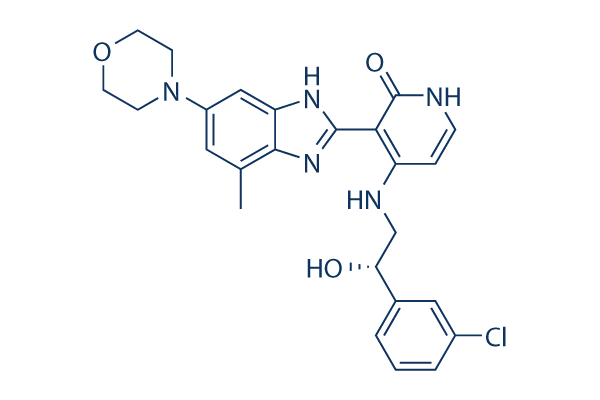
Chemische structuur
Moleculair gewicht: 479.96
Kwaliteitscontrole
| Gerelateerde doelwitten | EGFR VEGFR PDGFR FGFR c-Met Src MEK CSF-1R FLT3 HER2 |
|---|---|
| Overige IGF-1R Inhibitoren | Linsitinib (OSI-906) NVP-AEW541 BMS-754807 Picropodophyllin (AXL1717) GSK1904529A AG-1024 NVP-ADW742 NT157 PQ 401 MSDC-0160 |
Chemische informatie, Opslag en Stabiliteit
| Moleculair gewicht | 479.96 | Formule | C25H26ClN5O3 |
Opslag (Vanaf de ontvangstdatum) | |
|---|---|---|---|---|---|
| CAS-nr. | 468740-43-4 | SDF downloaden | Opslag van stamoplossingen |
|
|
| Synoniemen | CS-0117 | Smiles | CC1=CC(=CC2=C1N=C(N2)C3=C(C=CNC3=O)NCC(C4=CC(=CC=C4)Cl)O)N5CCOCC5 | ||
Oplosbaarheid
|
In vitro |
DMSO
: 96 mg/mL
(200.01 mM)
Water : Insoluble Ethanol : Insoluble |
Molariteitscalculator
|
In vivo |
|||||
In vivo Formuleringscalculator (Heldere oplossing)
Stap 1: Voer de onderstaande informatie in (Aanbevolen: Een extra dier voor het geval van verlies tijdens het experiment)
Stap 2: Voer de in vivo formulering in (Dit is alleen de calculator, geen formulering. Neem eerst contact met ons op als er geen in vivo formulering is in het gedeelte Oplosbaarheid.)
Berekeningsresultaten:
Werkconcentratie: mg/ml;
Methode voor het bereiden van DMSO-mastervloeistof: mg geneesmiddel vooraf opgelost in μL DMSO ( Concentratie mastervloeistof mg/mL, Neem eerst contact met ons op als de concentratie de DMSO-oplosbaarheid van de partij geneesmiddel overschrijdt. )
Methode voor het bereiden van in vivo formulering: Neem μL DMSO mastervloeistof, voeg vervolgens toeμL PEG300, mengen en helder maken, voeg vervolgens toeμL Tween 80, mengen en helder maken, voeg vervolgens toe μL ddH2O, mengen en helder maken.
Methode voor het bereiden van in vivo formulering: Neem μL DMSO mastervloeistof, voeg vervolgens toe μL Maïsolie, mengen en helder maken.
Opmerking: 1. Zorg ervoor dat de vloeistof helder is voordat u het volgende oplosmiddel toevoegt.
2. Zorg ervoor dat u het/de oplosmiddel(en) in de juiste volgorde toevoegt. U moet ervoor zorgen dat de verkregen oplossing, bij de vorige toevoeging, een heldere oplossing is voordat u verdergaat met het toevoegen van het volgende oplosmiddel. Fysische methoden zoals vortexen, echografie of een warmwaterbad kunnen worden gebruikt om het oplossen te bevorderen.
Werkingsmechanisme
| Targets/IC50/Ki |
Insulin Receptor
73 nM
IGF-1R
100 nM
FAK
150 nM
MEK
182 nM
LCK
341 nM
VEGFR2
1.4 μM
EGF
1.6 μM
Met
4.87 μM
|
|---|---|
| In vitro |
BMS-536924 remt ook FAK en Lck met een IC50 van respectievelijk 150 nM en 341 nM. Deze verbinding remt cellulaire proliferatie en verstoort Akt- en MAPK-fosforylering. Het remt IGF-I-gestimuleerde IGF-1R-signalering in MCF10A-cellen en blokkeert constitutieve IGF-1R-activiteit in CD8-IGF-1R-MCF10A. Pre-incubatie van MCF10A-cellen met 1 μM van deze chemische stof blokkeert volledig het vermogen van IGF-I om IGF-1R-fosforylering te stimuleren. IGF-I-stimulatie resulteert in verhoogde fosforylering van ERK1/2, GSK3β en Akt. Deze verbinding remt deze ligand-geïnduceerde fosforylering. Behandeling van de CD8-IGF-1R-MCF10A-cellen met deze remmer resulteert in een dosisafhankelijke remming van fosforylering met gedeeltelijke remming bij 0,01 μM en 0,1 μM, maar volledige receptorremming bij een concentratie van 1 μM. Maximale remming van gefosforyleerd IGF-1R wordt al 10 minuten na incubatie waargenomen. Het behoudt zijn vermogen om IGF-1R-fosforylering tot 48 uur lang te remmen. Toevoeging van dit middel remt Akt-fosforylering tijdsafhankelijk vanaf 1 uur. Na 48 uur is Akt-activering volledig geblokkeerd. Behandeling met deze verbinding vertoont antiproliferatieactiviteit in een panel van kankercellijnen, waaronder TC32, HT1080/S, SK-LMS-1, H513 en CTR-cellen. pIGF-1R/pIR wordt geactiveerd bij IGF-I/insuline-stimulatie en de activering wordt geremd door deze chemische stof met vergelijkbare potenties in Rh41- en Rh36-cellijnen. De expressie van geprogrammeerde celdood 4 (PDCD4), splitsing van poly(ADP-ribose) polymerase (PARP) en caspase-3 worden gereguleerd in Rh41-cellen behandeld met deze remmer.
|
| Kinase Assay |
IGF-I-Pathactiviteit
|
|
1 × 10⁶ pBabe-MCF10A-cellen worden gezaaid op schaaltjes van 60 mm. Na 24 uur wordt het medium vervangen door serumvrij medium en 's nachts geïncubeerd bij 37 °C gedurende 24 uur. Cellen worden vervolgens gedurende 1 uur voor-geïncubeerd met of zonder 1 uM BMS-536924 in serumvrij medium, gevolgd door stimulatie met IGF-I (50 ng/mL) gedurende 10 minuten. Celmonolagen worden tweemaal gewassen met PBS en geoogst voor immunoblotanalyse
|
|
| In vivo |
Orale toediening van BMS-536924 bij 100-300 mpk remt sterk het IGR-1R Sal tumormodel. Werkzaamheid wordt ook waargenomen in het niet-gemodificeerde Colo205 humaan coloncarcinoommodel. Orale toediening van deze verbinding volgens een eenmaal daags schema (100-300 mpk) of een tweemaal daags schema (50, 100 mpk) toont antitumoractiviteit in dit tumormodel. Orale glucosetolerantietest (OGTT) toont aan dat 100 mpk (b.i.d.) een significante verhoging van de glucosespiegels veroorzaakt na glucosetoediening. De farmacokinetische parameters van deze chemische stof, oraal toegediend in poly(ethyleenglycol) 400 en water (80:20 v/v), worden bepaald bij muis, rat, hond en aap. Goede biologische beschikbaarheid is duidelijk in alle soorten. Significante niet-lineaire farmacokinetiek wordt waargenomen bij knaagdieren bij toenemende p.o.-dosis. Deze verbinding vermindert het tumorxenograftvolume van CD8-IGF-1R-MCF10A-cellen na twee weken behandeling (100mg/kg) tot 76%. Orale toediening van 70 mg/kg van deze chemische stof remt significant de tumorgroei (TGBC-1TKB-cellen) geïnoculeerd in naakte muizen. Het reguleert apoptose in xenografttumoren. De behandeling heeft geen nadelige effecten op het lichaamsgewicht van muizen of de glucosespiegels op het moment van overlijden, wat duidt op een verdraaglijke toxiciteit.
|
Referenties |
|
Technische ondersteuning
Tel: +1-832-582-8158 Ext:3
Als u nog andere vragen heeft, kunt u een bericht achterlaten.
Veelgestelde vragen
Vraag 1:
What are the differences between it and S1034?
Antwoord:
The most remarkable difference between these two IGF-IR inhibitors is that S1012 is an ATP-competitive inhibitor. You will get more information about the differences between IR inhibitors in this reference: http://www.sciencedirect.com/science/article/pii/S1359644605035129.

Producten zijn uitsluitend voor onderzoeksdoeleinden. Niet voor menselijk gebruik. Wij verkopen niet aan patiënten.
©Copyright 2013 Selleck Chemicals. Alle rechten voorbehouden.