
uitsluitend voor onderzoeksdoeleinden
LY2886721 BACE Remmer
Cat.Nr.: S2156
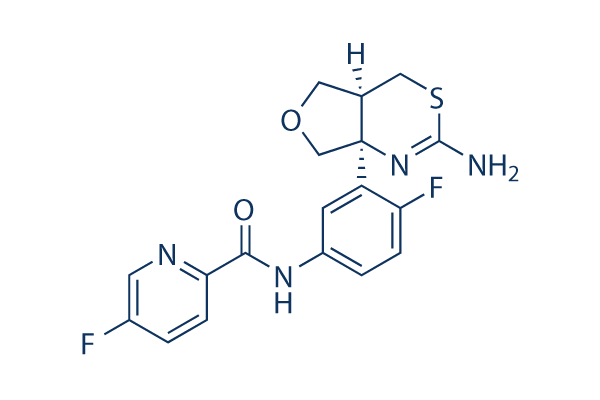
Chemische structuur
Moleculair gewicht: 390.41
Kwaliteitscontrole (Quality Control)
| Gerelateerde doelwitten | Adrenergic Receptor AChR 5-HT Receptor COX Calcium Channel Histamine Receptor Dopamine Receptor GABA Receptor TRP Channel Cholinesterase (ChE) |
|---|---|
| Overige BACE Inhibitoren | Verubecestat (MK-8931) LY2811376 Verubecestat (MK-8931) Trifluoroacetate AZD3839 Lanabecestat (AZD3293) Elenbecestat Loganin LX2343 Dieckol |
Chemische informatie, Opslag en Stabiliteit (Chemical Information, Storage & Stability)
| Moleculair gewicht | 390.41 | Formule | C18H16F2N4O2S |
Opslag (Vanaf de ontvangstdatum) | |
|---|---|---|---|---|---|
| CAS-nr. | 1262036-50-9 | SDF downloaden | Opslag van stamoplossingen |
|
|
| Synoniemen | N/A | Smiles | C1C2CSC(=NC2(CO1)C3=C(C=CC(=C3)NC(=O)C4=NC=C(C=C4)F)F)N | ||
Oplosbaarheid (Solubility)
|
In vitro |
DMSO
: 35 mg/mL
(89.64 mM)
Water : Insoluble Ethanol : Insoluble |
Molariteitscalculator
|
In vivo |
|||||
In vivo Formuleringscalculator (Heldere oplossing)
Stap 1: Voer de onderstaande informatie in (Aanbevolen: Een extra dier voor het geval van verlies tijdens het experiment)
Stap 2: Voer de in vivo formulering in (Dit is alleen de calculator, geen formulering. Neem eerst contact met ons op als er geen in vivo formulering is in het gedeelte Oplosbaarheid.)
Berekeningsresultaten:
Werkconcentratie: mg/ml;
Methode voor het bereiden van DMSO-mastervloeistof: mg geneesmiddel vooraf opgelost in μL DMSO ( Concentratie mastervloeistof mg/mL, Neem eerst contact met ons op als de concentratie de DMSO-oplosbaarheid van de partij geneesmiddel overschrijdt. )
Methode voor het bereiden van in vivo formulering: Neem μL DMSO mastervloeistof, voeg vervolgens toeμL PEG300, mengen en helder maken, voeg vervolgens toeμL Tween 80, mengen en helder maken, voeg vervolgens toe μL ddH2O, mengen en helder maken.
Methode voor het bereiden van in vivo formulering: Neem μL DMSO mastervloeistof, voeg vervolgens toe μL Maïsolie, mengen en helder maken.
Opmerking: 1. Zorg ervoor dat de vloeistof helder is voordat u het volgende oplosmiddel toevoegt.
2. Zorg ervoor dat u het/de oplosmiddel(en) in de juiste volgorde toevoegt. U moet ervoor zorgen dat de verkregen oplossing, bij de vorige toevoeging, een heldere oplossing is voordat u verdergaat met het toevoegen van het volgende oplosmiddel. Fysische methoden zoals vortexen, echografie of een warmwaterbad kunnen worden gebruikt om het oplossen te bevorderen.
Werkingsmechanisme (Mechanism of Action)
| Targets/IC50/Ki |
BACE2
(Cell-free assay) 10.2 nM
BACE1
(Cell-free assay) 20.3 nM
|
|---|---|
| In vitro |
LY2886721 is an oral, small molecule of β-site amyloid protein cleaving enzyme (BACE) inhibitor with the potential to inhibit the synthesis of β-amyloid and thereby to slow the clinical progression of AD. This compound can also targetγ-secretase to nhibit the synthesis of β-amyloid. It inhibits recombinant hBACE1 with an IC50 of 20.3 nM. In cellular assays, this chemical inhibits Abeta with an IC50 of 18.7 nM and 10.7 nM, HEK293Swe and PDAPP neuronal culture, respectively. It has high selectivity against key off-target proteases, which efficiently translates in vitro activity into robust in vivo amyloid β lowering in nonclinical animal models. Assessment of its activity against hBACE2 demonstrates an IC50 of 10.2 nM. Assessment of the compound's activity against cathepsin D, pepsin, renin, or other important aspartyl proteases shows essentially no inhibition (IC50 >100,000 nM), suggesting that activity against these common aspartyl proteases is unlikely to be significant.
|
| In vivo |
Oral administration of LY2886721 to PDAPP mice produces dose-dependent reductions in brain Abeta, C99 and sAPPbeta. Brain Abeta levels are decreased ∼20%-65% relative to vehicle-treated groups three hours after a 3-30 mg/kg dose of this compound. Brain C99 and sAPPb levels also are reduced in a dose-dependent manner consistent with BACE1 inhibition in vivo. The pharmacodynamic responses to this chemical persists out to 9 hours post dose in brains of PDAPP mice. Pharmacodynamic studies in beagle dog reveal robust and sustained reductions in plasma Abeta following 1 mg/kg dosing. Central effects of BACE1 inhibition in dog are manifested by a 50% reduction in CSF Abeta at 9 hours after a 0.5 mg/kg dose. The geometric mean terminal elimination t1/2 is determined to be 17.2 h (range 8.19-36.3 h). The geometric mean apparent oral clearance is 34.8 L/h (38% CV) and the apparent volume of distribution during the terminal phase was 863 L (56% CV) across dose levels. This compound is freely permeable across the blood-brain barrier.
|
Referenties |
|
Informatie klinische proef (Clinical Trial Information)
(gegevens van https://clinicaltrials.gov, bijgewerkt op 2018-05-18)
| NCT-nummer | Rekrutering | Aandoeningen | Sponsor/Medewerkers | Startdatum | Fasen |
|---|---|---|---|---|---|
| NCT01561430 | TERMINATED | Alzheimer's Disease |
Eli Lilly and Company |
2012-03 | PHASE1; PHASE2 |
| NCT01775904 | COMPLETED | Healthy Volunteers |
Eli Lilly and Company |
2013-02 | PHASE1 |
| NCT01807026 | COMPLETED | Alzheimer Disease; Healthy Volunteers |
Eli Lilly and Company |
2013-03 | PHASE1 |
| NCT01807026 | Completed | Alzheimer Disease|Healthy Volunteers |
Eli Lilly and Company |
2013-03 | Phase 1 |
| NCT01534273 | COMPLETED | Healthy Volunteers |
Eli Lilly and Company |
2012-02 | PHASE1 |
| NCT01534273 | Completed | Healthy Volunteers |
Eli Lilly and Company |
2012-02 | Phase 1 |

Producten zijn uitsluitend voor onderzoeksdoeleinden. Niet voor menselijk gebruik. Wij verkopen niet aan patiënten.
©Copyright 2013 Selleck Chemicals. Alle rechten voorbehouden.