
uitsluitend voor onderzoeksdoeleinden
Idebenone ROS Chemisch
Cat.Nr.: S2605
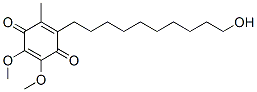
Chemische structuur
Moleculair gewicht: 338.44
Kwaliteitscontrole (Quality Control)
| Gerelateerde doelwitten | PD-1/PD-L1 CXCR STING AhR Immunology & Inflammation related CD markers Interleukins Anti-infection Antioxidant COX |
|---|---|
| Overige ROS Inhibitoren | MitoQ (Mitoquinone) Mesylate Piperlongumine H2DCFDA (DCFH-DA) Neohesperidin Gallic acid Pyrogallol Disufenton sodium Troxerutin Carnosic acid (20R)Ginsenoside Rg3 |
Chemische informatie, Opslag en Stabiliteit (Chemical Information, Storage & Stability)
| Moleculair gewicht | 338.44 | Formule | C19H30O5 |
Opslag (Vanaf de ontvangstdatum) | |
|---|---|---|---|---|---|
| CAS-nr. | 58186-27-9 | SDF downloaden | Opslag van stamoplossingen |
|
|
| Synoniemen | CV-2619 | Smiles | CC1=C(C(=O)C(=C(C1=O)OC)OC)CCCCCCCCCCO | ||
Oplosbaarheid (Solubility)
|
In vitro |
DMSO
: 68 mg/mL
(200.92 mM)
Ethanol : 68 mg/mL Water : Insoluble |
Molariteitscalculator
|
In vivo |
|||||
In vivo Formuleringscalculator (Heldere oplossing)
Stap 1: Voer de onderstaande informatie in (Aanbevolen: Een extra dier voor het geval van verlies tijdens het experiment)
Stap 2: Voer de in vivo formulering in (Dit is alleen de calculator, geen formulering. Neem eerst contact met ons op als er geen in vivo formulering is in het gedeelte Oplosbaarheid.)
Berekeningsresultaten:
Werkconcentratie: mg/ml;
Methode voor het bereiden van DMSO-mastervloeistof: mg geneesmiddel vooraf opgelost in μL DMSO ( Concentratie mastervloeistof mg/mL, Neem eerst contact met ons op als de concentratie de DMSO-oplosbaarheid van de partij geneesmiddel overschrijdt. )
Methode voor het bereiden van in vivo formulering: Neem μL DMSO mastervloeistof, voeg vervolgens toeμL PEG300, mengen en helder maken, voeg vervolgens toeμL Tween 80, mengen en helder maken, voeg vervolgens toe μL ddH2O, mengen en helder maken.
Methode voor het bereiden van in vivo formulering: Neem μL DMSO mastervloeistof, voeg vervolgens toe μL Maïsolie, mengen en helder maken.
Opmerking: 1. Zorg ervoor dat de vloeistof helder is voordat u het volgende oplosmiddel toevoegt.
2. Zorg ervoor dat u het/de oplosmiddel(en) in de juiste volgorde toevoegt. U moet ervoor zorgen dat de verkregen oplossing, bij de vorige toevoeging, een heldere oplossing is voordat u verdergaat met het toevoegen van het volgende oplosmiddel. Fysische methoden zoals vortexen, echografie of een warmwaterbad kunnen worden gebruikt om het oplossen te bevorderen.
Werkingsmechanisme (Mechanism of Action)
| In vitro |
Idebenone effectively protects from retinal cell injury after oxidative stress or hypoglycemia, whereas the protection afforded after postincubation of both antioxidants is decreased. This compound attenuates delayed retinal cell damage, mediated by chemical ischemia. This chemical, a centrally active antioxidant used to treat multiinfarct dementia, protects cells from this form of glutamate-induced cytotoxicity in vitro. It provides significant protection against the neuronal degeneration induced by intrastriatal injection of kainic acid and quisqualic acid, but not the NMDA receptor agonist, quinolinic acid.
|
|---|---|
| In vivo |
Idebenone prevents the behavioural deficits in Y-maze and water maze, but not passive avoidance, tasks in A beta-(1-42)-infused rats when they are repeatedly administered by mouth once a day from 3 days before the start of A beta infusion to the end of behavioural experiments. This compound (100 and 300 mg/kg) is orally administered to rats for 3 days, it increases the state 3 respiration stimulated by ADP, slightly decreasez the state 4 respiration after the consumption of ADP and resultz in a significant increase of the respiratory control index (RCI) by 14-19% for glutamate oxidation and 10-17% for succinate oxidation, respectively. It significantly suppresses by about 10% the non-respiratory oxygen consumption, which closely associated with non-enzymatic reactions such as lipid peroxidation, membrane lysis and swelling of mitochondria.
|
Referenties |
|
Informatie klinische proef (Clinical Trial Information)
(gegevens van https://clinicaltrials.gov, bijgewerkt op 2025-11-25)
| NCT-nummer | Rekrutering | Aandoeningen | Sponsor/Medewerkers | Startdatum | Fasen |
|---|---|---|---|---|---|
| NCT04534023 | ACTIVE_NOT_RECRUITING | Rapid Eye Movement Sleep Behavior Disorder; Synucleinopathy |
Ruijin Hospital |
2020-08-31 | PHASE2 |
| NCT05987397 | UNKNOWN | Post Stroke Epilepsy |
Xiangya Hospital of Central South University |
2023-07-05 | PHASE4 |
| NCT04151472 | RECRUITING | Migraine Disorders; Headache Disorders |
Second Affiliated Hospital, Zhejiang University, School of Medicine |
2021-12-08 | PHASE3 |
| NCT04071639 | UNKNOWN | Huntington Disease |
Second Affiliated Hospital, Zhejiang University, School of Medicine |
2020-03-12 | PHASE1 |
| NCT05411978 | UNKNOWN | Migraine |
Beijing Tiantan Hospital |
2022-05-09 | PHASE4 |
| NCT04669158 | COMPLETED | Non Alcoholic Steatohepatitis; Fibrosis |
Stanford University |
2021-07-30 | PHASE1; PHASE2 |

Producten zijn uitsluitend voor onderzoeksdoeleinden. Niet voor menselijk gebruik. Wij verkopen niet aan patiënten.
©Copyright 2013 Selleck Chemicals. Alle rechten voorbehouden.