
uitsluitend voor onderzoeksdoeleinden
AT9283 JAK remmer
Cat.Nr.S1134
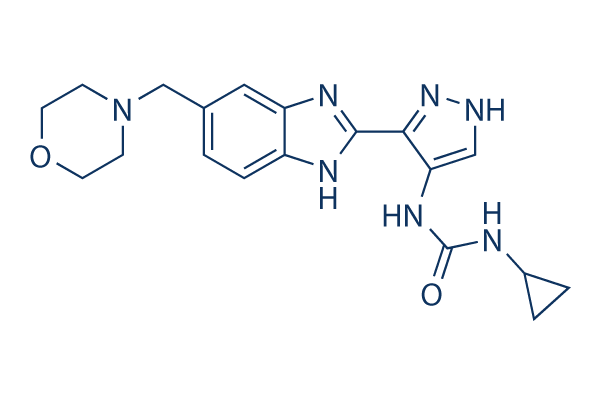
Chemische structuur
Moleculair gewicht: 381.43
Kwaliteitscontrole
| Gerelateerde doelwitten | EGFR STAT Pim |
|---|---|
| Overige JAK Inhibitoren | BMS-986165 (Deucravacitinib) AZD1480 WP1066 Momelotinib (CYT387) Filgotinib (GLPG0634) Gandotinib (LY2784544) Pacritinib TG101209 Cerdulatinib (PRT062070) hydrochloride NVP-BSK805 2HCl |
Celkweek, behandeling & werkconcentratie
| Cellijnen | Assaytype | Concentratie | Incubatietijd | Formulering | Activiteitsbeschrijving | PMID |
|---|---|---|---|---|---|---|
| HCT116 | Cytotoxicity assay | 10 to 14 days | Cytotoxicity against human HCT116 cells assessed as number of colonies after 10 to 14 days by colony forming assay, IC50=0.012μM | 19143567 | ||
| HCT116 | Function assay | 10 mg/kg | Cmax in BALB/c mouse bearing human HCT116 cells at 10 mg/kg, po, Cmax=0.45μM | 19143567 | ||
| HCT116 | Function assay | 5 mg/kg | Cmax in BALB/c mouse bearing human HCT116 cells at 5 mg/kg, iv, Cmax=4.9μM | 19143567 | ||
| HCT116 | Function assay | 20 mg/kg | Cmax in BALB/c mouse bearing human HCT116 cells at 20 mg/kg, ip, Cmax=8.4μM | 19143567 | ||
| HT-29 | Antitumor assay | 72 hrs | Antitumor activity against human HT-29 cells after 72 hrs by MTT assay, IC50=0.383μM | 23664099 | ||
| A549 | Antitumor assay | 72 hrs | Antitumor activity against human A549 cells after 72 hrs by MTT assay, IC50=0.512μM | 23664099 | ||
| LoVo | Antitumor assay | 72 hrs | Antitumor activity against human LoVo cells after 72 hrs by MTT assay, IC50=0.553μM | 23664099 | ||
| K562 | Antitumor assay | 72 hrs | Antitumor activity against human K562 cells after 72 hrs by MTT assay, IC50=1.6μM | 23664099 | ||
| U937 | Antitumor assay | 72 hrs | Antitumor activity against human U937 cells after 72 hrs by MTT assay, IC50=6.7μM | 23664099 | ||
| BL21 (DE3) | Function assay | 30 mins | Inhibition of His6-tagged MELK catalytic domain (1 to 340 residues) (unknown origin) expressed in Escherichia coli BL21 (DE3) cells using Bcl-GL as substrate measured after 30 mins in presence of [gamma32P]ATP by liquid scintillation counting method, IC50=0.685μM | 28351607 | ||
| Sf9 | Function assay | Binding affinity to N-terminal TEV-cleavable hexa-histidine tagged human JAK2 JH1 domain (840 to 1132 residues) expressed in baculovirus-infected Sf9 cells by ITC assay, Kd=0.011μM | 28626521 | |||
| Sf9 | Function assay | Binding affinity to C-terminal thrombin-cleavable hexa-histidine tagged human JAK2 JH2 pseudokinase domain (536 to 812 residues) W659A/W777A/F794H mutant expressed in baculovirus-infected Sf9 cells by ITC assay, Kd=1.323μM | 28626521 | |||
| Sf9 | Function assay | 10 uM | 60 mins | Displacement of BODIPY-ATP from C-terminal thrombin-cleavable hexa-histidine tagged human JAK2 JH2 pseudokinase domain (536 to 812 residues) W659A/W777A/F794H mutant expressed in baculovirus-infected Sf9 cells at 10 uM after 60 mins by high-throughput flu | 28626521 | |
| HCT116 | Function assay | Inhibition of Aurora B kinase in human HCT116 cells assessed as reduction in polyploid phenotype, IC50=0.03μM | 28918096 | |||
| DAOY | qHTS assay | qHTS of pediatric cancer cell lines to identify multiple opportunities for drug repurposing: Primary screen for DAOY cells | 29435139 | |||
| SJ-GBM2 | qHTS assay | qHTS of pediatric cancer cell lines to identify multiple opportunities for drug repurposing: Primary screen for SJ-GBM2 cells | 29435139 | |||
| A673 | qHTS assay | qHTS of pediatric cancer cell lines to identify multiple opportunities for drug repurposing: Primary screen for A673 cells | 29435139 | |||
| SK-N-MC | qHTS assay | qHTS of pediatric cancer cell lines to identify multiple opportunities for drug repurposing: Primary screen for SK-N-MC cells | 29435139 | |||
| BT-37 | qHTS assay | qHTS of pediatric cancer cell lines to identify multiple opportunities for drug repurposing: Primary screen for BT-37 cells | 29435139 | |||
| NB-EBc1 | qHTS assay | qHTS of pediatric cancer cell lines to identify multiple opportunities for drug repurposing: Primary screen for NB-EBc1 cells | 29435139 | |||
| U-2 OS | qHTS assay | qHTS of pediatric cancer cell lines to identify multiple opportunities for drug repurposing: Primary screen for U-2 OS cells | 29435139 | |||
| Saos-2 | qHTS assay | qHTS of pediatric cancer cell lines to identify multiple opportunities for drug repurposing: Primary screen for Saos-2 cells | 29435139 | |||
| SK-N-SH | qHTS assay | qHTS of pediatric cancer cell lines to identify multiple opportunities for drug repurposing: Primary screen for SK-N-SH cells | 29435139 | |||
| NB1643 | qHTS assay | qHTS of pediatric cancer cell lines to identify multiple opportunities for drug repurposing: Primary screen for NB1643 cells | 29435139 | |||
| LAN-5 | qHTS assay | qHTS of pediatric cancer cell lines to identify multiple opportunities for drug repurposing: Primary screen for LAN-5 cells | 29435139 | |||
| BT-12 | qHTS assay | qHTS of pediatric cancer cell lines to identify multiple opportunities for drug repurposing: Primary screen for BT-12 cells | 29435139 | |||
| Rh18 | qHTS assay | qHTS of pediatric cancer cell lines to identify multiple opportunities for drug repurposing: Primary screen for Rh18 cells | 29435139 | |||
| OHS-50 | qHTS assay | qHTS of pediatric cancer cell lines to identify multiple opportunities for drug repurposing: Primary screen for OHS-50 cells | 29435139 | |||
| RD | qHTS assay | qHTS of pediatric cancer cell lines to identify multiple opportunities for drug repurposing: Primary screen for RD cells | 29435139 | |||
| MG 63 (6-TG R) | qHTS assay | qHTS of pediatric cancer cell lines to identify multiple opportunities for drug repurposing: Primary screen for MG 63 (6-TG R) cells | 29435139 | |||
| fibroblast cells | qHTS assay | qHTS of pediatric cancer cell lines to identify multiple opportunities for drug repurposing: Primary screen for control Hh wild type fibroblast cells | 29435139 | |||
| Rh41 | qHTS assay | qHTS of pediatric cancer cell lines to identify multiple opportunities for drug repurposing: Primary screen for Rh41 cells | 29435139 | |||
| SK-N-MC | qHTS assay | qHTS of pediatric cancer cell lines to identify multiple opportunities for drug repurposing: Confirmatory screen for SK-N-MC cells | 29435139 | |||
| Klik om meer experimentele gegevens over de cellijn te bekijken | ||||||
Chemische informatie, Opslag en Stabiliteit
| Moleculair gewicht | 381.43 | Formule | C19H23N7O2 |
Opslag (Vanaf de ontvangstdatum) | |
|---|---|---|---|---|---|
| CAS-nr. | 896466-04-9 | SDF downloaden | Opslag van stamoplossingen |
|
|
| Synoniemen | N/A | Smiles | C1CC1NC(=O)NC2=C(NN=C2)C3=NC4=C(N3)C=C(C=C4)CN5CCOCC5 | ||
Oplosbaarheid
|
In vitro |
DMSO
: 76 mg/mL
(199.25 mM)
Ethanol : 25 mg/mL Water : Insoluble |
Molariteitscalculator
|
In vivo |
|||||
In vivo Formuleringscalculator (Heldere oplossing)
Stap 1: Voer de onderstaande informatie in (Aanbevolen: Een extra dier voor het geval van verlies tijdens het experiment)
Stap 2: Voer de in vivo formulering in (Dit is alleen de calculator, geen formulering. Neem eerst contact met ons op als er geen in vivo formulering is in het gedeelte Oplosbaarheid.)
Berekeningsresultaten:
Werkconcentratie: mg/ml;
Methode voor het bereiden van DMSO-mastervloeistof: mg geneesmiddel vooraf opgelost in μL DMSO ( Concentratie mastervloeistof mg/mL, Neem eerst contact met ons op als de concentratie de DMSO-oplosbaarheid van de partij geneesmiddel overschrijdt. )
Methode voor het bereiden van in vivo formulering: Neem μL DMSO mastervloeistof, voeg vervolgens toeμL PEG300, mengen en helder maken, voeg vervolgens toeμL Tween 80, mengen en helder maken, voeg vervolgens toe μL ddH2O, mengen en helder maken.
Methode voor het bereiden van in vivo formulering: Neem μL DMSO mastervloeistof, voeg vervolgens toe μL Maïsolie, mengen en helder maken.
Opmerking: 1. Zorg ervoor dat de vloeistof helder is voordat u het volgende oplosmiddel toevoegt.
2. Zorg ervoor dat u het/de oplosmiddel(en) in de juiste volgorde toevoegt. U moet ervoor zorgen dat de verkregen oplossing, bij de vorige toevoeging, een heldere oplossing is voordat u verdergaat met het toevoegen van het volgende oplosmiddel. Fysische methoden zoals vortexen, echografie of een warmwaterbad kunnen worden gebruikt om het oplossen te bevorderen.
Werkingsmechanisme
| Targets/IC50/Ki |
JAK3
(Cell-free assay) 1.1 nM
JAK2
(Cell-free assay) 1.2 nM
Aurora A
(Cell-free assay) ~3.0 nM
Aurora B
(Cell-free assay) ~3.0 nM
Abl1 (T315I)
(Cell-free assay) 4 nM
GSK-3β
(Cell-free assay) 1 nM-10 nM
FGFR2
(Cell-free assay) 1-10 nM
VEGFR3/FLT4
(Cell-free assay) 1 nM-10 nM
Mer
(Cell-free assay) 1 nM-10 nM
RET
(Cell-free assay) 1 nM-10 nM
RSK2
(Cell-free assay) 1 nM-10 nM
RSK3
(Cell-free assay) 1 nM-10 nM
TYK2
(Cell-free assay) 1 nM-10 nM
YES
(Cell-free assay) 1 nM-10 nM
Abl (Q252H)
(Cell-free assay) 10 nM-30 nM
DRAK1
(Cell-free assay) 10 nM-30 nM
FGFR1
(Cell-free assay) 10 nM-30 nM
FGFR1 (V561M)
(Cell-free assay) 10 nM-30 nM
FGFR2 (N549H)
(Cell-free assay) 10 nM-30 nM
FGFR3
(Cell-free assay) 10 nM-30 nM
VEGFR1/FLT1
(Cell-free assay) 10 nM-30 nM
FLT3
(Cell-free assay) 10 nM-30 nM
PDGFRα (D842V)
(Cell-free assay) 10 nM-30 nM
PDK-1
(Cell-free assay) 10 nM-30 nM
PKCμ
(Cell-free assay) 10 nM-30 nM
RSK4
(Cell-free assay) 10 nM-30 nM
Src (T341M)
(Cell-free assay) 10 nM-30 nM
VEGFR2
(Cell-free assay) 10 nM-30 nM
|
|---|---|
| In vitro |
AT9283 leidt tot een duidelijk polyploïd fenotype door de activiteit van Aurora B kinase in HCT116-cellen te remmen met een IC50 van 30 nM. Bovendien produceert deze verbinding ook een krachtige remming van de HCT116-kolonievorming. |
| Kinase Assay |
Aurora A en Aurora B Kinase Assays
|
|
Assays voor Aurora A en B worden uitgevoerd in een DELFIA-formaat. Het Aurora A-enzym wordt geïncubeerd met AT9283 en 3 μM cross-tide substraat (biotine-CGPKGPGRRGRRRTSSFAEG) in 10 mM MOPS, pH 7, 0,1 mg/mL BSA, 0,001% Brij-35, 0,5% glycerol, 0,2 mM EDTA, 10 mM MgCl2, 0,01% β-mercapto-ethanol, 15 μM ATP en 2,5% DMSO. Het Aurora B-enzym wordt geïncubeerd met deze verbinding, 3 μM van het bovengenoemde substraat in 25 mM Tris, pH 8,5, 5 mM MgCl2, 0,1 mg/mL BSA, 0,025% Tween-20, 1 mM DTT, 15 μM ATP en 2,5% DMSO. De reacties worden 60 minuten en 45-90 minuten, respectievelijk voor Aurora A en Aurora B, voortgezet alvorens te quenchen met EDTA. De reactiemengsels worden vervolgens overgebracht naar een neutravidine-gecoate plaat en het gefosforyleerde peptide wordt gekwantificeerd door middel van een fosfo-specifieke antilichaam en een met europium gelabeld secundair antilichaam met behulp van tijd-opgeloste fluorescentie (excitatie, 337 nm; emissie, 620 nm). IC50-waarden voor de controleverbindingen zijn 92 nM (Aurora A-assay) en 17 nM (Aurora B).
|
|
| In vivo |
Bij HCT116 humane colorectale carcinoom xenograft dragende muizen, resulteert AT9283-behandeling (15 mg/kg en 20 mg/kg) gedurende 16 dagen in een significante tumorremming van respectievelijk 67% en 76%. Bovendien vertoont deze verbinding ook een significant langere halfwaardetijd in tumoren (2,5 uur) vergeleken met plasma (0,5 uur) en een bescheiden orale biologische beschikbaarheid bij muizen (Fp.o. = 24%). |
Referenties |
|
Toepassingen
| Methoden | Biomarkers | Afbeeldingen | PMID |
|---|---|---|---|
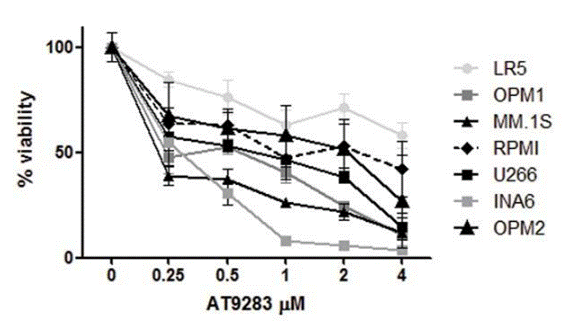
| Growth inhibition assay | Cell viability |
|
21430070 |
Informatie klinische proef
(gegevens van https://clinicaltrials.gov, bijgewerkt op 2024-05-22)
| NCT-nummer | Rekrutering | Aandoeningen | Sponsor/Medewerkers | Startdatum | Fasen |
|---|---|---|---|---|---|
| NCT01145989 | Completed | Multiple Myeloma |
NCIC Clinical Trials Group|Astex Pharmaceuticals Inc.|Canadian Cancer Trials Group |
February 15 2011 | Phase 2 |
| NCT00443976 | Completed | Non-Hodgkins Lymphoma|Unspecified Adult Solid Tumor Protocol Specific |
NCIC Clinical Trials Group|Astex Pharmaceuticals Inc.|Canadian Cancer Trials Group |
January 30 2007 | Phase 1 |
Technische ondersteuning
Tel: +1-832-582-8158 Ext:3
Als u nog andere vragen heeft, kunt u een bericht achterlaten.

Producten zijn uitsluitend voor onderzoeksdoeleinden. Niet voor menselijk gebruik. Wij verkopen niet aan patiënten.
©Copyright 2013 Selleck Chemicals. Alle rechten voorbehouden.