
réservé à la recherche
A-674563 HCl Akt inhibiteur
N° Cat.S2670
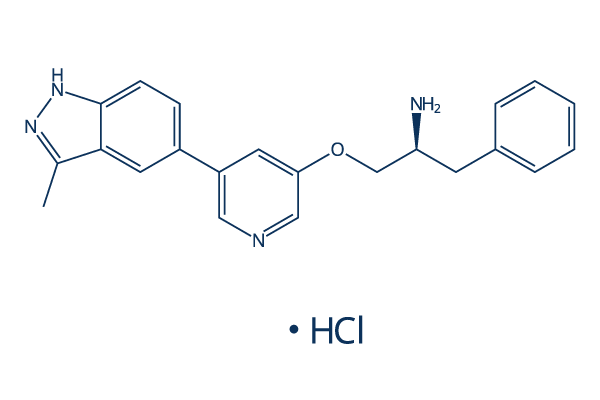
Structure chimique
Poids moléculaire: 394.9
Contrôle qualité
| Cibles apparentées | PI3K mTOR GSK-3 ATM/ATR DNA-PK AMPK PDPK1 PTEN PP2A PDK |
|---|---|
| Autre Akt Inhibiteurs | SC79 AZD5363 (Capivasertib) MK-2206 Dihydrochloride Ipatasertib (GDC-0068) Perifosine GSK690693 Triciribine (API-2) Afuresertib (GSK2110183) CCT128930 Akti-1/2 |
Culture cellulaire, traitement et concentration de travail
| Lignées cellulaires | Type dessai | Concentration | Temps dincubation | Formulation | Description de lactivité | PMID |
|---|---|---|---|---|---|---|
| MiaPaCa2 cell | Proliferation assay | Antiproliferative activity against human MiaPaCa2 cell line, EC50=0.4 μM | 16678413 | |||
| MIA PaCa cells | Cytotoxic assay | Cytotoxicity against human MIA PaCa cells by MTT assay, EC50=0.64 μM | 17523610 | |||
| MOLM14 | Cytotoxicity assay | Cytotoxicity against human MOLM14 cells, EC50=0.06μM. | 31207462 | |||
| MV4-11 | Cytotoxicity assay | Cytotoxicity against human MV4-11 cells, EC50=0.092μM. | 31207462 | |||
| MOLM13 | Cytotoxicity assay | Cytotoxicity against human MOLM13 cells, EC50=0.17μM. | 31207462 | |||
| KB-3-1 | Function assay | P-glycoprotein substrates identified in KB-3-1 adenocarcinoma cell line, qHTS therapeutic library screen | 31515284 | |||
| TC32 | qHTS assay | qHTS of pediatric cancer cell lines to identify multiple opportunities for drug repurposing: Primary screen for TC32 cells | 31515284 | |||
| DAOY | qHTS assay | qHTS of pediatric cancer cell lines to identify multiple opportunities for drug repurposing: Primary screen for DAOY cells | 31515284 | |||
| SJ-GBM2 | qHTS assay | qHTS of pediatric cancer cell lines to identify multiple opportunities for drug repurposing: Primary screen for SJ-GBM2 cells | 29435139 | |||
| A673 | qHTS assay | qHTS of pediatric cancer cell lines to identify multiple opportunities for drug repurposing: Primary screen for A673 cells | 29435139 | |||
| SK-N-MC | qHTS assay | qHTS of pediatric cancer cell lines to identify multiple opportunities for drug repurposing: Primary screen for SK-N-MC cells | 29435139 | |||
| BT-37 | qHTS assay | qHTS of pediatric cancer cell lines to identify multiple opportunities for drug repurposing: Primary screen for BT-37 cells | 29435139 | |||
| NB-EBc1 | qHTS assay | qHTS of pediatric cancer cell lines to identify multiple opportunities for drug repurposing: Primary screen for NB-EBc1 cells | 29435139 | |||
| Saos-2 | qHTS assay | qHTS of pediatric cancer cell lines to identify multiple opportunities for drug repurposing: Primary screen for Saos-2 cells | 29435139 | |||
| SK-N-SH | qHTS assay | qHTS of pediatric cancer cell lines to identify multiple opportunities for drug repurposing: Primary screen for SK-N-SH cells | 29435139 | |||
| NB1643 | qHTS assay | qHTS of pediatric cancer cell lines to identify multiple opportunities for drug repurposing: Primary screen for NB1643 cells | 29435139 | |||
| LAN-5 | qHTS assay | qHTS of pediatric cancer cell lines to identify multiple opportunities for drug repurposing: Primary screen for LAN-5 cells | 29435139 | |||
| BT-12 | qHTS assay | qHTS of pediatric cancer cell lines to identify multiple opportunities for drug repurposing: Primary screen for BT-12 cells | 29435139 | |||
| Rh18 | qHTS assay | qHTS of pediatric cancer cell lines to identify multiple opportunities for drug repurposing: Primary screen for Rh18 cells | 29435139 | |||
| RD | qHTS assay | qHTS of pediatric cancer cell lines to identify multiple opportunities for drug repurposing: Primary screen for RD cells | 29435139 | |||
| MG 63 (6-TG R) | qHTS assay | qHTS of pediatric cancer cell lines to identify multiple opportunities for drug repurposing: Primary screen for MG 63 (6-TG R) cells | 29435139 | |||
| Rh41 | qHTS assay | qHTS of pediatric cancer cell lines to identify multiple opportunities for drug repurposing: Primary screen for Rh41 cells | 29435139 | |||
| NB1643 | qHTS assay | qHTS of pediatric cancer cell lines to identify multiple opportunities for drug repurposing: Confirmatory screen for NB1643 cells | 29435139 | |||
| A673 | qHTS assay | qHTS of pediatric cancer cell lines to identify multiple opportunities for drug repurposing: Confirmatory screen for A673 cells) | 29435139 | |||
| SK-N-MC | qHTS assay | qHTS of pediatric cancer cell lines to identify multiple opportunities for drug repurposing: Confirmatory screen for SK-N-MC cells | 29435139 | |||
| BT-12 | qHTS assay | qHTS of pediatric cancer cell lines to identify multiple opportunities for drug repurposing: Confirmatory screen for BT-12 cells | 29435139 | |||
| LAN-5 | qHTS assay | qHTS of pediatric cancer cell lines to identify multiple opportunities for drug repurposing: Confirmatory screen for LAN-5 cells | 29435139 | |||
| DAOY | qHTS assay | qHTS of pediatric cancer cell lines to identify multiple opportunities for drug repurposing: Confirmatory screen for DAOY cells | 29435139 | |||
| BT-37 | qHTS assay | qHTS of pediatric cancer cell lines to identify multiple opportunities for drug repurposing: Confirmatory screen for BT-37 cells | 29435139 | |||
| TC32 | qHTS assay | qHTS of pediatric cancer cell lines to identify multiple opportunities for drug repurposing: Confirmatory screen for TC32 cells | 29435139 | |||
| MG 63 (6-TG R) | qHTS assay | qHTS of pediatric cancer cell lines to identify multiple opportunities for drug repurposing: Confirmatory screen for MG 63 (6-TG R) cells | 29435139 | |||
| fibroblast cells | qHTS assay | qHTS of pediatric cancer cell lines to identify multiple opportunities for drug repurposing: Confirmatory screen for control Hh wild type fibroblast cells | 29435139 | |||
| Rh18 | qHTS assay | qHTS of pediatric cancer cell lines to identify multiple opportunities for drug repurposing: Confirmatory screen for Rh18 cells | 29435139 | |||
| Rh30 | qHTS assay | qHTS of pediatric cancer cell lines to identify multiple opportunities for drug repurposing: Confirmatory screen for Rh30 cells | 29435139 | |||
| Saos-2 | qHTS assay | qHTS of pediatric cancer cell lines to identify multiple opportunities for drug repurposing: Confirmatory screen for Saos-2 cells | 29435139 | |||
| OHS-50 | qHTS assay | qHTS of pediatric cancer cell lines to identify multiple opportunities for drug repurposing: Confirmatory screen for OHS-50 cells | 29435139 | |||
| SK-N-SH | qHTS assay | qHTS of pediatric cancer cell lines to identify multiple opportunities for drug repurposing: Confirmatory screen for SK-N-SH cells | 29435139 | |||
| Cliquez pour voir plus de données expérimentales sur les lignées cellulaires | ||||||
Informations chimiques, stockage et stabilité
| Poids moléculaire | 394.9 | Formule | C22H22N4O.CIH |
Stockage (À partir de la date de réception) | |
|---|---|---|---|---|---|
| N° CAS | 2070009-66-2 | -- | Stockage des solutions mères |
|
|
| Synonymes | N/A | Smiles | CC1=C2C=C(C=CC2=NN1)C3=CC(=CN=C3)OCC(CC4=CC=CC=C4)N | ||
Solubilité
|
In vitro |
DMSO
: 72 mg/mL
(182.32 mM)
Water : 72 mg/mL Ethanol : 18 mg/mL |
Calculateur de molarité
|
In vivo |
|||||
Calculateur de formulation in vivo (Solution claire)
Étape 1 : Entrez les informations ci-dessous (Recommandé : Un animal supplémentaire pour tenir compte des pertes pendant lexpérience)
Étape 2 : Entrez la formulation in vivo (Ceci nest que le calculateur, pas la formulation. Veuillez nous contacter dabord sil ny a pas de formulation in vivo dans la section Solubilité.)
Résultats du calcul :
Concentration de travail : mg/ml;
Méthode de préparation du liquide maître DMSO : mg médicament prédissous dans μL DMSO ( Concentration du liquide maître mg/mL, Veuillez nous contacter dabord si la concentration dépasse la solubilité du DMSO du lot de médicament. )
Méthode de préparation de la formulation in vivo : Prendre μL DMSO liquide maître, ajouter ensuiteμL PEG300, mélanger et clarifier, ajouter ensuiteμL Tween 80, mélanger et clarifier, ajouter ensuite μL ddH2O, mélanger et clarifier.
Méthode de préparation de la formulation in vivo : Prendre μL DMSO liquide maître, ajouter ensuite μL Huile de maïs, mélanger et clarifier.
Remarque : 1. Assurez-vous que le liquide est clair avant dajouter le solvant suivant.
2. Assurez-vous dajouter le(s) solvant(s) dans lordre. Vous devez vous assurer que la solution obtenue lors de lajout précédent est une solution claire avant de procéder à lajout du solvant suivant. Des méthodes physiques telles que le vortex, les ultrasons ou le bain-marie peuvent être utilisées pour faciliter la dissolution.
Mécanisme daction
| Fonctionnalités |
Orally bioavailable compound (achieved by replacing indole of A-443654 with phenyl moiety) and somewhat less selective for Akt over PKA than A-443654.
|
|---|---|
| Targets/IC50/Ki |
Akt1
(Cell-free assay) 11 nM(Ki)
PKA
(Cell-free assay) 16 nM(Ki)
CDK2
(Cell-free assay) 46 nM(Ki)
GSK-3β
(Cell-free assay) 110 nM(Ki)
ERK2
(Cell-free assay) 260 nM(Ki)
PKCδ
(Cell-free assay) 360 nM(Ki)
RSK2
(Cell-free assay) 580 nM(Ki)
|
| In vitro |
A-674563 HCl est obtenu à partir de A-443654 en remplaçant l'indole par un fragment phényle et en obtenant une activité orale. A-674563 ralentit la prolifération des cellules tumorales avec une EC50 de 0,4 The kinase assay uses His-Akt1 and a biotinylated mouse Bad peptide as substrate. The kinase assay is carried out at room temperature for 30 minutes in 50 M. A-674563 n'inhibe pas la phosphorylation d'Akt en soi, mais bloque la phosphorylation des cibles en aval d'Akt de manière dose-dépendante. Le blocage d'Akt induit par A-674563 entraîne une diminution de la phosphorylation des cibles en aval des cellules STS et une inhibition de la croissance des cellules tumorales. A-674563 induit un arrêt du cycle cellulaire en phase G2 et une apoptose dans les cellules STS. |
| Kinase Assay |
Test Kinase Akt
|
|
Le test kinase utilise His-Akt1 et un peptide Bad de souris biotinylé comme substrat. Le test kinase est effectué à température ambiante pendant 30 minutes dans 50
M. The kinase assay uses His-Akt1 and a biotinylated mouse Bad peptide as substrate. The kinase assay is carried out at room temperature for 30 minutes in 50
L de tampon de réaction [20 mM HEPES, pH 7,5, 10 mM MgCl2, 0,1% (p/v) Triton X-100, 5
L de tampon de réaction [20 mM HEPES, pH 7.5, 10 mM MgCl2, 0.1% (w/v) Triton X-100, 5
M ATP (Km = 40
M ATP (Km = 40
M), 5
M), 5
M peptide (Km = 15
M peptide (Km = 15
M), 1 mM DTT, 60 ng d'Akt1, et 0,5
M), 1 mM DTT, 60 ng of Akt1, and 0.5
Ci de [
33P]ATP] en présence de différentes concentrations de A-674563. Chaque réaction est arrêtée par l'ajout de 50
Ci of [
33P]ATP] in the presence of different concentrations of A-674563. Each reaction is stopped by adding 50
L de tampon de terminaison (0,1 M EDTA, pH 8,0 et 4 M NaCl). Les peptides Bad biotinylés sont immobilisés sur des plaques FLASH revêtues de streptavidine. Après lavage avec du PBS-Tween 20 (0,05%), le phosphopeptide 33P capturé sur les plaques FLASH est mesuré avec un compteur γ TopCount Packard Instruments.
|
|
| In vivo |
A-674563 ne montre aucune activité inhibitrice tumorale significative en monothérapie; l'efficacité de la thérapie combinée est significativement améliorée par rapport à la monothérapie. Les souris traitées avec A674563 (20 mg/kg/bid, p.o.) présentent une croissance tumorale plus lente et une diminution de plus de 50% du volume tumoral à la fin de l'étude par rapport au groupe témoin. A-674563 est identifié comme ayant un profil PK drastiquement amélioré avec une biodisponibilité orale de 67% chez la souris, mais est 70 fois moins actif que A-443654. |
Références |
|
Support technique
Tel: +1-832-582-8158 Ext:3
Si vous avez dautres questions, veuillez laisser un message.

Les produits sont destinés à la recherche uniquement. Non destinés à lusage humain. Nous ne vendons pas aux patients.
©Copyright 2013 Selleck Chemicals. Tous droits réservés.