
Données techniques
| Formule | C19H14Cl2N2O3S |
||||||||||
| Poids moléculaire | 421.3 | N° CAS | 879085-55-9 | ||||||||
| Solubilité (25°C)* | In vitro | DMSO | 84 mg/mL (199.38 mM) | ||||||||
| Water | Insoluble | ||||||||||
| Ethanol | Insoluble | ||||||||||
| In Vivo (Ajoutez les solvants au produit individuellement et dans lordre.) |
|
||||||||||
|
* <1 mg/ml signifie légèrement soluble ou insoluble. * Veuillez noter que Selleck teste la solubilité de tous les composés en interne, et la solubilité réelle peut différer légèrement des valeurs publiées. Ceci est normal et est dû à de légères variations dun lot à lautre. * Expédition à température ambiante (les tests de stabilité montrent que ce produit peut être expédié sans aucune mesure de refroidissement.) |
|||||||||||
Préparation des solutions mères
Activité biologique
| Description | Vismodegib (GDC-0449) est un inhibiteur hedgehog puissant, nouveau et spécifique avec un IC50 de 3 nM et inhibe également la P-gp avec un IC50 de 3,0 μM dans un essai sans cellules. | ||
|---|---|---|---|
| Cibles |
|
||
| In vitro | Vismodegib (GDC-0449) cible la Hedgehog signaling pathway, bloquant les activités des récepteurs de surface cellulaire du ligand Hedgehog PTCH et/ou SMO et supprimant la signalisation Hedgehog. Ce composé prévient de multiples transporteurs à cassette de liaison à l'ATP (ABC) et bloque également ABCG2, Pgp et MRP1 — des ABC Transporter importants associés à la MDR. C'est un puissant inhibiteur des ABC Transporter, ABCG2/BCRP et ABCB1/Pgp, et un léger inhibiteur de ABCC1/MRP1. Dans les cellules HEK293 surexprimant ABCG2, il augmente la rétention du substrat fluorescent BODIPY d'ABCG2 et resensibilise ces cellules. Dans les cellules de rein de chien Madin-Darby II conçues pour surexprimer Pgp ou MRP1, il augmente la rétention de la calcéine-AM et les resensibilise. Il resensibilise également les cellules de carcinome pulmonaire non à petites cellules humaines NCI-H460/par et NCI-H460/MX20, qui surexpriment ABCG2 en réponse au SN-38. Les valeurs d'IC50 pour la prévention d'ABCG2 et de Pgp sont d'environ 1,4 μM et 3,0 μM, respectivement. De plus, il altère l'homéostasie du Ca2+ intracellulaire et inhibe la croissance cellulaire dans les cellules cancéreuses pulmonaires résistantes. |
||
| In Vivo | Vismodegib (GDC-0449) a été utilisé pour traiter le médulloblastome dans des modèles animaux. Il prévient la croissance des xénogreffes pancréatiques primaires sans inhiber de manière non spécifique la prolifération des cellules pancréatiques. L'administration orale de ce composé provoque des régressions tumorales dans le modèle d'allogreffe de médulloblastome Ptch(+/-) à des doses ≥25 mg/kg et une inhibition de la croissance tumorale à des doses allant jusqu'à 92 mg/kg administrées deux fois par jour dans deux modèles de cancer colorectal dépendants du ligand, D5123 et 1040830. L'analyse de l'activité de la voie Hh et la modélisation PK/PD révèlent qu'il inhibe Gli1 avec un IC50 similaire dans les modèles de médulloblastome et de D5123 (0,165 μM et 0,267 μM, respectivement). La modulation de la voie est liée à l'efficacité en utilisant un modèle PK/PD intégré révélant une relation abrupte où > 50% de l'activité de GDC-0449 est associée à >80% de répression de la voie Hh. |
Protocole (de référence)
| Test cellulaire : |
|
|---|---|
| Étude animale : |
|
Références
|
Validation du produit par le client
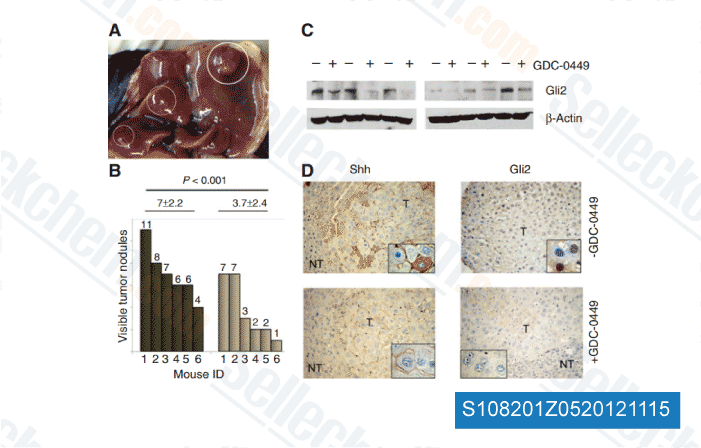
-
Données de [ Cancer Res , 2014 , 72, 5912-20 ]
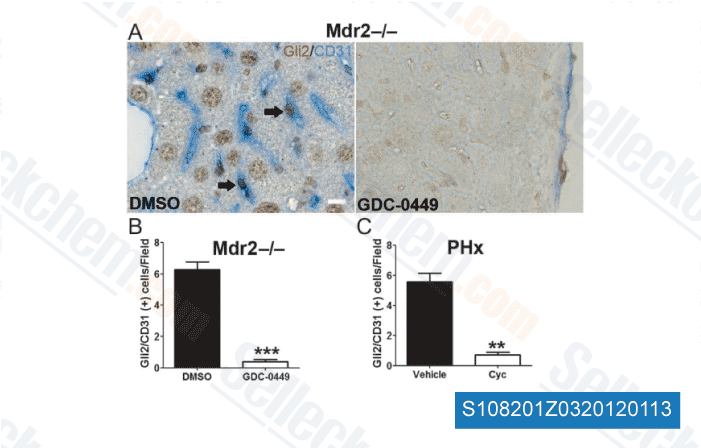
-
Données de [ Gut , 2013 , 62, 299-309 ]
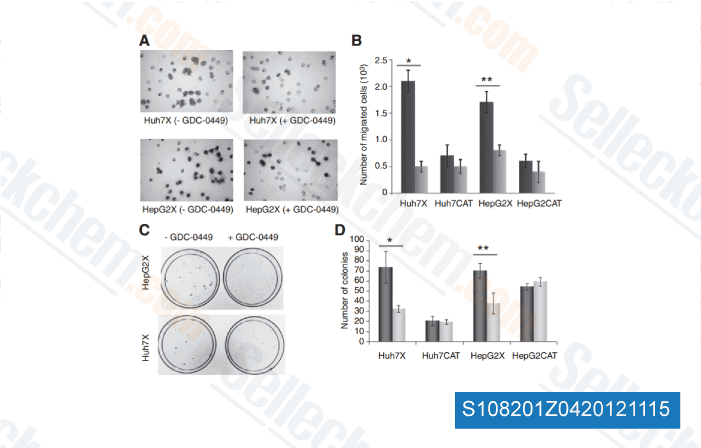
-
Données de [ Cancer Res , 2013 , 72, 5912-20 ]
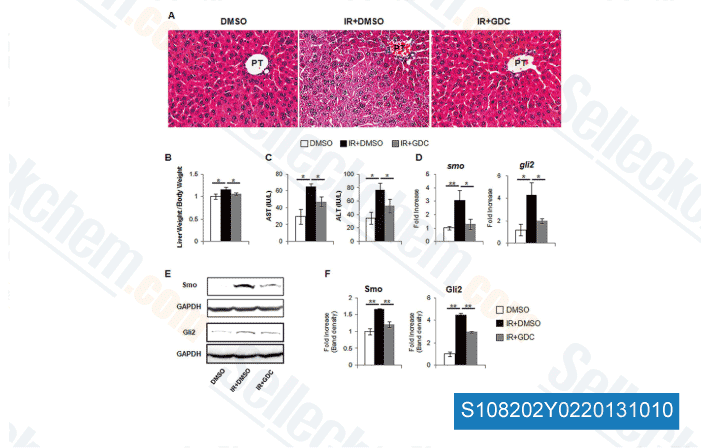
-
Données de [ PLoS One , 2013 , 8, e74141 ]
De Selleck Vismodegib (GDC-0449) A été cité par 225 Publications
| Sonic hedgehog medulloblastomas are dependent on Netrin-1 for survival [ Nat Commun, 2025, 16(1):5137] | PubMed: 40461501 |
| OLIG2 mediates a rare targetable stem cell fate transition in sonic hedgehog medulloblastoma [ Nat Commun, 2025, 16(1):1092] | PubMed: 39904987 |
| The O-glycosyltransferase C1GALT1 promotes EWSR1::FLI1 expression and is a therapeutic target for Ewing sarcoma [ Nat Commun, 2025, 16(1):1267] | PubMed: 39894896 |
| BBS8-dependent ciliary Hedgehog signaling governs cell fate in the white adipose tissue [ EMBO J, 2025, 10.1038/s44318-025-00524-y] | PubMed: 40836034 |
| GPR137-RAB8A activation promotes ovarian cancer development via the Hedgehog pathway [ J Exp Clin Cancer Res, 2025, 44(1):22] | PubMed: 39856733 |
| BCL2 drives castration resistance in castration-sensitive prostate cancer by orchestrating reciprocal crosstalk between oncogenic pathways [ Cell Rep, 2025, 44(6):115779] | PubMed: 40448998 |
| The acetylation GLI1 affects arsenical-induced renal fibrosis by mediating the Hedgehog signalling pathway [ Ecotoxicol Environ Saf, 2025, 302:118676] | PubMed: 40669272 |
| Cranial base synostosis in mice caused by upregulation of Wnt following partial inhibition of Shh [ BMC Biol, 2025, 23(1):268] | PubMed: 40859304 |
| Spatially organized tumor-stroma boundary determines the efficacy of immunotherapy in colorectal cancer patients [ Nat Commun, 2024, 15(1):10259] | PubMed: 39592630 |
| Basal-to-inflammatory transition and tumor resistance via crosstalk with a pro-inflammatory stromal niche [ Nat Commun, 2024, 15(1):8134] | PubMed: 39289380 |
POLITIQUE DE RETOUR
La politique de retour inconditionnelle de Selleck Chemical garantit une expérience dachat en ligne fluide à nos clients. Si vous nêtes en aucun cas satisfait de votre achat, vous pouvez retourner tout article dans les 7 jours suivant sa réception. En cas de problèmes de qualité du produit, quil sagisse de problèmes liés au protocole ou au produit, vous pouvez retourner tout article dans les 365 jours suivant la date dachat initiale. Veuillez suivre les instructions ci-dessous lors du retour des produits.
EXPÉDITION ET STOCKAGE
Les produits Selleck sont transportés à température ambiante. Si vous recevez le produit à température ambiante, soyez assuré que le service dinspection de la qualité de Selleck a mené des expériences pour vérifier que le placement à température normale pendant un mois naffectera pas lactivité biologique des produits en poudre. Après réception, veuillez stocker le produit conformément aux exigences décrites dans la fiche technique. La plupart des produits Selleck sont stables dans les conditions recommandées.
NON DESTINÉ À UN USAGE HUMAIN, VÉTÉRINAIRE DIAGNOSTIQUE OU THÉRAPEUTIQUE.