
Données techniques
| Formule | C16H20N6O.C6H8O7 |
||||||
| Poids moléculaire | 504.49 | N° CAS | 540737-29-9 | ||||
| Solubilité (25°C)* | In vitro | DMSO | 100 mg/mL (198.21 mM) | ||||
| Water | Insoluble | ||||||
| Ethanol | Insoluble | ||||||
| In Vivo (Ajoutez les solvants au produit individuellement et dans lordre.) |
|
||||||
|
* <1 mg/ml signifie légèrement soluble ou insoluble. * Veuillez noter que Selleck teste la solubilité de tous les composés en interne, et la solubilité réelle peut différer légèrement des valeurs publiées. Ceci est normal et est dû à de légères variations dun lot à lautre. * Expédition à température ambiante (les tests de stabilité montrent que ce produit peut être expédié sans aucune mesure de refroidissement.) |
|||||||
Préparation des solutions mères
Activité biologique
| Description | Le citrate de Tofacitinib (CP-690550, Tasocitinib) est un nouvel inhibiteur de JAK avec des IC50 de 1 nM, 20 nM et 112 nM contre JAK3, JAK2 et JAK1, respectivement. Il possède également une activité Anti-infection. | ||||
|---|---|---|---|---|---|
| Cibles |
|
||||
| In vitro | Le citrate de Tofacitinib inhibe la prolifération des blastes de lymphocytes T humains médiée par l'IL-2 et l'expression de CD69 induite par l'IL-15 avec des IC50 de 11 nM et 48 nM, respectivement. Le citrate de Tofacitinib prévient la réaction lymphocytaire mixte avec une IC50 de 87 nM. Le traitement par le citrate de Tofacitinib de cellules murines FDCP-EpoR (Patersen–erythropoietin receptor), dépendantes d'un facteur et hébergeant le JAK2 humain sauvage ou V617F, conduit à la prévention de la prolifération cellulaire avec des IC50 de 2,1 µM et 0,25 µM, respectivement. Le citrate de Tofacitinib inhibe la phosphorylation de STAT1 et STAT3 induite par l'interleukine-6 avec des IC50 de 23 nM et 77 nM, respectivement. De plus, le citrate de Tofacitinib génère un effet pro-apoptotique significatif sur les cellules murines FDCP-EpoR portant JAK2VV617F, tandis qu'un effet moindre est observé pour les cellules portant le JAK2 de type sauvage. Cette activité est associée à l'inhibition de la phosphorylation des effecteurs de signalisation en aval clés dépendants de JAK2V617F, à savoir le transducteur de signal et activateur de la transcription (STAT)3, STAT5, et l'homologue de l'oncogène viral du thymome murin v-akt (AKT). De plus, le citrate de Tofacitinib prévient l'expression de CD69 induite par l'IL-15 dans les cellules NK et les cellules T CD8+ humaines et de singe cynomolgus in vitro. | ||||
| In Vivo | Le citrate de Tofacitinib diminue une réponse d'hypersensibilité de type retardé et prolonge la survie d'allogreffes cardiaques dans des modèles murins. De plus, le traitement par le citrate de Tofacitinib de progéniteurs érythroïdes expansés ex vivo de patients atteints de PV positifs pour JAK2V617F entraîne une activité antiproliférative spécifique (IC50 = 0,2 μM) et pro-apoptotique. En revanche, les progéniteurs expansés de contrôles sains sont moins sensibles au citrate de Tofacitinib en termes de prolifération (IC50 > 1,0 μM) et d'apoptose. Pendant 2 semaines de dosage de citrate de Tofacitinib à 10 et 30 mg/kg/jour, une diminution significative et dépendante du temps du nombre de cellules NK par rapport au traitement par véhicule est observée. Le nombre de cellules CD8+ à mémoire effectrice dans le groupe traité par le citrate de Tofacitinib est 55% inférieur à celui observé chez les animaux traités par véhicule. |
Protocole (de référence)
| Test kinase : |
|
|---|---|
| Test cellulaire : |
|
| Étude animale : |
|
Références
|
Validation du produit par le client
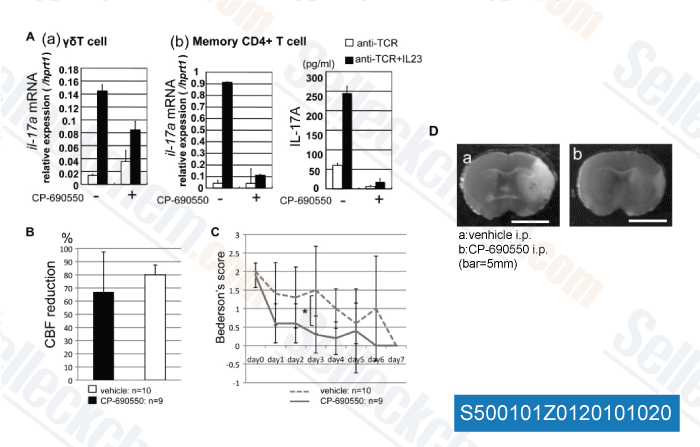
-
Données de [ Biochem Biophy Res Commun , 2010 , 402, 500–506 ]
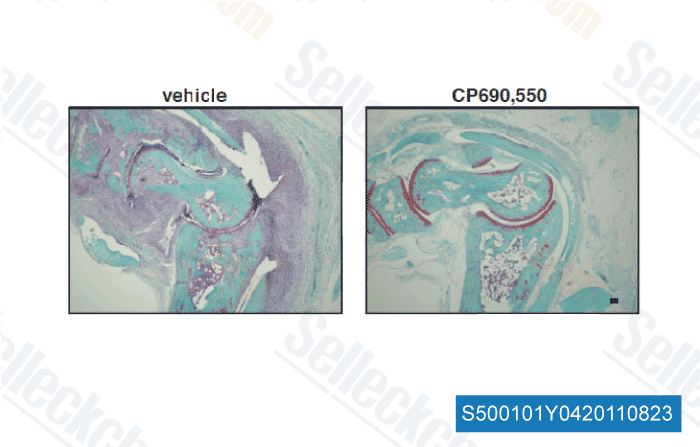
-
, , Dr. Akihiko Yoshimura of Akihiko Yoshimura
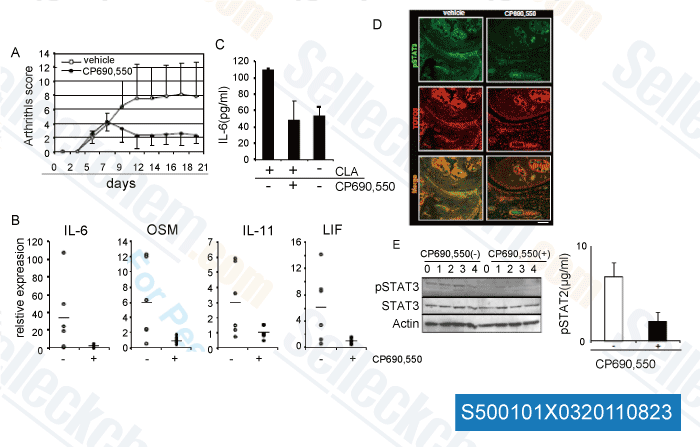
-
, , Saraswati Sukumar of Johns Hopkins University School of Medicine
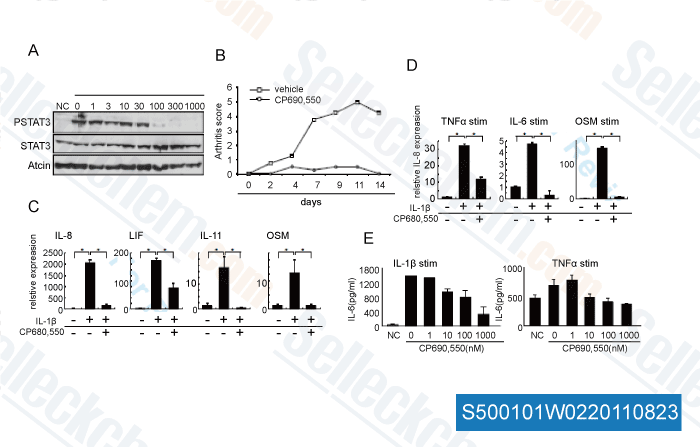
-
, , Dr. Akihiko Yoshimura of Akihiko Yoshimura
De Selleck CP-690550 (Tofacitinib) Citrate A été cité par 198 Publications
| Unveiling the Anti-Angiogenic Potential of Small-Molecule (Kinase) Inhibitors for Application in Rheumatoid Arthritis [ Cells, 2025, 14(2)102] | PubMed: 39851530 |
| Pharmacological evaluation of drug therapies in Aicardi-Goutières syndrome: insights from patient-derived neural stem cells [ Front Pharmacol, 2025, 16:1549183] | PubMed: 40183101 |
| JAK/STAT3 represents a therapeutic target for colorectal cancer patients with stromal-rich tumors [ J Exp Clin Cancer Res, 2024, 43(1):64] | PubMed: 38424636 |
| Patient-derived rhabdomyosarcoma cells recapitulate the genetic and transcriptomic landscapes of primary tumors [ iScience, 2024, 27(10):110862] | PubMed: 39319271 |
| A panel of janus kinase inhibitors identified with anti-inflammatory effects protect mice from lethal influenza virus infection [ Antimicrob Agents Chemother, 2024, 68(4):e0135023.] | PubMed: 38470034 |
| Tofacitinib to prevent anti-drug antibody formation against LMB-100 immunotoxin in patients with advanced mesothelin-expressing cancers [ Front Oncol, 2024, 14:1386190] | PubMed: 38706610 |
| Metabolic signature and proteasome activity controls synovial migration of CDC42hiCD14+ cells in rheumatoid arthritis [ Front Immunol, 2023, 14:1187093] | PubMed: 37662900 |
| Comprehensive protocols for culturing and molecular biological analysis of IBD patient-derived colon epithelial organoids [ Front Immunol, 2023, 14:1097383] | PubMed: 36911731 |
| In vitro and in vivo modelling of mutant JAK3/STAT5 signaling in leukemia [ Heliyon, 2023, 9(11):e22085] | PubMed: 38053908 |
| Cap analysis of gene expression (CAGE) 法を用いた nestin-induced Ikk2 deficient マウスにおける皮膚炎の分子病態解析 [ University of Toyama Graduate School of Medical and Pharmaceutical Education (Doctoral Course), 2023, ] | PubMed: none |
POLITIQUE DE RETOUR
La politique de retour inconditionnelle de Selleck Chemical garantit une expérience dachat en ligne fluide à nos clients. Si vous nêtes en aucun cas satisfait de votre achat, vous pouvez retourner tout article dans les 7 jours suivant sa réception. En cas de problèmes de qualité du produit, quil sagisse de problèmes liés au protocole ou au produit, vous pouvez retourner tout article dans les 365 jours suivant la date dachat initiale. Veuillez suivre les instructions ci-dessous lors du retour des produits.
EXPÉDITION ET STOCKAGE
Les produits Selleck sont transportés à température ambiante. Si vous recevez le produit à température ambiante, soyez assuré que le service dinspection de la qualité de Selleck a mené des expériences pour vérifier que le placement à température normale pendant un mois naffectera pas lactivité biologique des produits en poudre. Après réception, veuillez stocker le produit conformément aux exigences décrites dans la fiche technique. La plupart des produits Selleck sont stables dans les conditions recommandées.
NON DESTINÉ À UN USAGE HUMAIN, VÉTÉRINAIRE DIAGNOSTIQUE OU THÉRAPEUTIQUE.