
Données techniques
| Formule | C13H10BrN3O4 |
||||||
| Poids moléculaire | 352.14 | N° CAS | 182498-32-4 | ||||
| Solubilité (25°C)* | In vitro | DMSO | 70 mg/mL (198.78 mM) | ||||
| Ethanol | 16 mg/mL (45.43 mM) | ||||||
| Water | Insoluble | ||||||
| In Vivo (Ajoutez les solvants au produit individuellement et dans lordre.) |
|
||||||
|
* <1 mg/ml signifie légèrement soluble ou insoluble. * Veuillez noter que Selleck teste la solubilité de tous les composés en interne, et la solubilité réelle peut différer légèrement des valeurs publiées. Ceci est normal et est dû à de légères variations dun lot à lautre. * Expédition à température ambiante (les tests de stabilité montrent que ce produit peut être expédié sans aucune mesure de refroidissement.) |
|||||||
Préparation des solutions mères
Activité biologique
| Description | SB225002 est un antagoniste puissant et sélectif de CXCR2 avec un IC50 de 22 nM pour l'inhibition de la liaison de l'interleukine IL-8 à CXCR2, avec une sélectivité > 150 fois supérieure aux autres 7-TMRs testés. | ||
|---|---|---|---|
| Cibles |
|
||
| In vitro | In vitro, le SB225002 inhibe la mobilisation du calcium stimulée par le GROα et inhibe puissamment la chimiotaxie des neutrophiles humains et de lapin induite par l'IL-8 et le GROalpha. Ce composé réduit substantiellement les niveaux d'ERK1/2 phosphorylée et diminue la prolifération cellulaire dans les cellules WHCO1. Il présente également une activité antitumorale en tant qu'inhibiteur de la microtubule. | ||
| In Vivo | Chez les lapins, le SB225002 bloque sélectivement la margination des neutrophiles induite par l'IL-8. Dans un modèle murin de carcinome cholangiocellulaire intrahépatique, ce composé (1 mg/kg i.p.) supprime la croissance des tumeurs sous-cutanées transplantées. De plus, il présente également des effets antinociceptifs durables et réduit la colite induite par le TNBS dans des modèles murins. |
Protocole (de référence)
| Test kinase :[1] |
|
|---|---|
| Test cellulaire :[2] |
|
| Étude animale :[1] |
|
Références
|
Validation du produit par le client
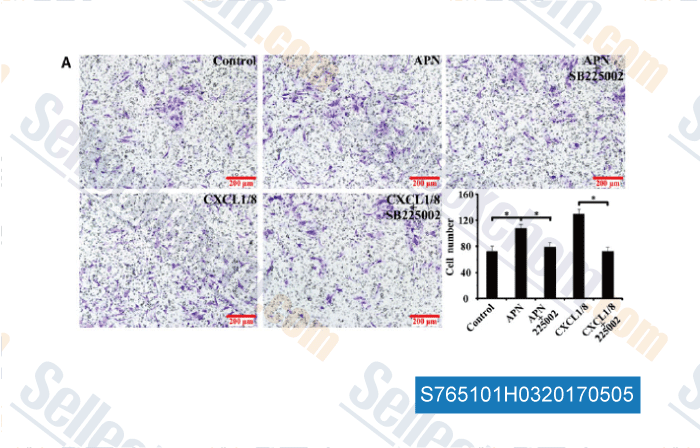
-
, , J Cell Mol Med, 2017, 21(7):1411-1419
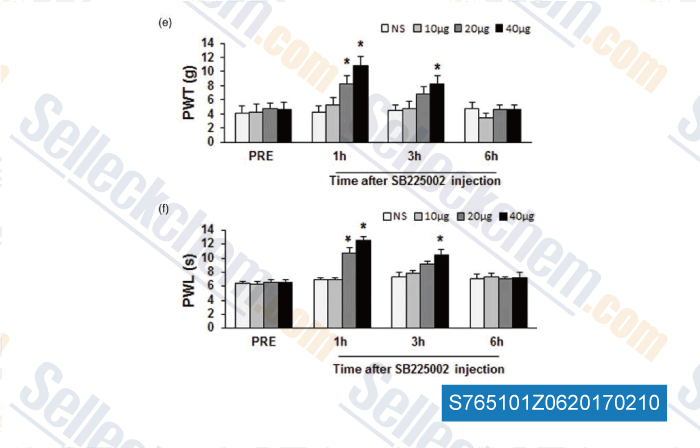
-
, , Mol Pain, 2016, doi: 10.1177/1744806916646381
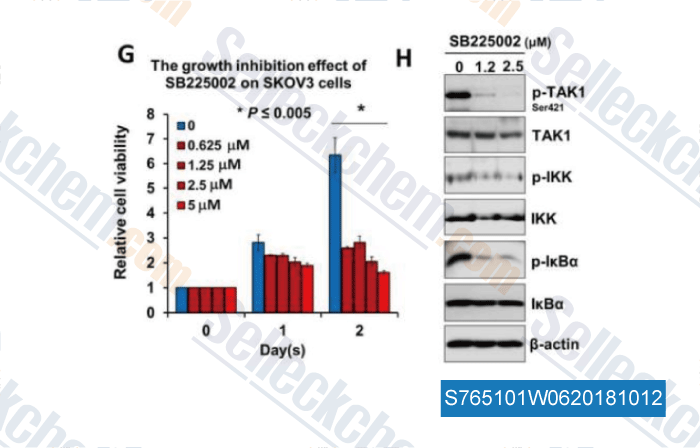
-
Données de [ , , Theranostics, 2018, 8(5):1270-1285 ]
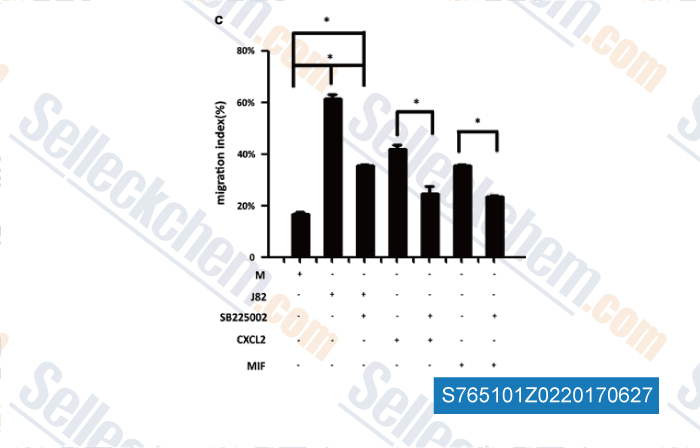
-
Données de [ , , Oncogene, 2017, 36(15):2095-2104 ]
De Selleck SB 225002 A été cité par 91 Publications
| Myeloid-Derived Suppressor Cell Accumulation Drives Intestinal Fibrosis through mCCL6/hCCL15 Chemokine-Mediated Fibroblast Activation [ Adv Sci (Weinh), 2025, 12(8):e2411711] | PubMed: 39739231 |
| Tumor-derived exosomes induce neutrophil infiltration and reprogramming to promote T-cell exhaustion in hepatocellular carcinoma [ Theranostics, 2025, 15(7):2852-2869] | PubMed: 40083930 |
| USP15 Facilitates Colorectal Cancer Immune Evasion through SMYD3/CCL2-Dependent Myeloid-Derived Suppressor Cell Recruitment [ Cancer Immunol Res, 2025, 10.1158/2326-6066.CIR-24-1194] | PubMed: 40323348 |
| Cholesterol 25-Hydroxylase Enhances Myeloid-Derived Suppressor Cell (MDSC) Immunosuppression via the Stimulator of Interferon Genes (STING)-Tank-Binding Kinase 1 (TBK1)-Receptor-Interacting Protein Kinase 3 (RIPK3) Pathway in Colorectal Cancer [ MedComm (2020), 2025, 6(10):e70411] | PubMed: 41020041 |
| CXCR2 mediates rotenone-induced neuroinflammation and neurodegeneration through neurotrophil infiltration and extracellular traps formation in mice [ Int J Biol Macromol, 2025, 330(Pt 4):148305] | PubMed: 41093199 |
| KRASG12D drives immunosuppression in lung adenocarcinoma through paracrine signaling [ JCI Insight, 2025, 10(1)e182228] | PubMed: 39782689 |
| Induction of cell death by the CXCR2 antagonist SB225002 in colorectal cancer and stromal cells [ Biomed Pharmacother, 2025, 188:118203] | PubMed: 40412356 |
| The crosstalk of monocyte-neutrophil in hair follicles regulates neutrophil transepidermal migration in contact dermatitis [ Commun Biol, 2025, 8(1):564] | PubMed: 40185981 |
| IDO1 promotes Echinococcus multilocularis infection by regulating the formation of neutrophil extracellular traps [ Vet Res, 2025, 56(1):131] | PubMed: 40597301 |
| Extracellular-vesicle-packaged S100A11 from osteosarcoma cells mediates lung premetastatic niche formation by recruiting gMDSCs [ Cell Rep, 2024, 43(2):113751] | PubMed: 38341855 |
POLITIQUE DE RETOUR
La politique de retour inconditionnelle de Selleck Chemical garantit une expérience dachat en ligne fluide à nos clients. Si vous nêtes en aucun cas satisfait de votre achat, vous pouvez retourner tout article dans les 7 jours suivant sa réception. En cas de problèmes de qualité du produit, quil sagisse de problèmes liés au protocole ou au produit, vous pouvez retourner tout article dans les 365 jours suivant la date dachat initiale. Veuillez suivre les instructions ci-dessous lors du retour des produits.
EXPÉDITION ET STOCKAGE
Les produits Selleck sont transportés à température ambiante. Si vous recevez le produit à température ambiante, soyez assuré que le service dinspection de la qualité de Selleck a mené des expériences pour vérifier que le placement à température normale pendant un mois naffectera pas lactivité biologique des produits en poudre. Après réception, veuillez stocker le produit conformément aux exigences décrites dans la fiche technique. La plupart des produits Selleck sont stables dans les conditions recommandées.
NON DESTINÉ À UN USAGE HUMAIN, VÉTÉRINAIRE DIAGNOSTIQUE OU THÉRAPEUTIQUE.