
Données techniques
| Formule | C15H22N2O2 |
||||||
| Poids moléculaire | 262.35 | N° CAS | 347174-05-4 | ||||
| Solubilité (25°C)* | In vitro | DMSO | 52 mg/mL (198.2 mM) | ||||
| Ethanol | 52 mg/mL (198.2 mM) | ||||||
| Water | Insoluble | ||||||
| In Vivo (Ajoutez les solvants au produit individuellement et dans lordre.) |
|
||||||
|
* <1 mg/ml signifie légèrement soluble ou insoluble. * Veuillez noter que Selleck teste la solubilité de tous les composés en interne, et la solubilité réelle peut différer légèrement des valeurs publiées. Ceci est normal et est dû à de légères variations dun lot à lautre. * Expédition à température ambiante (les tests de stabilité montrent que ce produit peut être expédié sans aucune mesure de refroidissement.) |
|||||||
Préparation des solutions mères
Activité biologique
| Description | Le Ferrostatin-1 (Fer-1) est un inhibiteur puissant et sélectif de la ferroptosis avec une EC50 de 60 nM. | ||
|---|---|---|---|
| Cibles |
|
||
| In vitro | La Ferrostatin-1 (Fer-1) (2 μM) prévient la ferroptosis induite par l'erastine dans les cellules cancéreuses, ainsi que la mort cellulaire induite par le glutamate dans les tranches de cerveau de rat postnatal. C'est un piégeur de ROS lipidiques, le fragment N-cyclohexyle servant d'ancre lipophile au sein des membranes biologiques. Ce composé n'inhibe pas la phosphorylation de la kinase régulée par le signal extracellulaire (ERK) ni n'arrête la prolifération des cellules HT-1080, ce qui suggère qu'il n'inhibe pas la voie MEK/ERK, ne chélate pas le fer et n'inhibe pas la synthèse des protéines. Cependant, il prévient l'accumulation de ROS cytosoliques et lipidiques induite par l'erastine. La Ferrostatin-1 oxyde facilement le radical stable 2,2-diphényl-1-picrylhydrazyl (DPPH) dans des conditions acellulaires. |
||
| In Vivo | La Ferrostatin-1 (Fer-1), un antioxydant synthétique, est un inhibiteur puissant et sélectif de la ferroptosis. Elle agit via un mécanisme réducteur pour prévenir les dommages aux lipides membranaires et inhibe ainsi la mort cellulaire. |
Protocole (de référence)
| Test cellulaire : |
|
|---|---|
| Étude animale : |
|
Références
|
Validation du produit par le client
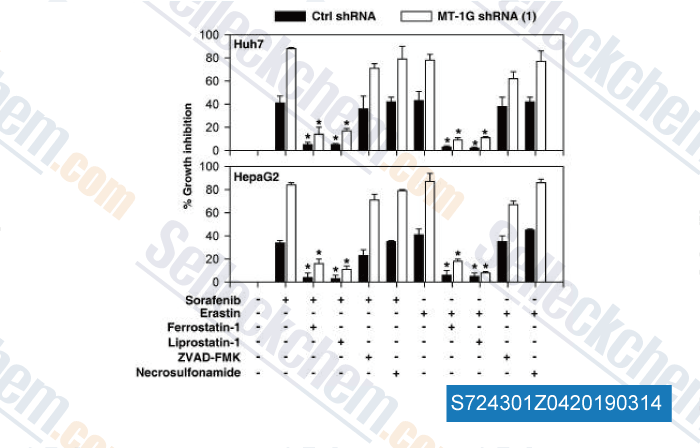
-
Données de [ , , Hepatology, 2016, 64(2):488-500 ]
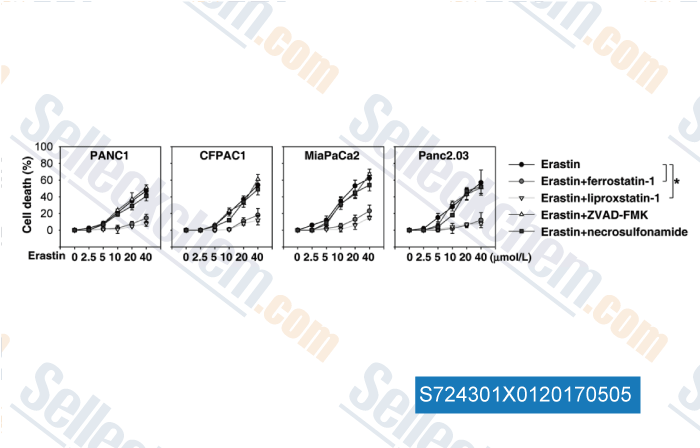
-
Données de [ , , Cancer Res, 2017, 77(8):2064-2077 ]
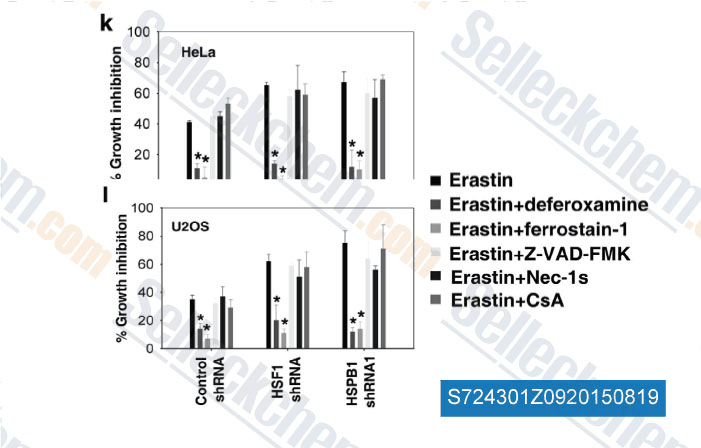
-
Données de [ , , Oncogene, 2015, 10.1038/onc.2015.32 ]
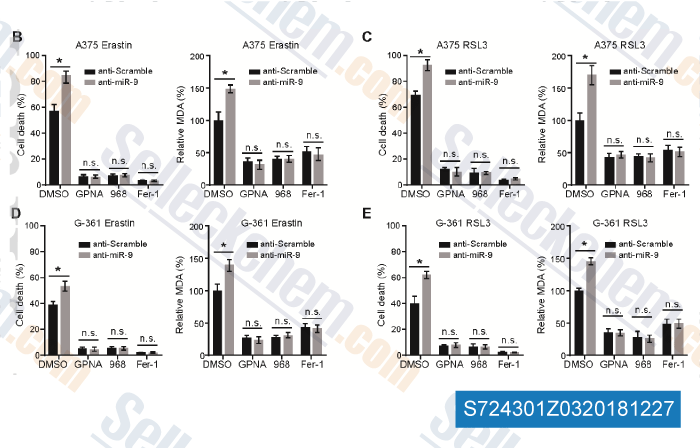
-
Données de [ , , Mol Carcinog, 2018, 57(11):1566-1576 ]
De Selleck Ferrostatin-1 (Fer-1) A été cité par 670 Publications
| Ferroptosis modulates invasion and migration in prostate cancer PC-3M subclones [ Exp Cell Res, 2026, 454(2):114847] | PubMed: 41325788 |
| Inhibition of heme biosynthesis triggers cuproptosis in acute myeloid leukemia [ Cell, 2025, S0092-8674(25)01233-4] | PubMed: 41265435 |
| Lymphoma accelerates T cell and tissue aging [ Cancer Cell, 2025, S1535-6108(25)00329-0] | PubMed: 40845845 |
| Radiotherapy promotes cuproptosis and synergizes with cuproptosis inducers to overcome tumor radioresistance [ Cancer Cell, 2025, S1535-6108(25)00132-1] | PubMed: 40215978 |
| The noncanonical function of liver-type phosphofructokinase potentiates the efficacy of HDAC inhibitors in cancer [ Signal Transduct Target Ther, 2025, 10(1):341] | PubMed: 41083431 |
| Cytosolic cytochrome c represses ferroptosis [ Cell Metab, 2025, S1550-4131(25)00149-4] | PubMed: 40233758 |
| RIPK1 senses S-adenosylmethionine scarcity to drive cell death and inflammation [ Cell Metab, 2025, S1550-4131(25)00294-3] | PubMed: 40570842 |
| Antibody-functionalized iron-based nanoplatform for ferroptosis-augmented targeted therapy of HER2-positive breast cancer [ Bioact Mater, 2025, 52:702-718] | PubMed: 40641578 |
| Harnessing the FGFR2/NF2/YAP signaling-dependent necroptosis to develop an FGFR2/IL-8 dual blockade therapeutic strategy [ Nat Commun, 2025, 16(1):4128] | PubMed: 40319089 |
| Senescence-associated lysosomal dysfunction impairs cystine deprivation-induced lipid peroxidation and ferroptosis [ Nat Commun, 2025, 16(1):6617] | PubMed: 40731111 |
POLITIQUE DE RETOUR
La politique de retour inconditionnelle de Selleck Chemical garantit une expérience dachat en ligne fluide à nos clients. Si vous nêtes en aucun cas satisfait de votre achat, vous pouvez retourner tout article dans les 7 jours suivant sa réception. En cas de problèmes de qualité du produit, quil sagisse de problèmes liés au protocole ou au produit, vous pouvez retourner tout article dans les 365 jours suivant la date dachat initiale. Veuillez suivre les instructions ci-dessous lors du retour des produits.
EXPÉDITION ET STOCKAGE
Les produits Selleck sont transportés à température ambiante. Si vous recevez le produit à température ambiante, soyez assuré que le service dinspection de la qualité de Selleck a mené des expériences pour vérifier que le placement à température normale pendant un mois naffectera pas lactivité biologique des produits en poudre. Après réception, veuillez stocker le produit conformément aux exigences décrites dans la fiche technique. La plupart des produits Selleck sont stables dans les conditions recommandées.
NON DESTINÉ À UN USAGE HUMAIN, VÉTÉRINAIRE DIAGNOSTIQUE OU THÉRAPEUTIQUE.