
Données techniques
| Formule | C6H12N2O4Pt |
|||
| Poids moléculaire | 371.25 | N° CAS | 41575-94-4 | |
| Solubilité (25°C)* | In vitro | Water | 4.5 mg/mL (12.12 mM) | |
| Ethanol | Insoluble | |||
|
* <1 mg/ml signifie légèrement soluble ou insoluble. * Veuillez noter que Selleck teste la solubilité de tous les composés en interne, et la solubilité réelle peut différer légèrement des valeurs publiées. Ceci est normal et est dû à de légères variations dun lot à lautre. * Expédition à température ambiante (les tests de stabilité montrent que ce produit peut être expédié sans aucune mesure de refroidissement.) |
||||
Préparation des solutions mères
Activité biologique
| Description | Carboplatin, un dérivé du CDDP, est un inhibiteur de la synthèse de l'ADN qui se lie à l'ADN, inhibe la réplication et la transcription et induit la mort cellulaire et interfère avec le mécanisme de réparation de la cellule dans les cellules A2780, SKOV-3, IGROV-1 et HX62. Il induit la formation de liaisons croisées inter-brins de l'ADN et de liaisons croisées ADN-protéines. Les solutions sont instables et doivent être fraîchement préparées. Le DMSO n'est pas recommandé pour dissoudre les médicaments à base de platine, ce qui peut facilement entraîner l'inactivation du médicament. | |
|---|---|---|
| Cibles |
|
|
| In vitro | Le Carboplatin exerce un effet inhibiteur sur la prolifération cellulaire dans un panel de lignées cellulaires de cancer ovarien humain, y compris les cellules A2780, SKOV3 et IGROV-1 avec une IC50 de 6,1 μM, 12,4 μM et 2,2 μM, respectivement. Ce composé montre également des activités anti-prolifératives dans les lignées cellulaires de carcinoïde pulmonaire, telles que les cellules UMC-11, H727 et H835 avec une IC50 de 36,4 μM, 3,4 μM et 35,8 μM, respectivement. |
|
| In Vivo | Dans les xénogreffes tumorales A2780, le Carboplatin (60 mg/kg par voie i.p.) administré en agents uniques montre un effet antitumoral modeste avec des volumes tumoraux relatifs au jour 6 de 8,4 comparé au contrôle de 11,9, et les poids tumoraux du jour 6 relatifs au contrôle (T/C) de 67%. Pour les xénogreffes VC8 (déficientes en Brca2), le traitement avec ce composé retarde la croissance tumorale et réduit la masse tumorale de 42% par rapport au groupe véhicule. |
|
| Caractéristiques | Ce produit n'est pas recommandé pour être dissous dans le diméthylsulfoxyde (DMSO). |
Protocole (de référence)
| Test cellulaire : |
|
|---|---|
| Étude animale : |
|
Références
|
Validation du produit par le client
![<p>Detection of apoptotic responses was found to increase in epimorphin-treated A1847 with increasing concentrations of carboplatin compared to those of the untreated controls. Data were normalized to the controls and are represented as means ± S.D. [*p<0.05 compared with control]. Images of apoptotic cells were captured at 10X magnification, with at least 3 images per well, using an upright phase-contrast microscope (T3.15A; Fisher Scientific).</p>](https://file.selleckchem.com/downloads/review/700px/Carboplatin-S121502Z0220130923.gif)
-
Données de [ PLoS One , 2012 , 8, e72637 ]
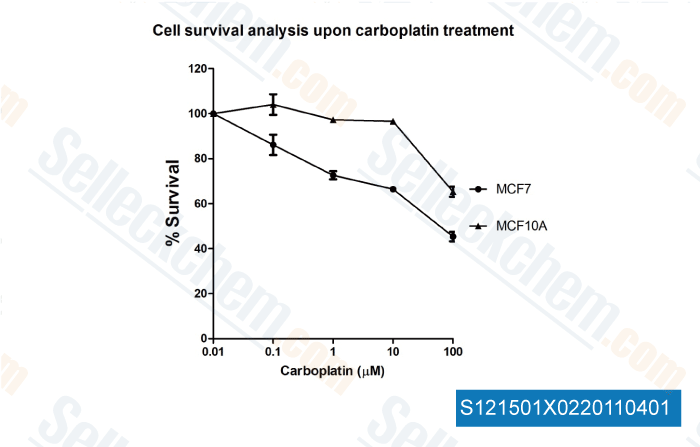
-
, , Dr. Helen Sadik of Johns Hopkins University
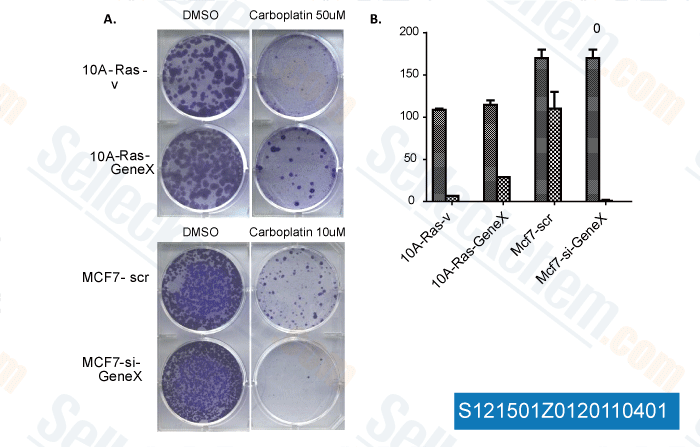
-
, , Dr. Helen Sadik of Johns Hopkins University
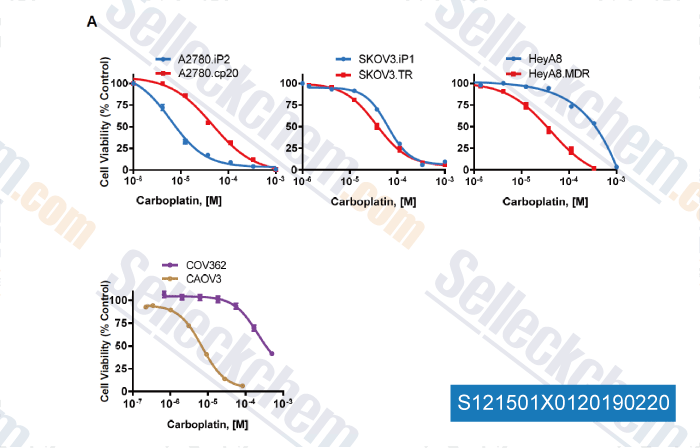
-
Données de [ , , Cancer Lett, 2018, 436:75-86 ]
De Selleck Carboplatin A été cité par 158 Publications
| Non-canonical dihydrolipoyl transacetylase promotes chemotherapy resistance via mitochondrial tetrahydrofolate signaling [ Nat Commun, 2025, 16(1):8932] | PubMed: 41062483 |
| Screening a living biobank identifies cabazitaxel as a strategy to combat acquired taxol resistance in high-grade serous ovarian cancer [ Cell Rep Med, 2025, 6(6):102160] | PubMed: 40466638 |
| Profiling the Activity of the Potent and Highly Selective CDK2 Inhibitor BLU-222 Reveals Determinants of Response in CCNE1-Aberrant Ovarian and Endometrial Tumors [ Cancer Res, 2025, 10.1158/0008-5472.CAN-24-2360] | PubMed: 39945650 |
| USP9X integrates TGF-β and hypoxia signalings to promote ovarian cancer chemoresistance via HIF-2α-maintained stemness [ Cell Death Dis, 2025, 16(1):312] | PubMed: 40246814 |
| Cancer-metastasis-on-a-chip reveals efficacy of bevacizumab and siRNA in overcoming carboplatin resistance in SKOV3 ovarian cancer within a fibrotic metastatic microenvironment [ Mater Today Bio, 2025, 34:102240] | PubMed: 40917515 |
| Low dose DNA methyltransferase inhibitors potentiate PARP inhibitors in homologous recombination repair deficient tumors [ Breast Cancer Res, 2025, 27(1):8] | PubMed: 39819384 |
| ABCB1 confers resistance to carboplatin by accumulating stem-like cells in the G2/M phase of the cell cycle in p53null ovarian cancer [ Cell Death Discov, 2025, 11(1):132] | PubMed: 40175339 |
| Homologous Repair-Deficient Pancreatic Cancer: Refined Targeting of DNA Damage Response is an Effective Therapeutic Strategy [ United Eur Gastroent, 2025, 13(7):1328-1342] | PubMed: 40823818 |
| NAD+ Boosting Through NRH Supplementation Enhances Treatment Efficacy in EOC In Vitro [ Int J Mol Sci, 2025, 26(4)1719] | PubMed: 40004182 |
| O 6-methylguanine DNA methyltransferase (MGMT) expression in U1242 glioblastoma cells enhances in vitro clonogenicity, tumor implantation in vivo, and sensitivity to alisertib-carboplatin combination treatment [ Front Cell Neurosci, 2025, 19:1552015] | PubMed: 40336841 |
POLITIQUE DE RETOUR
La politique de retour inconditionnelle de Selleck Chemical garantit une expérience dachat en ligne fluide à nos clients. Si vous nêtes en aucun cas satisfait de votre achat, vous pouvez retourner tout article dans les 7 jours suivant sa réception. En cas de problèmes de qualité du produit, quil sagisse de problèmes liés au protocole ou au produit, vous pouvez retourner tout article dans les 365 jours suivant la date dachat initiale. Veuillez suivre les instructions ci-dessous lors du retour des produits.
EXPÉDITION ET STOCKAGE
Les produits Selleck sont transportés à température ambiante. Si vous recevez le produit à température ambiante, soyez assuré que le service dinspection de la qualité de Selleck a mené des expériences pour vérifier que le placement à température normale pendant un mois naffectera pas lactivité biologique des produits en poudre. Après réception, veuillez stocker le produit conformément aux exigences décrites dans la fiche technique. La plupart des produits Selleck sont stables dans les conditions recommandées.
NON DESTINÉ À UN USAGE HUMAIN, VÉTÉRINAIRE DIAGNOSTIQUE OU THÉRAPEUTIQUE.