
Données techniques
| Formule | C21H24N4O2 |
||||||
| Poids moléculaire | 364.44 | N° CAS | 663619-89-4 | ||||
| Solubilité (25°C)* | In vitro | DMSO | 12 mg/mL (32.92 mM) | ||||
| Water | Insoluble | ||||||
| Ethanol | Insoluble | ||||||
| In Vivo (Ajoutez les solvants au produit individuellement et dans lordre.) |
|
||||||
|
* <1 mg/ml signifie légèrement soluble ou insoluble. * Veuillez noter que Selleck teste la solubilité de tous les composés en interne, et la solubilité réelle peut différer légèrement des valeurs publiées. Ceci est normal et est dû à de légères variations dun lot à lautre. * Expédition à température ambiante (les tests de stabilité montrent que ce produit peut être expédié sans aucune mesure de refroidissement.) |
|||||||
Préparation des solutions mères
Activité biologique
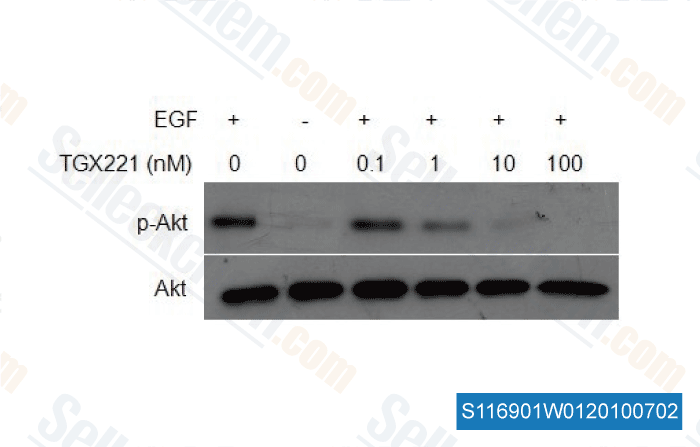
| Description | TGX-221 est un inhibiteur p110β-spécifique avec un IC50 de 5 nM dans un essai sans cellules, 1000 fois plus sélectif pour p110β que p110α. | ||||
|---|---|---|---|---|---|
| Cibles |
|
||||
| In vitro | L'activité de TGX-221 contre différentes isoformes est mesurée dans un essai PI3K in vitro utilisant plusieurs préparations de p85/p110 recombinant. Ce composé présente une faible puissance contre p110δ avec un IC50 de 211 nM. De plus, il atténue partiellement la phosphorylation de Ser473 de la PKB induite par l'insuline dans les cellules macrophages J774.2. Ce produit chimique inhibe l'interaction plaquette-ECC, l'agrégation plaquettaire et la liaison plaquette-granulocyte dans un modèle de circulation extracorporelle (ECC). Une étude récente montre qu'après traitement avec ce composé (0,2, 2 et 20 μM), les cellules PC3 montrent une inhibition de la prolifération avec une réduction significative de l'activité de l'isoforme p110β PI3K. | ||||
| In Vivo | En tant qu'agent antithrombotique, le TGX-221 à des doses de 1 + 1 (49 %) et 3 + 3 (88 %) améliore le débit sanguin intégré sur 30 minutes dans un modèle murin. De plus, le temps de saignement de la queue (BT) (sec) augmente avec ce composé à des doses de 3 + 3 (médiane 1560) et 1 + 1 (1305) et le BT rénal moyen (sec) augmente également dans tous les groupes TGX-221. |
Protocole (de référence)
| Test kinase :[1] |
|
|---|---|
| Test cellulaire :[3] |
|
| Étude animale :[3] |
|
Références
|
Validation du produit par le client
![<p>(H) 30-min pretreatment of LCLs with 0.5 μmol/L TGX-221 significantly reduces protein synthesis in FXS patient cells [n = 40, 4 independent experiments, 2-way ANOVA: * P (genotype) < 0.001, * P (treatment) = 0.005, * P (interaction) < 0.001, Bon-ferroni post hocanalyses, * P = 0.001, #P = 0.002, ≠P = 0.02]. Example images are shown on the left: upper panel: signal for newly synthesized proteins (red), lower panel: overlay with tubulin staining (green). Scale bar is 20 μm. (I) Increasing concentrations of TGX-221 (5 μmol/L and 10 μmol/L) further reduce protein synthesis rates in FXS LCLs to healthy control levels.</p>](https://file.selleckchem.com/downloads/review/700px/TGX-221-S116901Y0120120509.gif)
-
Données de [ Mol Med , 2012 , 18, 336-45 ]
![<p>(E) TGX-221 treatment (0.5 μmol/L, 30 min) of control and FXS LCLs reduces PI3K activity as shown by a radioactive PI3K assay of p110β-specific immunoprecipitates from LCL lysates, and decreases PI3K/mTOR down-stream signaling as shown by strongly reduced phosphorylation of S6 independently of the genotype. (F, G) Quantification demonstrates a significant, dose-dependent effect of TGX-221 treatment on PI3K activity [F, competitive ELISA, n = 4, 2-way ANOVA, *P (genotype) = 0.0079, *P (treatment) = 0.0258, P (interaction) = 0.9418], and on S6 phosphorylation[G, ELISA, n = 4, 2-way ANOVA, *P (genotype) = 0.013), *P (treatment) < 0.0001, P (interaction) = 0.195].</p>](https://file.selleckchem.com/downloads/review/700px/TGX-221-S116901Z0220120509.gif)
-
Données de [ Mol Med , 2012 , 18, 336-45 ]
![<p>A p110β-selective antagonist rescues increased protein synthesis in synaptic fractions from Fmr1 KO mice and in LCLs from a patient with FXS. (A–C) Treatment of synaptoneurosomes with TGX-221 (1 μmol/L, 30 min) reduces p110β-specific PI3K activity and phosphorylation of the downstream target AKT in both WT and Fmr1 KO SNS, shown by a radioactive PI3K assay and phosphoAkt- specific western blot-ting (A). (B) Quantification of PI3K activity using a competitive ELISA showed a significant reduction in PI3K activity in both genotypes after treatment [ n = 4, 2-way ANOVA, *P (genotype) = 0.0086, * P (treatment) = 0.0087, P (interaction) = 0.7154]. (C) Densitometric quantification of phosphoAkt-specific western blots showed a significant effect of treatment (C, n = 4, 2-way ANOVA, *P (treatment) = 0.0005, P (genotype) =0.372, P (interaction) = 0.4894).</p>](https://file.selleckchem.com/downloads/review/700px/TGX-221-S116901Z0120120509.gif)
-
Données de [ Mol Med , 2012 , 18, 336-45 ]
-
, , Dr. Zhang of Tianjin Medical University
De Selleck TGX-221 A été cité par 102 Publications
| hnRNPL phase separation activates PIK3CB transcription and promotes glycolysis in ovarian cancer [ Nat Commun, 2025, 16(1):4828] | PubMed: 40413189 |
| PI3K-dependent GAB1/Erk phosphorylation renders head and neck squamous cell carcinoma sensitive to PI3Kα inhibitors [ Cell Death Dis, 2025, 16(1):457] | PubMed: 40533463 |
| Role and Therapeutic Potential of miR-301b-3p in Regulating the PI3K-AKT Pathway via PIK3CB in Eosinophilic Chronic Rhinosinusitis [ J Inflamm Res, 2025, 18:10235-10251] | PubMed: 40756418 |
| Development of Acquired Resistance in Alpelisib-treated Gastric Cancer Cells With PIK3CA Mutations and Overcoming Strategies [ Anticancer Res, 2025, 45(5):1877-1896] | PubMed: 40295072 |
| Integration of 3D bioprinting and multi-algorithm machine learning identified glioma susceptibilities and microenvironment characteristics [ Cell Discov, 2024, 10(1):39] | PubMed: 38594259 |
| Microglia degrade Alzheimer's amyloid-beta deposits extracellularly via digestive exophagy [ Cell Rep, 2024, 43(12):115052] | PubMed: 39644493 |
| WWP1 inhibition suppresses the proliferation of pancreatic cancer cells by regulating the PI3K-AKT pathway [ J Gastroenterol, 2024, 10.1007/s00535-024-02192-x] | PubMed: 39656237 |
| Machine learning-based identification of lower grade glioma stemness subtypes discriminates patient prognosis and drug response [ Comput Struct Biotechnol J, 2023, 21:3827-3840] | PubMed: 37560125 |
| Pan-PI3K inhibition with copanlisib overcomes Treg- and M2-TAM-mediated immune suppression and promotes anti-tumor immune responses [ Clin Exp Med, 2023, 10.1007/s10238-023-01227-6] | PubMed: 37935952 |
| Overcoming resistance to immune checkpoint therapy in PTEN-null prostate cancer by intermittent anti-PI3Kα/β/δ treatment [ Nat Commun, 2022, 13(1):182] | PubMed: 35013322 |
POLITIQUE DE RETOUR
La politique de retour inconditionnelle de Selleck Chemical garantit une expérience dachat en ligne fluide à nos clients. Si vous nêtes en aucun cas satisfait de votre achat, vous pouvez retourner tout article dans les 7 jours suivant sa réception. En cas de problèmes de qualité du produit, quil sagisse de problèmes liés au protocole ou au produit, vous pouvez retourner tout article dans les 365 jours suivant la date dachat initiale. Veuillez suivre les instructions ci-dessous lors du retour des produits.
EXPÉDITION ET STOCKAGE
Les produits Selleck sont transportés à température ambiante. Si vous recevez le produit à température ambiante, soyez assuré que le service dinspection de la qualité de Selleck a mené des expériences pour vérifier que le placement à température normale pendant un mois naffectera pas lactivité biologique des produits en poudre. Après réception, veuillez stocker le produit conformément aux exigences décrites dans la fiche technique. La plupart des produits Selleck sont stables dans les conditions recommandées.
NON DESTINÉ À UN USAGE HUMAIN, VÉTÉRINAIRE DIAGNOSTIQUE OU THÉRAPEUTIQUE.