
Données techniques
| Formule | C33H38N4O6.HCl.3H2O |
||||||
| Poids moléculaire | 677.18 | N° CAS | 136572-09-3 | ||||
| Solubilité (25°C)* | In vitro | DMSO | 100 mg/mL (147.67 mM) | ||||
| Water | Insoluble | ||||||
| Ethanol | Insoluble | ||||||
| In Vivo (Ajoutez les solvants au produit individuellement et dans lordre.) |
|
||||||
|
* <1 mg/ml signifie légèrement soluble ou insoluble. * Veuillez noter que Selleck teste la solubilité de tous les composés en interne, et la solubilité réelle peut différer légèrement des valeurs publiées. Ceci est normal et est dû à de légères variations dun lot à lautre. * Expédition à température ambiante (les tests de stabilité montrent que ce produit peut être expédié sans aucune mesure de refroidissement.) |
|||||||
Préparation des solutions mères
Activité biologique
| Description | Irinotecan HCl Trihydrate est un chlorhydrate trihydraté d'irinotécan (Camptosar, Campto, CPT-11) qui est un Topoisomerase I inhibitor avec une IC50 de 15,8 et 5,17 ","M respectivement pour les cellules LoVo et HT-29. | |
|---|---|---|
| Cibles |
|
|
| In vitro | Irinotecan est activé en SN-38 par les carboxylestérases pour pouvoir interagir avec sa cible, la Topoisomerase I. Irinotecan induit des quantités similaires de complexes clivables à son IC50 dans les cellules LoVo et les lignées cellulaires HT-29. Le SN-38 induit une formation de complexes clivables dépendante de la concentration, qui n'est pas significativement différente dans les cellules LoVo et les lignées cellulaires HT-29. L'accumulation cellulaire d'Irinotecan est nettement différente, atteignant des niveaux constamment plus élevés dans les cellules HT-29 que dans les cellules LoVo. Le cycle E lactone d'Irinotecan et de SN-38 s'hydrolyse réversiblement dans les solutions aqueuses, et l'interconversion entre les formes lactone et carboxylate dépend du pH et de la température. Le foie est principalement responsable de l'activation d'Irinotecan en SN-38. À des concentrations égales d'Irinotecan et de glucuronide de SN-38, le taux de production de SN-38 médiée par la bêta-glucuronidase est plus élevé que celui formé à partir d'Irinotecan dans les tissus tumoraux et normaux. Irinotecan est également converti en SN-38 dans les intestins, le plasma et les tissus tumoraux. Irinotecan est significativement plus actif dans les lignées cellulaires de CPSC que dans celles de CBNPC, alors qu'aucune différence significative entre les types histologiques n'est observée avec le SN-38. | |
| In Vivo | Dans les xénogreffes COLO 320, Irinotecan induit une inhibition maximale de la croissance de 92 %. Une seule dose d'Irinotecan augmente significativement les quantités de Topoisomerase I liées de manière covalente à l'ADN dans l'estomac, le duodénum, le côlon et le foie. Parallèlement, le groupe traité par Irinotecan présente des quantités significativement plus élevées de DNA Damage/DNA Repair dans les cellules de la muqueuse colique par rapport au groupe témoin. | |
| Caractéristiques | Irinotecan est une prodrogue utilisée pour traiter le cancer colorectal métastatique. |
Protocole (de référence)
| Test cellulaire : |
|
|---|---|
| Étude animale : |
|
Références
|
Validation du produit par le client
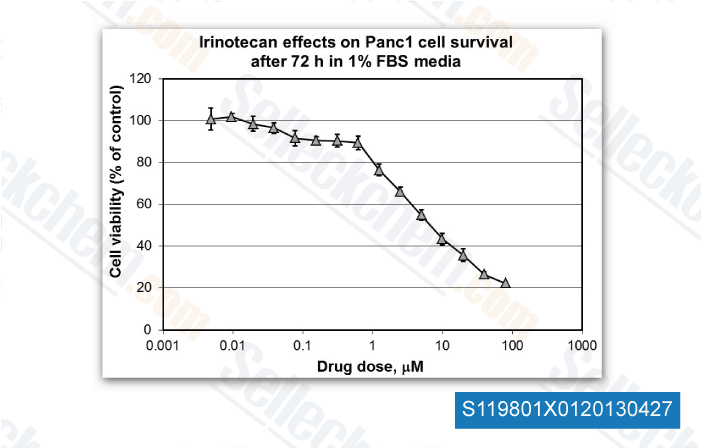
-
Dr. Edita Aksamitiene from Thomas Jefferson University, , Dr. Mikhail Menshikov of Cardiology Research Center
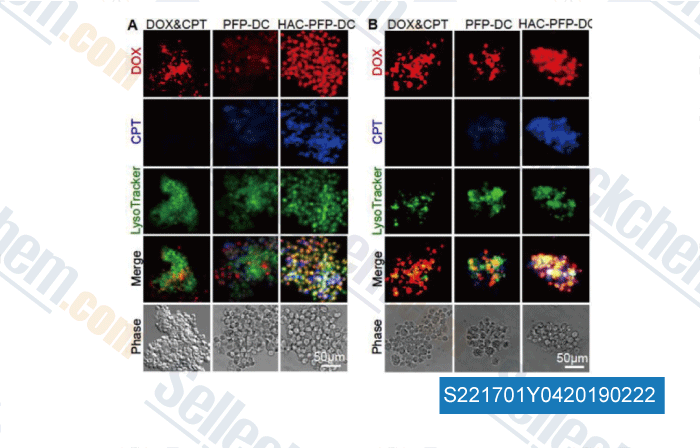
-
Données de [ , , Biomaterials, 2015, 72:74-89 ]
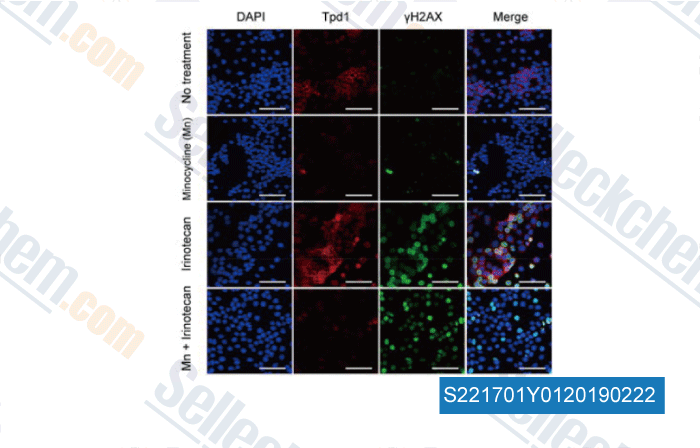
-
Données de [ , , Mol Cancer Ther, 2018, 17(2):508-520 ]
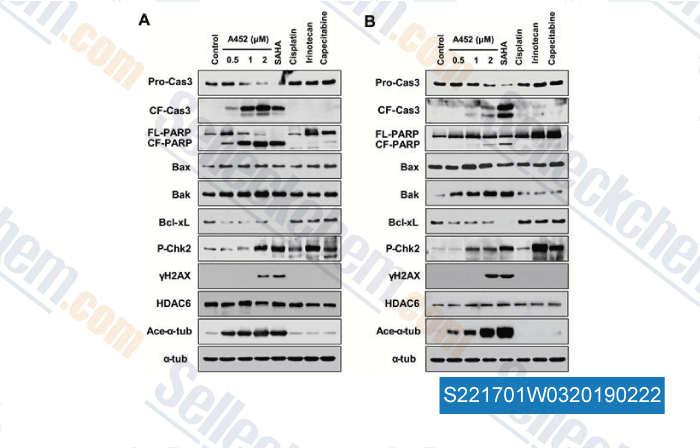
-
Données de [ , , Carcinogenesis, 2018, 39(1):72-83 ]
De Selleck Irinotecan Hydrochloride Trihydrate A été cité par 90 Publications
| NSUN5 Mediates Resistance to Doxorubicin via Up-regulation of DNA Damage Repair Proteins BRCA2 and BRIP1 in Colorectal Cancer [ Am J Pathol, 2025, S0002-9440(25)00252-4] | PubMed: 40713976 |
| The novel SMYD3 inhibitor EM127 impairs DNA repair response to chemotherapy-induced DNA damage and reverses cancer chemoresistance [ J Exp Clin Cancer Res, 2024, 43(1):151] | PubMed: 38812026 |
| Establishment, characterization, and biobanking of 36 pancreatic cancer organoids: prediction of metastasis in resectable pancreatic cancer [ Cell Oncol (Dordr), 2024, 10.1007/s13402-024-00939-5] | PubMed: 38619751 |
| CHD1L Inhibitor OTI-611 Synergizes with Chemotherapy to Enhance Antitumor Efficacy and Prolong Survival in Colorectal Cancer Mouse Models [ Int J Mol Sci, 2024, 25(23)13160] | PubMed: 39684869 |
| Effects of simulated microgravity on colorectal cancer organoids growth and drug response [ Sci Rep, 2024, 14(1):25526] | PubMed: 39462078 |
| Assessment of stromal SCD-induced drug resistance of PDAC using 3D-printed zPDX model chips [ iScience, 2023, 26(1):105723] | PubMed: 36590169 |
| Artesunate ameliorates irinotecan-induced intestinal injury by suppressing cellular senescence and significantly enhances anti-tumor activity [ Int Immunopharmacol, 2023, 119:110205] | PubMed: 37104917 |
| Cutoff value of IC50 for drug sensitivity in patient-derived tumor organoids in colorectal cancer [ iScience, 2023, 26(7):107116] | PubMed: 37426352 |
| The role of pregnane X receptor (PXR-in cancer drug resistance and identification of novel PXR antagonists [ Tübingen, 2023, ] | PubMed: None |
| p53 controls choice between apoptotic and non-apoptotic death following DNA damage [ bioRxiv, 2023, 2023.01.17.524444] | PubMed: 36712034 |
POLITIQUE DE RETOUR
La politique de retour inconditionnelle de Selleck Chemical garantit une expérience dachat en ligne fluide à nos clients. Si vous nêtes en aucun cas satisfait de votre achat, vous pouvez retourner tout article dans les 7 jours suivant sa réception. En cas de problèmes de qualité du produit, quil sagisse de problèmes liés au protocole ou au produit, vous pouvez retourner tout article dans les 365 jours suivant la date dachat initiale. Veuillez suivre les instructions ci-dessous lors du retour des produits.
EXPÉDITION ET STOCKAGE
Les produits Selleck sont transportés à température ambiante. Si vous recevez le produit à température ambiante, soyez assuré que le service dinspection de la qualité de Selleck a mené des expériences pour vérifier que le placement à température normale pendant un mois naffectera pas lactivité biologique des produits en poudre. Après réception, veuillez stocker le produit conformément aux exigences décrites dans la fiche technique. La plupart des produits Selleck sont stables dans les conditions recommandées.
NON DESTINÉ À UN USAGE HUMAIN, VÉTÉRINAIRE DIAGNOSTIQUE OU THÉRAPEUTIQUE.