
Données techniques
| Formule | C11H8O4 |
||||||
| Poids moléculaire | 204.18 | N° CAS | 14003-96-4 | ||||
| Solubilité (25°C)* | In vitro | DMSO | 41 mg/mL (200.8 mM) | ||||
| Water | Insoluble | ||||||
| Ethanol | Insoluble | ||||||
| In Vivo (Ajoutez les solvants au produit individuellement et dans lordre.) |
|
||||||
|
* <1 mg/ml signifie légèrement soluble ou insoluble. * Veuillez noter que Selleck teste la solubilité de tous les composés en interne, et la solubilité réelle peut différer légèrement des valeurs publiées. Ceci est normal et est dû à de légères variations dun lot à lautre. * Expédition à température ambiante (les tests de stabilité montrent que ce produit peut être expédié sans aucune mesure de refroidissement.) |
|||||||
Préparation des solutions mères
Activité biologique
| Description | 4μ8C (IRE1 Inhibitor III) est un inhibiteur puissant et sélectif de l'IRE1 Rnase avec une IC50 de 76 nM. | ||
|---|---|---|---|
| Cibles |
|
||
| In vitro | 4μ8C bloque l'accès du substrat (RIDD) au site actif d'IRE1 et inactive sélectivement à la fois l'épissage de Xbp1 et la dégradation de l'ARNm médiée par IRE1. L'inhibition d'IRE1 induit ensuite un stress du RE sans toxicité aiguë mesurable. 4μ8C, en tant qu'inhibiteur d'IRE1, bloque la production d'IL-4, d'IL-5 et d'IL-13 par les lymphocytes T CD4+. |
||
| In Vivo | 4μ8c est un inhibiteur IRE1 Inhibitor III qui réduit les lésions athérosclérotiques et atténue efficacement le développement de la plaque chez les souris. |
||
| Caractéristiques | Inhibiteur sélectif de l'IRE1 Rnase, utilisé comme plateforme pour le développement de nouveaux médicaments à action locale. |
Protocole (de référence)
| Test kinase : |
|
|---|---|
| Test cellulaire : |
|
| Étude animale : |
|
Références
|
Validation du produit par le client

-
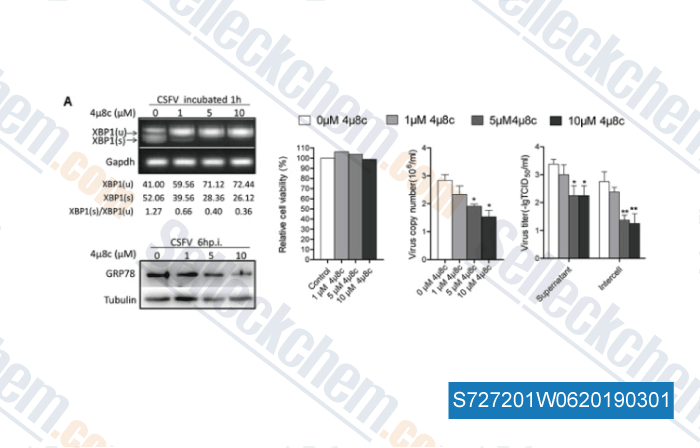
Données de [ , , Free Radic Biol Med, 2018, 124:395-407 ]
-
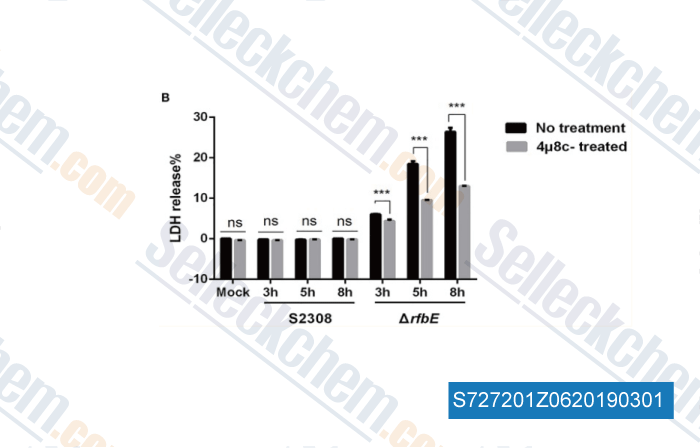
Données de [ , , Front Microbiol, 2017, 8:2129 ]
-
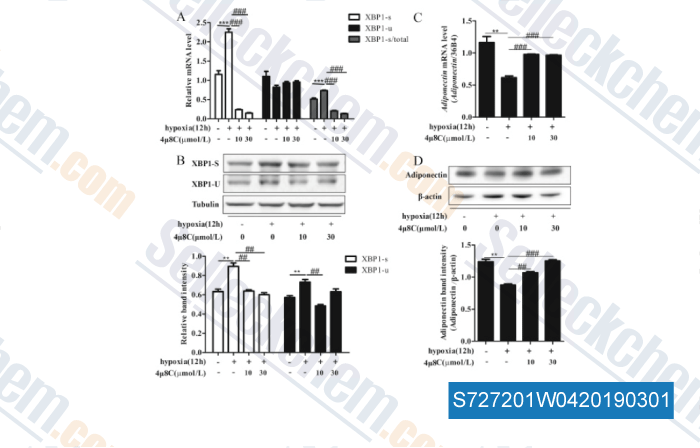
Données de [ , , Front Cell Infect Microbiol, 2017, 7:422 ]
-
Données de [ , , Biochem Biophys Res Commun, 2017, 493(1):346-351 ]
De Selleck 4μ8C A été cité par 57 Publications
| TaIRE1-mediated unconventional splicing of the TabZIP60 mRNA and the miR172 precursor regulates heat stress tolerance in wheat [ J Integr Plant Biol, 2025, 67(9):2388-2400.] | PubMed: 40607649 |
| TaIRE1-mediated unconventional splicing of the TabZIP60 mRNA and the miR172 precursor regulates heat stress tolerance in wheat [ J Integr Plant Biol, 2025, 10.1111/jipb.13963] | PubMed: 40607649 |
| The IRE1α/XBP1-mediated upregulation of LMTK2 attenuates endoplasmic reticulum stress by enhancing autophagic activity [ Cancer Lett, 2025, 633:217993] | PubMed: 40834986 |
| Curcumin Attenuates Fumonisin B1-Induced PK-15 Cell Apoptosis by Upregulating miR-1249 Expression to Inhibit the IRE1/MKK7/JNK/CASPASE3 Signaling Pathway [ Antioxidants (Basel), 2025, 14(2)168] | PubMed: 40002355 |
| Mitochondrial ROS-ER Stress Axis Governs IL-10 Production in Neutrophils and Regulates Inflammation in Murine Chlamydia pneumoniae Lung Infection [ Cells, 2025, 14(19)1523] | PubMed: 41090752 |
| Oridonin alleviates SiNPs-induced pulmonary fibrosis by inhibiting pyroptosis via IRE1α-XBP1s-NLRP3 pathway [ Int Immunopharmacol, 2025, 164:115388] | PubMed: 40845545 |
| PERK Regulates Epithelial-Mesenchymal Transition Through Autophagy and Lipid Metabolism in Lens Epithelial Cells [ Invest Ophthalmol Vis Sci, 2025, 66(5):35] | PubMed: 40408092 |
| MAM-Mediated Mitochondrial Ca2+ Overload and Endoplasmic Reticulum Stress Aggravates Synaptic Plasticity Impairment in Diabetic Mice [ Brain Sci, 2025, 15(11)1157] | PubMed: 41300164 |
| TMED4 facilitates regulatory T cell suppressive function via ROS homeostasis in tumor and autoimmune mouse models [ J Clin Invest, 2024, 135(1)e179874] | PubMed: 39480507 |
| MANF facilitates breast cancer cell survival under glucose-starvation conditions via PRKN-mediated mitophagy regulation [ Autophagy, 2024, 1-22.] | PubMed: 39147386 |
POLITIQUE DE RETOUR
La politique de retour inconditionnelle de Selleck Chemical garantit une expérience dachat en ligne fluide à nos clients. Si vous nêtes en aucun cas satisfait de votre achat, vous pouvez retourner tout article dans les 7 jours suivant sa réception. En cas de problèmes de qualité du produit, quil sagisse de problèmes liés au protocole ou au produit, vous pouvez retourner tout article dans les 365 jours suivant la date dachat initiale. Veuillez suivre les instructions ci-dessous lors du retour des produits.
EXPÉDITION ET STOCKAGE
Les produits Selleck sont transportés à température ambiante. Si vous recevez le produit à température ambiante, soyez assuré que le service dinspection de la qualité de Selleck a mené des expériences pour vérifier que le placement à température normale pendant un mois naffectera pas lactivité biologique des produits en poudre. Après réception, veuillez stocker le produit conformément aux exigences décrites dans la fiche technique. La plupart des produits Selleck sont stables dans les conditions recommandées.
NON DESTINÉ À UN USAGE HUMAIN, VÉTÉRINAIRE DIAGNOSTIQUE OU THÉRAPEUTIQUE.