
uitsluitend voor onderzoeksdoeleinden
SB269970 HCl 5-HT Receptor Antagonist
Cat.Nr.: S2849
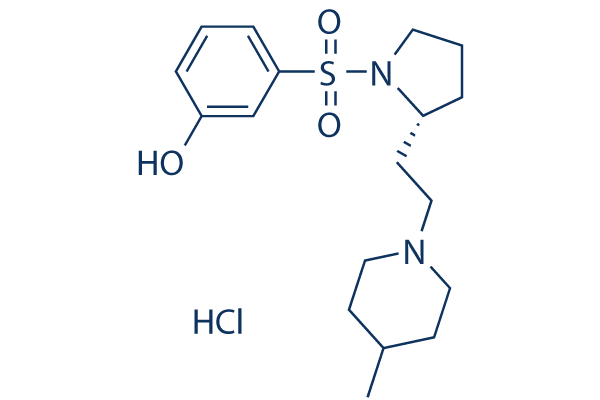
Chemische structuur
Moleculair gewicht: 388.95
Kwaliteitscontrole (Quality Control)
| Gerelateerde doelwitten | Adrenergic Receptor AChR COX Calcium Channel Histamine Receptor Dopamine Receptor GABA Receptor TRP Channel Cholinesterase (ChE) GluR |
|---|---|
| Overige 5-HT Receptor Inhibitoren | Serotonin Hydrochloride (5-HT HCl) WAY-100635 Maleate Puerarin Ketanserin BRL-15572 Dihydrochloride RS-127445 Nuciferine Flopropione BRL-54443 SB 271046 hydrochloride |
Chemische informatie, Opslag en Stabiliteit (Chemical Information, Storage & Stability)
| Moleculair gewicht | 388.95 | Formule | C18H28N2O3S.HCl |
Opslag (Vanaf de ontvangstdatum) | |
|---|---|---|---|---|---|
| CAS-nr. | 261901-57-9 | SDF downloaden | Opslag van stamoplossingen |
|
|
| Synoniemen | N/A | Smiles | CC1CCN(CC1)CCC2CCCN2S(=O)(=O)C3=CC=CC(=C3)O.Cl | ||
Oplosbaarheid (Solubility)
|
In vitro |
DMSO
: 11 mg/mL
(28.28 mM)
Water : Insoluble Ethanol : Insoluble |
Molariteitscalculator
|
In vivo |
|||||
In vivo Formuleringscalculator (Heldere oplossing)
Stap 1: Voer de onderstaande informatie in (Aanbevolen: Een extra dier voor het geval van verlies tijdens het experiment)
Stap 2: Voer de in vivo formulering in (Dit is alleen de calculator, geen formulering. Neem eerst contact met ons op als er geen in vivo formulering is in het gedeelte Oplosbaarheid.)
Berekeningsresultaten:
Werkconcentratie: mg/ml;
Methode voor het bereiden van DMSO-mastervloeistof: mg geneesmiddel vooraf opgelost in μL DMSO ( Concentratie mastervloeistof mg/mL, Neem eerst contact met ons op als de concentratie de DMSO-oplosbaarheid van de partij geneesmiddel overschrijdt. )
Methode voor het bereiden van in vivo formulering: Neem μL DMSO mastervloeistof, voeg vervolgens toeμL PEG300, mengen en helder maken, voeg vervolgens toeμL Tween 80, mengen en helder maken, voeg vervolgens toe μL ddH2O, mengen en helder maken.
Methode voor het bereiden van in vivo formulering: Neem μL DMSO mastervloeistof, voeg vervolgens toe μL Maïsolie, mengen en helder maken.
Opmerking: 1. Zorg ervoor dat de vloeistof helder is voordat u het volgende oplosmiddel toevoegt.
2. Zorg ervoor dat u het/de oplosmiddel(en) in de juiste volgorde toevoegt. U moet ervoor zorgen dat de verkregen oplossing, bij de vorige toevoeging, een heldere oplossing is voordat u verdergaat met het toevoegen van het volgende oplosmiddel. Fysische methoden zoals vortexen, echografie of een warmwaterbad kunnen worden gebruikt om het oplossen te bevorderen.
Werkingsmechanisme (Mechanism of Action)
| Kenmerken |
A hydrochloride salt form of SB-269970 which is a potent 5-HT 7 receptor antagonist.
|
|---|---|
| Targets/IC50/Ki |
5-HT7
8.3(pKi)
|
| In vitro |
SB-269970 inhibits 5-CT-stimulated adenylyl cyclase activity in guinea-pig hippocampal membranes. SB-269970 (0.03 μM, 0.1 μM, 0.3 μM and 1 μM) produces a concentration-related rightward-shift of the 5-CT concentration-response curve with no significant alteration in the maximal response to 5-CT. SB-269970 (1 μM) has any effect on 5-HT efflux when superfused alone.
|
| In vivo |
SB-269970 (10 mg/kg and 30 mg/kg) significantly reduces the effects of amphetamine by 25 and 27%, respectively, and blocks the effects of ketamine by 38% (10 mg/kg) and 30% (30 mg/kg). SB-269970 significantly reduces amphetamine-induced hyperactivity in wild-type mice and is without effects in 5-HT7 knockout mice. Systemic administration of SB-269970 (30 mg/kg) significantly reverses amphetamine disruption of PPI and did not enhance PPI by itself compared to control. SB-269970 significantly reverses the deficits induced by MK-801, but not by scopolamine. SB-269970 normalizes MK-801-induced glutamate but not dopamine release in the cortex. SB-269970 (in one medium dose of 0.5 or 1 mg/kg) exerts a specific antianxiety-like effect in the Vogel drinking test in rats, in the elevated plus-maze test in rats and in the four-plate test in mice. Moreover, SB-269970 (in one medium dose of 5 or 10 mg/kg) reveals antidepressant-like activity in the forced swimming and the tail suspension tests in mice. SB-269970 at doses of 0.3, 1 and 3 μg exhibits an anticonflict effect which is weaker than that of diazepam (40 μg), whereas SB-269970 at doses of 3 and 10 μg had marked anti-immobility action comparable to that of imipramine (0.1 μg).
|
Referenties |
|

Producten zijn uitsluitend voor onderzoeksdoeleinden. Niet voor menselijk gebruik. Wij verkopen niet aan patiënten.
©Copyright 2013 Selleck Chemicals. Alle rechten voorbehouden.