
uitsluitend voor onderzoeksdoeleinden
Cutamesine Dihydrochloride Sigma Receptor Agonist
Cat.Nr.: S2917
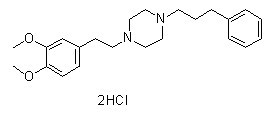
Chemische structuur
Moleculair gewicht: 441.43
Kwaliteitscontrole (Quality Control)
| Gerelateerde doelwitten | CXCR Hedgehog/Smoothened PKA Adrenergic Receptor AChR 5-HT Receptor Histamine Receptor Dopamine Receptor Ras KRas |
|---|---|
| Overige Sigma Receptor Inhibitoren | BD-1047 dihydrobromide S1RA Siramesine HCl Anavex 2-73 HCl PRE-084 hydrochloride Ditolylguanidine 4-IBP BD1063 2HCL Carbetapentane WQ 1 |
Chemische informatie, Opslag en Stabiliteit (Chemical Information, Storage & Stability)
| Moleculair gewicht | 441.43 | Formule | C23H32N2O2.2HCl |
Opslag (Vanaf de ontvangstdatum) | |
|---|---|---|---|---|---|
| CAS-nr. | 165377-44-6 | SDF downloaden | Opslag van stamoplossingen |
|
|
| Synoniemen | SA4503 dihydrochloride, AGY94806 dihydrochloride | Smiles | Cl.Cl.COC1=C(OC)C=C(CCN2CCN(CCCC3=CC=CC=C3)CC2)C=C1 | ||
Oplosbaarheid (Solubility)
|
In vitro |
Water : 88 mg/mL
DMSO
: 22 mg/mL
(49.83 mM)
Ethanol : 11 mg/mL |
Molariteitscalculator
|
In vivo |
|||||
In vivo Formuleringscalculator (Heldere oplossing)
Stap 1: Voer de onderstaande informatie in (Aanbevolen: Een extra dier voor het geval van verlies tijdens het experiment)
Stap 2: Voer de in vivo formulering in (Dit is alleen de calculator, geen formulering. Neem eerst contact met ons op als er geen in vivo formulering is in het gedeelte Oplosbaarheid.)
Berekeningsresultaten:
Werkconcentratie: mg/ml;
Methode voor het bereiden van DMSO-mastervloeistof: mg geneesmiddel vooraf opgelost in μL DMSO ( Concentratie mastervloeistof mg/mL, Neem eerst contact met ons op als de concentratie de DMSO-oplosbaarheid van de partij geneesmiddel overschrijdt. )
Methode voor het bereiden van in vivo formulering: Neem μL DMSO mastervloeistof, voeg vervolgens toeμL PEG300, mengen en helder maken, voeg vervolgens toeμL Tween 80, mengen en helder maken, voeg vervolgens toe μL ddH2O, mengen en helder maken.
Methode voor het bereiden van in vivo formulering: Neem μL DMSO mastervloeistof, voeg vervolgens toe μL Maïsolie, mengen en helder maken.
Opmerking: 1. Zorg ervoor dat de vloeistof helder is voordat u het volgende oplosmiddel toevoegt.
2. Zorg ervoor dat u het/de oplosmiddel(en) in de juiste volgorde toevoegt. U moet ervoor zorgen dat de verkregen oplossing, bij de vorige toevoeging, een heldere oplossing is voordat u verdergaat met het toevoegen van het volgende oplosmiddel. Fysische methoden zoals vortexen, echografie of een warmwaterbad kunnen worden gebruikt om het oplossen te bevorderen.
Werkingsmechanisme (Mechanism of Action)
| Targets/IC50/Ki |
Sigma-1 receptor
17.4 mM
|
|---|---|
| In vitro |
SA 4503 has weak binding affinities for sigma 1 adrenergic, dopamine D, serotonin (5-HT)1A, 5-HT2, histamine H, muscarinic M1, and muscarinic M2 receptors at a concentration of 10 μM. GTP weaks SA 4503-induced inhibition of (+)-[3H]pentazocine binding in rat brain membranes. SA 4503 inhibits specific (+)-[3H]pentazocine binding in a competitive manner. |
| In vivo |
SA 4503 (0.03 mg/kg-1 mg/kg s.c.) attenuates the dizocilpine (0.15 mg/kg i.p.) and L-NAME (100 mg/kg i.p.)-induced memory deficits following a bell-shaped curve in both the Y-maze for spatial working memory and step-down type passive avoidance test in mice. Progesterone (2 mg/kg s.c.) blocks the SA 4503 effects in the dizocilpine- and L-NAME-amnesia models, in accordance with the purported neurosteroids/sigma1 receptors interaction. SA 4503 (100 nM-300 nM) increases the electrically evoked release of acetylcholine in hippocampal but not striatal slices of rats. Concentrations below 100 nM does not alter the electrically evoked release of acetylcholine in either brain area. SA 4503 (1 mg/kg i.p. bid) produces a significant decrease and increase in the number of spontaneously active SNC and VTA DA neurons in rats. SA 4503 (1 mg/kg i.p. repeat ) produces a significant increase in the number of spontaneously active VTA DA neurons. The repeated administration of SA 4503 produces a greater alteration of the firing pattern of spontaneously active VTA compared to SNC DA neurons. Repeated treatment with SA 4503 (0.3 mg/kg) ameliorates the behavioral deficits in olfactory bulbectomized rats resembling depression symptoms in the open-field test, sexual behavior test, and cued and contextual fear-conditioning test. SA 4503 displays advantages over desipramine in the sexual behavior test. SA 4503 also reverses the decrease in the protein expression of NMDA receptor subunit (NR)1, but not NR2A or NR2B, in the prefrontal cortex, hippocampus, and amygdala of olfactory bulbectomized rats. |
Referenties |
|

Producten zijn uitsluitend voor onderzoeksdoeleinden. Niet voor menselijk gebruik. Wij verkopen niet aan patiënten.
©Copyright 2013 Selleck Chemicals. Alle rechten voorbehouden.