
uitsluitend voor onderzoeksdoeleinden
Camostat Mesilate Sodium Channel Remmer
Cat.Nr.: S2874
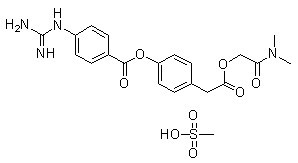
Chemische structuur
Moleculair gewicht: 494.52
Kwaliteitscontrole (Quality Control)
| Gerelateerde doelwitten | CFTR CRM1 CD markers AChR Calcium Channel Potassium Channel GABA Receptor TRP Channel ATPase GluR |
|---|---|
| Overige Sodium Channel Inhibitoren | A-803467 cariporide Tolperisone HCl Vinpocetine Veratramine Bulleyaconi cine A GS967 Ambroxol HCl Benzocaine Nefopam HCl |
Celkweek, behandeling & werkconcentratie
(Cell Culture, Treatment & Working Concentration)
| Cellijnen | Assaytype | Concentratie | Incubatietijd | Formulering | Activiteitsbeschrijving | PMID |
|---|---|---|---|---|---|---|
| Caco-2 | Function assay | 48 hours | Determination of IC50 values for inhibition of SARS-CoV-2 induced cytotoxicity of Caco-2 cells after 48 hours by high content imaging, IC50 = 0.64 μM. | ChEMBL | ||
| Klik om meer experimentele gegevens over de cellijn te bekijken | ||||||
Chemische informatie, Opslag en Stabiliteit (Chemical Information, Storage & Stability)
| Moleculair gewicht | 494.52 | Formule | C20H22N4O5.CH4O3S |
Opslag (Vanaf de ontvangstdatum) | |
|---|---|---|---|---|---|
| CAS-nr. | 59721-29-8 | SDF downloaden | Opslag van stamoplossingen |
|
|
| Synoniemen | FOY-305, FOY-S980 | Smiles | CN(C)C(=O)COC(=O)CC1=CC=C(C=C1)OC(=O)C2=CC=C(C=C2)N=C(N)N.CS(=O)(=O)O | ||
Oplosbaarheid (Solubility)
|
In vitro |
DMSO
: 100 mg/mL
(202.21 mM)
Water : 20 mg/mL Ethanol : Insoluble |
Molariteitscalculator
|
In vivo |
|||||
In vivo Formuleringscalculator (Heldere oplossing)
Stap 1: Voer de onderstaande informatie in (Aanbevolen: Een extra dier voor het geval van verlies tijdens het experiment)
Stap 2: Voer de in vivo formulering in (Dit is alleen de calculator, geen formulering. Neem eerst contact met ons op als er geen in vivo formulering is in het gedeelte Oplosbaarheid.)
Berekeningsresultaten:
Werkconcentratie: mg/ml;
Methode voor het bereiden van DMSO-mastervloeistof: mg geneesmiddel vooraf opgelost in μL DMSO ( Concentratie mastervloeistof mg/mL, Neem eerst contact met ons op als de concentratie de DMSO-oplosbaarheid van de partij geneesmiddel overschrijdt. )
Methode voor het bereiden van in vivo formulering: Neem μL DMSO mastervloeistof, voeg vervolgens toeμL PEG300, mengen en helder maken, voeg vervolgens toeμL Tween 80, mengen en helder maken, voeg vervolgens toe μL ddH2O, mengen en helder maken.
Methode voor het bereiden van in vivo formulering: Neem μL DMSO mastervloeistof, voeg vervolgens toe μL Maïsolie, mengen en helder maken.
Opmerking: 1. Zorg ervoor dat de vloeistof helder is voordat u het volgende oplosmiddel toevoegt.
2. Zorg ervoor dat u het/de oplosmiddel(en) in de juiste volgorde toevoegt. U moet ervoor zorgen dat de verkregen oplossing, bij de vorige toevoeging, een heldere oplossing is voordat u verdergaat met het toevoegen van het volgende oplosmiddel. Fysische methoden zoals vortexen, echografie of een warmwaterbad kunnen worden gebruikt om het oplossen te bevorderen.
Werkingsmechanisme (Mechanism of Action)
| Targets/IC50/Ki |
epithelial sodium channel (ENaC)
50 nM
|
|---|---|
| In vitro |
Camostat (30 μM) prolongs attenuation of ENaC function in human airway epithelial cell models that is reversible upon the addition of excess trypsin. Camostat mesilate (500 mM) inhibits generation of TGF-beta by suppressing plasmin activity and reduces the activity of TGF-beta, which blocks in vitro activation of HSCs. Camostat mesilate (20 mM) combined with insulin results a significant hypoglycemic effect following large intestinal administration. Camostat mesilate (20 mM) is effective in reducing insulin degradation in both small and large intestinal homogenates of rats. Camostat mesilate (2 mM) inhibits MCP-1 and TNF- production in activated rat monocytes. Camostat mesilate (2 mM) inhibits proliferation and MCP-1 production of cultured rat PSCs.
|
| In vivo |
Camostat (100 μg/kg i.t.) induces a potent and prolonged attenuation of ENaC activity in the guinea pig trachea. Camostat mesilate (1-2 mg/g of diet) markedly attenuats an increase in hepatic plasmin and TGF-beta levels, HSC activation, and hepatic fibrosis without apparent systemic or local side effects in porcine serum–treated rats. Camostat mesilate (1 mg/g) prevents pancreatic atrophy and improves pancreatic exocrine function of rat chronic pancreatitis induced by DBTC. Camostat mesilate (1 mg/g) inhibits chronic inflammation and pancreatic fibrosis induced by DBTC. Camostat mesilate (1 mg/g) inhibits the development of pancreatic fibrosis and PSCs activation in the pancreas induced by DBTC. Camostat mesilate (1 mg/g) suppresses monocytes infiltration and inhibits MCP-1 expression both in serum and in pancreatic tissue. Camostat mesilate (100 mg/kg) significantly increases the body weight and pancreatic wet weight, and it significantly inhibits inflammatory changes and fibrosis of the pancreas through the suppression of gene expressions of PAP, p8, and cytokines in rat chronic pancreatitis.
|
Referenties |
|
Informatie klinische proef (Clinical Trial Information)
(gegevens van https://clinicaltrials.gov, bijgewerkt op 2025-04-18)
| NCT-nummer | Rekrutering | Aandoeningen | Sponsor/Medewerkers | Startdatum | Fasen |
|---|---|---|---|---|---|
| NCT04321096 | COMPLETED | Corona Virus Infection |
University of Aarhus |
2020-04-04 | PHASE1; PHASE2 |
| NCT04470544 | COMPLETED | Severe Acute Respiratory Syndrome |
Alan Bryce |
2020-07-28 | PHASE2 |
| NCT04338906 | WITHDRAWN | COVID |
Heinrich-Heine University, Duesseldorf |
2020-05 | PHASE4 |
| NCT04681430 | COMPLETED | Corona Virus Infection; SARS-CoV-2 Infection; SARS-CoV-2 PCR Test Positive; SARS-CoV-2 Acute Respiratory Disease |
Heinrich-Heine University, Duesseldorf |
2021-01-08 | PHASE2 |
| NCT04652765 | TERMINATED | Covid19; SARS-CoV Infection; Coronavirus Infection |
Sidney Kimmel Comprehensive Cancer Center at Johns Hopkins |
2021-02-03 | PHASE1 |
| NCT04530617 | TERMINATED | Covid19; Diabetes; Hypertension; Obesity |
Instituto Nacional de Ciencias Medicas y Nutricion Salvador Zubiran |
2020-10-05 | PHASE2 |

Producten zijn uitsluitend voor onderzoeksdoeleinden. Niet voor menselijk gebruik. Wij verkopen niet aan patiënten.
©Copyright 2013 Selleck Chemicals. Alle rechten voorbehouden.