
uitsluitend voor onderzoeksdoeleinden
Riluzole Sodium Channel Remmer
Cat.Nr.: S1614
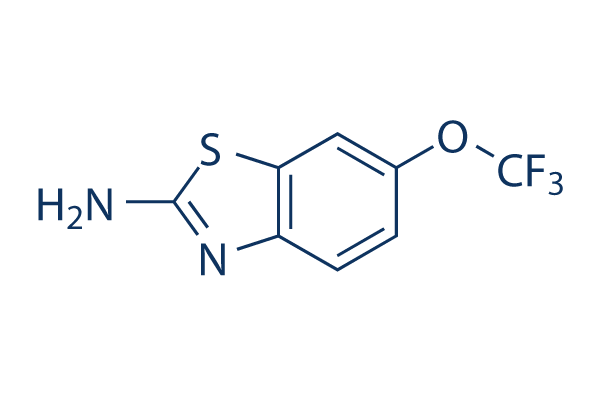
Chemische structuur
Moleculair gewicht: 234.2
Kwaliteitscontrole (Quality Control)
| Gerelateerde doelwitten | CFTR CRM1 CD markers AChR Calcium Channel Potassium Channel GABA Receptor TRP Channel ATPase GluR |
|---|---|
| Overige Sodium Channel Inhibitoren | Camostat Mesilate A-803467 cariporide Tolperisone HCl Vinpocetine Veratramine Bulleyaconi cine A GS967 Ambroxol HCl Benzocaine |
Chemische informatie, Opslag en Stabiliteit (Chemical Information, Storage & Stability)
| Moleculair gewicht | 234.2 | Formule | C8H5F3N2OS |
Opslag (Vanaf de ontvangstdatum) | |
|---|---|---|---|---|---|
| CAS-nr. | 1744-22-5 | SDF downloaden | Opslag van stamoplossingen |
|
|
| Synoniemen | RP-54274, PK 26124 | Smiles | C1=CC2=C(C=C1OC(F)(F)F)SC(=N2)N | ||
Oplosbaarheid (Solubility)
|
In vitro |
DMSO
: 47 mg/mL
(200.68 mM)
Ethanol : 47 mg/mL Water : Insoluble |
Molariteitscalculator
|
In vivo |
|||||
In vivo Formuleringscalculator (Heldere oplossing)
Stap 1: Voer de onderstaande informatie in (Aanbevolen: Een extra dier voor het geval van verlies tijdens het experiment)
Stap 2: Voer de in vivo formulering in (Dit is alleen de calculator, geen formulering. Neem eerst contact met ons op als er geen in vivo formulering is in het gedeelte Oplosbaarheid.)
Berekeningsresultaten:
Werkconcentratie: mg/ml;
Methode voor het bereiden van DMSO-mastervloeistof: mg geneesmiddel vooraf opgelost in μL DMSO ( Concentratie mastervloeistof mg/mL, Neem eerst contact met ons op als de concentratie de DMSO-oplosbaarheid van de partij geneesmiddel overschrijdt. )
Methode voor het bereiden van in vivo formulering: Neem μL DMSO mastervloeistof, voeg vervolgens toeμL PEG300, mengen en helder maken, voeg vervolgens toeμL Tween 80, mengen en helder maken, voeg vervolgens toe μL ddH2O, mengen en helder maken.
Methode voor het bereiden van in vivo formulering: Neem μL DMSO mastervloeistof, voeg vervolgens toe μL Maïsolie, mengen en helder maken.
Opmerking: 1. Zorg ervoor dat de vloeistof helder is voordat u het volgende oplosmiddel toevoegt.
2. Zorg ervoor dat u het/de oplosmiddel(en) in de juiste volgorde toevoegt. U moet ervoor zorgen dat de verkregen oplossing, bij de vorige toevoeging, een heldere oplossing is voordat u verdergaat met het toevoegen van het volgende oplosmiddel. Fysische methoden zoals vortexen, echografie of een warmwaterbad kunnen worden gebruikt om het oplossen te bevorderen.
Werkingsmechanisme (Mechanism of Action)
| Targets/IC50/Ki |
Sodium channel
NMDA receptor
Glutamate release
|
|---|---|
| In vitro |
Riluzole inhibits the release of glutamic acid from cultured neurons, and from brain slices. These effects may be partly due to inactivation of voltage-dependent sodium channels on glutamatergic nerve terminals, as well as activation of a G-protein-dependent signal transduction process. Electrophysiologic experiments performed on isolated excitatory amino acid receptors expressed in the Xenopus oocyte have revealed that this compound inhibits currents evoked by N-methyl-D-aspartate (NMDA) (IC50 = 18 μM) and kainic acid (IC50 = 167 μM). It has been shown to stabilize inactivated sodium channels in frog sciatic nerve, in rat cerebellar granule cells, and on recombinant rat sodium channels expressed in Xenopus oocytes (Ki = 0.2 μM). This chemical also blocks some of the postsynaptic effects of glutamic acid by noncompetitive blockade of NMDA receptors. It protects cultured neurons from anoxic damage, from the toxic effects of glutamic-acid-uptake inhibitors, and from the toxic factor in the CSF of patients with amyotrophic lateral sclerosis.
|
| In vivo |
Riluzole can easily cross the blood-brain barrier. This compound has neuroprotective, anticonvulsant, and sedative properties in vivo. In a rodent model of transient global cerebral ischemia, a complete suppression of the ischemia-evoked surge in glutamic acid release has been observed by this chemical treatment (8 mg/kg i.p.).
|
Referenties |
|
Toepassingen (Applications)
| Methoden | Biomarkers | Afbeeldingen | PMID |
|---|---|---|---|
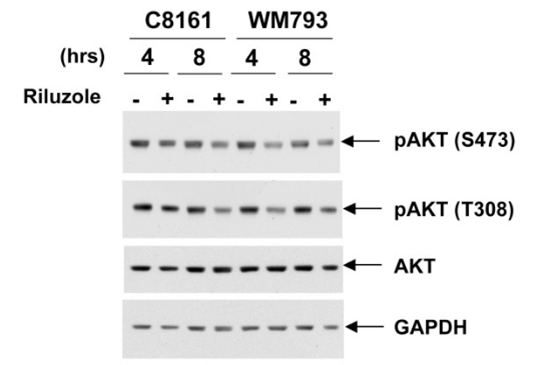
| Western blot | p-AKT / AKT p-Smad2 / Smad2 / p-Smad3 / Smad3 |
|
23077590 |
Informatie klinische proef (Clinical Trial Information)
(gegevens van https://clinicaltrials.gov, bijgewerkt op 2025-10-03)
| NCT-nummer | Rekrutering | Aandoeningen | Sponsor/Medewerkers | Startdatum | Fasen |
|---|---|---|---|---|---|
| NCT07174492 | NOT_YET_RECRUITING | Amyotrophic Lateral Sclerosis (ALS) |
AB Science |
2026-01-01 | PHASE3 |
| NCT07447050 | RECRUITING | Breast Cancer; Sarcoma; Gastric (Stomach) Cancer; Lung Cancer; Head and Neck Cancer; Colorectal Cancer; Ovarian Cancer; Liver Cancer; Genitourinary Cancer; Gynecologic Cancer |
University of California, Irvine |
2025-12-23 | PHASE2 |
| NCT03127267 | RECRUITING | Amyotrophic Lateral Sclerosis |
AB Science |
2021-02-02 | PHASE3 |
| NCT06580002 | RECRUITING | Breast Cancer; Sarcoma; Gastric Cancer; Lung Cancer; Head and Neck Cancer; Colorectal Cancer; Ovarian Cancer; Liver Cancer; Genitourinary Cancer; Gynecologic Cancer; Urinary Bladder Cancer; Leukemia; Lymphoid Leukemia; Myeloma Multiple; Prostate Cancer; Pancreas Cancer; Non-hodgkin Lymphoma; Hodgkin Lymphoma; Brain Cancer; Melanoma; Mycosis Fungoides; Kidney Cancer |
University of California, Irvine |
2024-12-02 | PHASE2 |
| NCT07142291 | RECRUITING | Amyotrophic Lateral Sclerosis (ALS) |
PhenoNet, Inc. |
2025-11-25 | PHASE2 |
| NCT07414212 | RECRUITING | Amyotrophic Lateral Sclerosis |
Biogipuzkoa Health Research Institute |
2025-11-25 | PHASE1; PHASE2 |

Producten zijn uitsluitend voor onderzoeksdoeleinden. Niet voor menselijk gebruik. Wij verkopen niet aan patiënten.
©Copyright 2013 Selleck Chemicals. Alle rechten voorbehouden.