
uitsluitend voor onderzoeksdoeleinden
Phenylephrine HCl Adrenergic Receptor Agonist
Cat.Nr.: S2569
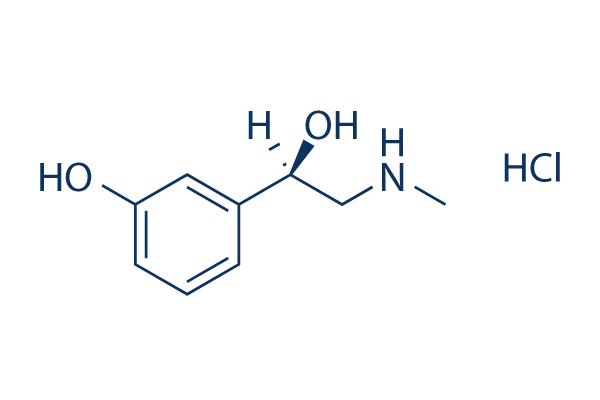
Chemische structuur
Moleculair gewicht: 203.67
Kwaliteitscontrole (Quality Control)
| Gerelateerde doelwitten | CXCR Hedgehog/Smoothened PKA AChR 5-HT Receptor Histamine Receptor Dopamine Receptor Ras KRas GPR |
|---|---|
| Overige Adrenergic Receptor Inhibitoren | ICI 118551 Hydrochloride (Zenidolol) L755507 Yohimbine HCl Atipamezole Adrenalone HCl Medetomidine HCl Noradrenaline bitartrate monohydrate Naftopidil Detomidine HCl L-Adrenaline |
Chemische informatie, Opslag en Stabiliteit (Chemical Information, Storage & Stability)
| Moleculair gewicht | 203.67 | Formule | C9H13NO2.HCl |
Opslag (Vanaf de ontvangstdatum) | |
|---|---|---|---|---|---|
| CAS-nr. | 61-76-7 | SDF downloaden | Opslag van stamoplossingen | Oplossingen zijn onstabiel. Bereid vers of koop kleine, voorverpakte formaten. Herverpakken na ontvangst. | |
| Synoniemen | NCI-C55641 HCl,(R)-(-)-Phenylephrine hydrochloride, L-Phenylephrine hydrochloride | Smiles | CNCC(C1=CC(=CC=C1)O)O.Cl | ||
Oplosbaarheid (Solubility)
|
In vitro |
DMSO
: 41 mg/mL
(201.3 mM)
Water : 41 mg/mL Ethanol : 41 mg/mL |
Molariteitscalculator
|
In vivo |
|||||
In vivo Formuleringscalculator (Heldere oplossing)
Stap 1: Voer de onderstaande informatie in (Aanbevolen: Een extra dier voor het geval van verlies tijdens het experiment)
Stap 2: Voer de in vivo formulering in (Dit is alleen de calculator, geen formulering. Neem eerst contact met ons op als er geen in vivo formulering is in het gedeelte Oplosbaarheid.)
Berekeningsresultaten:
Werkconcentratie: mg/ml;
Methode voor het bereiden van DMSO-mastervloeistof: mg geneesmiddel vooraf opgelost in μL DMSO ( Concentratie mastervloeistof mg/mL, Neem eerst contact met ons op als de concentratie de DMSO-oplosbaarheid van de partij geneesmiddel overschrijdt. )
Methode voor het bereiden van in vivo formulering: Neem μL DMSO mastervloeistof, voeg vervolgens toeμL PEG300, mengen en helder maken, voeg vervolgens toeμL Tween 80, mengen en helder maken, voeg vervolgens toe μL ddH2O, mengen en helder maken.
Methode voor het bereiden van in vivo formulering: Neem μL DMSO mastervloeistof, voeg vervolgens toe μL Maïsolie, mengen en helder maken.
Opmerking: 1. Zorg ervoor dat de vloeistof helder is voordat u het volgende oplosmiddel toevoegt.
2. Zorg ervoor dat u het/de oplosmiddel(en) in de juiste volgorde toevoegt. U moet ervoor zorgen dat de verkregen oplossing, bij de vorige toevoeging, een heldere oplossing is voordat u verdergaat met het toevoegen van het volgende oplosmiddel. Fysische methoden zoals vortexen, echografie of een warmwaterbad kunnen worden gebruikt om het oplossen te bevorderen.
Werkingsmechanisme (Mechanism of Action)
| Targets/IC50/Ki |
α1-adrenergic receptor
|
|---|---|
| In vitro |
Phenylephrine causes a rapid translocation of PKC-epsilon (EC50 = 0.9 mM) but the proportion lost from the soluble fraction is less than with ET-1. Phenylephrine at pCa 7 causes a dose-dependent increase in contractile force of the hyperpermeable cells, which is reversible on addition of phentolamine. Phenylephrine also protects cardiomyocytes against subsequent 24 h treatment with hypoxia and serum deprivation. Phenylephrine prevents the down-regulation of Bcl-2 and Bcl-X mRNA/protein and induces hypertrophic growth. Phenylephrine-mediated protection is abrogated by the phosphatidylinositol 3-kinase (PI 3-kinase) inhibitor wortmannin and is mimicked by the caspase-9 peptidic inhibitor LEHD-fmk. Phenylephrine stimulates phosphoinositide (PI) hydrolysis, cell growth, and expression of several genes [e.g., atrial natriuretic factor (ANF)] often associated with cardiac hypertrophy. Phenylephrine (1 礛) markedly potentiates HGF-induced hepatocyte DNA synthesis and proliferation. Phenylephrine (10 mM) reversibly increases I(Ca,L) (51.3%; n = 40) and shifted peak I(Ca,L) activation voltage by -10 mV. Phenylephrine also increases local, subsarcolemmal SR Ca2+ release via IP3-dependent signaling. Phenylephrin-induced NOi release requires stimulation of both PI-3K/Akt and IP3-dependent Ca2+ signaling. Phenylephrine-induced NOi release is inhibited by each of 1 mM prazocin, 10 mM L-NIO, 10 mM W-7, 10 mM LY294002, 2 mM H-89, 10 mM ryanodine, 5 mM thapsigargin, 2 mM 2-APB or 10 mM xestospongin C. |
Referenties |
|
Informatie klinische proef (Clinical Trial Information)
(gegevens van https://clinicaltrials.gov, bijgewerkt op 2026-02-13)
| NCT-nummer | Rekrutering | Aandoeningen | Sponsor/Medewerkers | Startdatum | Fasen |
|---|---|---|---|---|---|
| NCT06677970 | RECRUITING | Acute Ischemic Stroke |
Yonsei University |
2024-10-01 | PHASE3 |
| NCT06802224 | RECRUITING | Anesthesia; Surgery With General Anesthesia; Noncardiac Surgery; Hypotension During Surgery; Acute Kidney Injury (AKI); Myocardial Injury After Noncardiac Surgery (MINS); Vasopressor |
University of California, San Francisco |
2025-04-01 | PHASE4 |
| NCT01731444 | RECRUITING | Blood Loss, Surgical |
University of Manitoba |
2014-12-01 | PHASE1 |
| NCT07796282 | NOT_YET_RECRUITING | Spine Surgery; Intraoperative Hypotension; Tissue Perfusion |
Mayo Clinic |
2026-09 | PHASE4 |
| NCT06083948 | RECRUITING | Hypotension |
University of Aarhus |
2023-12-20 | PHASE2; PHASE3 |
| NCT05997732 | RECRUITING | Vasoconstriction; Vasodilation |
University of Alberta |
2023-10-31 | PHASE4 |

Producten zijn uitsluitend voor onderzoeksdoeleinden. Niet voor menselijk gebruik. Wij verkopen niet aan patiënten.
©Copyright 2013 Selleck Chemicals. Alle rechten voorbehouden.