
uitsluitend voor onderzoeksdoeleinden
Odanacatib Cysteine Protease Remmer
Cat.Nr.: S1115
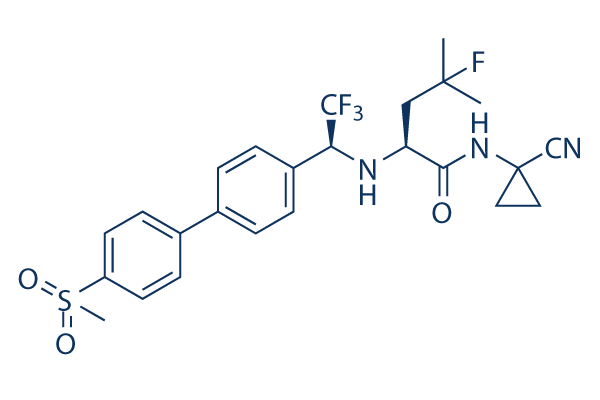
Chemische structuur
Moleculair gewicht: 525.56
Kwaliteitscontrole (Quality Control)
| Gerelateerde doelwitten | HDAC Caspase Proteasome Secretase MMP HCV Protease Tyrosinase HIV Protease DPP Serine Protease |
|---|---|
| Overige Cysteine Protease Inhibitoren | N-Ethylmaleimide (NEM) MG132 SSS Calpeptin Aloxistatin (E-64d) E-64 MG-101 (ALLN) Z-FA-FMK Cathepsin Inhibitor 1 PD 151746 Loxistatin Acid (E-64C) |
Celkweek, behandeling & werkconcentratie
(Cell Culture, Treatment & Working Concentration)
| Cellijnen | Assaytype | Concentratie | Incubatietijd | Formulering | Activiteitsbeschrijving | PMID |
|---|---|---|---|---|---|---|
| ramos cells | Function assay | Inhibition of cathepsin S in human ramos cells, IC50=0.045μM | 18226527 | |||
| stem cells | Function assay | 7 days | Inhibition of osteoclastogenesis in human bone marrow-derived stem cells assessed as reduction of pit formation by measuring TRACP5b activity after 7 days by bone TRAP assay, IC50=0.1μM | 22984809 | ||
| HepG2 | Function assay | Inhibition of cathepsin B in human HepG2 cells, IC50=1.05μM | 18226527 | |||
| B cells | Function assay | Inhibition of antigen presenting mouse B cells, IC50=1.5μM | 18226527 | |||
| HepG2 | Function assay | Inhibition of cathepsin L in human HepG2 cells, IC50=4.843μM | 18226527 | |||
| SJ-GBM2 | qHTS assay | qHTS of pediatric cancer cell lines to identify multiple opportunities for drug repurposing: Primary screen for SJ-GBM2 cells | 29435139 | |||
| Klik om meer experimentele gegevens over de cellijn te bekijken | ||||||
Chemische informatie, Opslag en Stabiliteit (Chemical Information, Storage & Stability)
| Moleculair gewicht | 525.56 | Formule | C25H27F4N3O3S |
Opslag (Vanaf de ontvangstdatum) | |
|---|---|---|---|---|---|
| CAS-nr. | 603139-19-1 | SDF downloaden | Opslag van stamoplossingen |
|
|
| Synoniemen | MK-0822 | Smiles | CC(C)(CC(C(=O)NC1(CC1)C#N)NC(C2=CC=C(C=C2)C3=CC=C(C=C3)S(=O)(=O)C)C(F)(F)F)F | ||
Oplosbaarheid (Solubility)
|
In vitro |
DMSO
: 100 mg/mL
(190.27 mM)
Water : Insoluble Ethanol : Insoluble |
Molariteitscalculator
|
In vivo |
|||||
In vivo Formuleringscalculator (Heldere oplossing)
Stap 1: Voer de onderstaande informatie in (Aanbevolen: Een extra dier voor het geval van verlies tijdens het experiment)
Stap 2: Voer de in vivo formulering in (Dit is alleen de calculator, geen formulering. Neem eerst contact met ons op als er geen in vivo formulering is in het gedeelte Oplosbaarheid.)
Berekeningsresultaten:
Werkconcentratie: mg/ml;
Methode voor het bereiden van DMSO-mastervloeistof: mg geneesmiddel vooraf opgelost in μL DMSO ( Concentratie mastervloeistof mg/mL, Neem eerst contact met ons op als de concentratie de DMSO-oplosbaarheid van de partij geneesmiddel overschrijdt. )
Methode voor het bereiden van in vivo formulering: Neem μL DMSO mastervloeistof, voeg vervolgens toeμL PEG300, mengen en helder maken, voeg vervolgens toeμL Tween 80, mengen en helder maken, voeg vervolgens toe μL ddH2O, mengen en helder maken.
Methode voor het bereiden van in vivo formulering: Neem μL DMSO mastervloeistof, voeg vervolgens toe μL Maïsolie, mengen en helder maken.
Opmerking: 1. Zorg ervoor dat de vloeistof helder is voordat u het volgende oplosmiddel toevoegt.
2. Zorg ervoor dat u het/de oplosmiddel(en) in de juiste volgorde toevoegt. U moet ervoor zorgen dat de verkregen oplossing, bij de vorige toevoeging, een heldere oplossing is voordat u verdergaat met het toevoegen van het volgende oplosmiddel. Fysische methoden zoals vortexen, echografie of een warmwaterbad kunnen worden gebruikt om het oplossen te bevorderen.
Werkingsmechanisme (Mechanism of Action)
| Kenmerken |
A potent, selective, and neutral cathepsin K inhibitor.
|
|---|---|
| Targets/IC50/Ki |
Cathepsin K (human)
0.2 nM
Cathepsin K (rabbit)
1 nM
|
| In vitro |
In vitro, Odanacatib shows the high inhibitory activity and selectivity on cathepsin K with IC50 values of 0.2 nM and 1 nM for human cathepsin K and rabbit cathepsin K, respectively. Furthermore, this compound also shows similar potencies in whole human cell enzyme occupancy assays with corrected IC50 of 5 nM. A recent study shows that this chemical results in reduction of Osteoclast (OC) resorption activity by interrupting intracellular vesicular trafficking.
|
| In vivo |
In preclinical rats, Odanacatib (10 mg/kg) exhibits excellent pharmacokinetics with clearance (Cl: 2 mL kg-1 min-1), low volume of distribution (Vdss: 1.1 L kg-1), half-life (T1/2: 6 hours) and oral bioavailability (F: 8%), respectively. Besides, this compound also exhibits excellent metabolic stability in rat hepatocytes with a 96% recovery of the parent identity. This chemical administrated by p.o. prevents bone loss in ovariectomized (OVX) rabbits in a dose-related manner. Moreover, it (9 µM/day) leads to a significant increase in proximal femur bone mineral density (BMD) (7.8%), femoral neck BMD (10.8%) and the greater trochanter BMD (6.5%). In the estrogen-deficient, skeletally mature rhesus monkeys, long-term treatment with this compound effectively inhibits bone turnover without reducing osteoclast number and maintains normal biomechanical properties of the spine of OVX nonhuman primates.
|
Referenties |
|
Informatie klinische proef (Clinical Trial Information)
(gegevens van https://clinicaltrials.gov, bijgewerkt op 2018-08-28)
| NCT-nummer | Rekrutering | Aandoeningen | Sponsor/Medewerkers | Startdatum | Fasen |
|---|---|---|---|---|---|
| NCT01630616 | TERMINATED | Osteoporosis |
Merck Sharp & Dohme LLC |
2013-03-12 | PHASE1 |
| NCT01552122 | WITHDRAWN | Osteoporosis; Postmenopausal Osteoporosis |
Merck Sharp & Dohme LLC |
2012-05 | PHASE3 |
| NCT01803607 | TERMINATED | Osteoporosis |
Merck Sharp & Dohme LLC |
2013-03-14 | PHASE3 |
| NCT01120600 | COMPLETED | Osteoporosis |
Merck Sharp & Dohme LLC |
2010-06-09 | PHASE3 |
| NCT01803607 | Terminated | Osteoporosis |
Merck Sharp & Dohme LLC |
2013-03-14 | Phase 3 |
| NCT01630616 | Terminated | Osteoporosis |
Merck Sharp & Dohme LLC |
2013-03-12 | Phase 1 |

Producten zijn uitsluitend voor onderzoeksdoeleinden. Niet voor menselijk gebruik. Wij verkopen niet aan patiënten.
©Copyright 2013 Selleck Chemicals. Alle rechten voorbehouden.