
uitsluitend voor onderzoeksdoeleinden
Methylprednisolone Glucocorticoid Receptor Agonist
Cat.Nr.: S1733
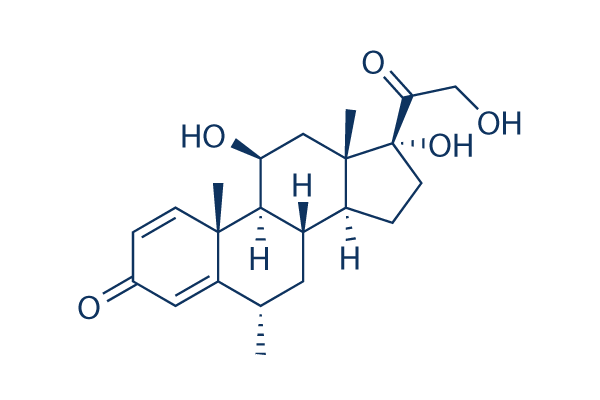
Chemische structuur
Moleculair gewicht: 374.47
Kwaliteitscontrole (Quality Control)
| Gerelateerde doelwitten | Adrenergic Receptor Estrogen/progestogen Receptor GPR Androgen Receptor ACE RAAS Progesterone Receptor Opioid Receptor THR PGES |
|---|---|
| Overige Glucocorticoid Receptor Inhibitoren | Relacorilant (CORT125134) Corticosterone AL082D06 (20S)-Protopanaxatriol Cortodoxone |
Celkweek, behandeling & werkconcentratie
(Cell Culture, Treatment & Working Concentration)
| Cellijnen | Assaytype | Concentratie | Incubatietijd | Formulering | Activiteitsbeschrijving | PMID |
|---|---|---|---|---|---|---|
| HepG2 cells | Function assay | 24 h | Activation of rat PXR expressed in human HepG2 cells after 24 hrs by luciferase reporter gene based luminescent analysis, EC50=4 μM | |||
| Klik om meer experimentele gegevens over de cellijn te bekijken | ||||||
Chemische informatie, Opslag en Stabiliteit (Chemical Information, Storage & Stability)
| Moleculair gewicht | 374.47 | Formule | C22H30O5 |
Opslag (Vanaf de ontvangstdatum) | |
|---|---|---|---|---|---|
| CAS-nr. | 83-43-2 | SDF downloaden | Opslag van stamoplossingen |
|
|
| Synoniemen | NSC-19987, U 7532 | Smiles | CC1CC2C3CCC(C3(CC(C2C4(C1=CC(=O)C=C4)C)O)C)(C(=O)CO)O | ||
Oplosbaarheid (Solubility)
|
In vitro |
DMSO
: 75 mg/mL
(200.28 mM)
Ethanol : 2 mg/mL Water : Insoluble |
Molariteitscalculator
|
In vivo |
|||||
In vivo Formuleringscalculator (Heldere oplossing)
Stap 1: Voer de onderstaande informatie in (Aanbevolen: Een extra dier voor het geval van verlies tijdens het experiment)
Stap 2: Voer de in vivo formulering in (Dit is alleen de calculator, geen formulering. Neem eerst contact met ons op als er geen in vivo formulering is in het gedeelte Oplosbaarheid.)
Berekeningsresultaten:
Werkconcentratie: mg/ml;
Methode voor het bereiden van DMSO-mastervloeistof: mg geneesmiddel vooraf opgelost in μL DMSO ( Concentratie mastervloeistof mg/mL, Neem eerst contact met ons op als de concentratie de DMSO-oplosbaarheid van de partij geneesmiddel overschrijdt. )
Methode voor het bereiden van in vivo formulering: Neem μL DMSO mastervloeistof, voeg vervolgens toeμL PEG300, mengen en helder maken, voeg vervolgens toeμL Tween 80, mengen en helder maken, voeg vervolgens toe μL ddH2O, mengen en helder maken.
Methode voor het bereiden van in vivo formulering: Neem μL DMSO mastervloeistof, voeg vervolgens toe μL Maïsolie, mengen en helder maken.
Opmerking: 1. Zorg ervoor dat de vloeistof helder is voordat u het volgende oplosmiddel toevoegt.
2. Zorg ervoor dat u het/de oplosmiddel(en) in de juiste volgorde toevoegt. U moet ervoor zorgen dat de verkregen oplossing, bij de vorige toevoeging, een heldere oplossing is voordat u verdergaat met het toevoegen van het volgende oplosmiddel. Fysische methoden zoals vortexen, echografie of een warmwaterbad kunnen worden gebruikt om het oplossen te bevorderen.
Werkingsmechanisme (Mechanism of Action)
| Targets/IC50/Ki |
Glucocorticoid receptor
|
|---|---|
| In vitro |
Methylprednisolone (2-10 mg/kg) markedly inhibits TNF production but does not affect serum levels of IL-10, while a high dose of this compound (50 mg/kg) increases LPS-induced IL-10 levels. This chemical (from 0.01 to 100 mg/mL) also increases the biosynthesis of IL-10 by LPS-activated mouse peritoneal macrophages. |
| In vivo |
Methylprednisolone decreases RGC survival in rats with electrophysiologically diagnosed optic neuritis. This compound decreases RGC survival by a nongenomic, calcium-dependent mechanism. Its induced enhancement of RGC degeneration depends on calcium influx through voltage-gated calcium channels. This treatment leads to a significant decrease in the number of ED1-positive cells in both rostral and caudal stumps. It results in a significant reduction in tissue loss in both cord stumps at 2, 4 and 8 week post-injury. This chemical leads to a long-term reduction of ED1-positive cells and spinal tissue loss, reduced dieback of vestibulospinal fibres, and a transient sprouting of vestibulospinal fibres near the lesion at 1 and 2 weeks post-lesion. At a dose of 30 mg/kg which has been shown to be effective in improving functional outcomes in rat SCI models, it suppresses TNF-α expression and NF-kB activation. Its inhibition of NF-kB function is likely mediated by the induction of IkB, which traps NF-kB in inactive cytoplasmic complexes. |
Referenties |
|
Informatie klinische proef (Clinical Trial Information)
(gegevens van https://clinicaltrials.gov, bijgewerkt op 2026-07-30)
| NCT-nummer | Rekrutering | Aandoeningen | Sponsor/Medewerkers | Startdatum | Fasen |
|---|---|---|---|---|---|
| NCT07072585 | NOT_YET_RECRUITING | Stage II T Lymphoblastic Leukemia/Lymphoma; Stage III T Lymphoblastic Leukemia/Lymphoma; Stage IV T Lymphoblastic Leukemia/Lymphoma; T Acute Lymphoblastic Leukemia; T Lymphoblastic Lymphoma |
Children's Oncology Group |
2026-08-28 | PHASE2; PHASE3 |
| NCT07478003 | RECRUITING | STEMI - ST Elevation Myocardial Infarction |
Thomas Engstrom |
2026-04-20 | PHASE3 |
| NCT07258771 | RECRUITING | Ulcerative Colitis Acute |
Berinstein, Jeffrey |
2026-01-16 | PHASE4 |
| NCT06970743 | ACTIVE_NOT_RECRUITING | Chronic Lymphocytic Leukemia; Small Lymphocytic Lymphoma |
BeOne Medicines |
2025-05-29 | PHASE3 |
| NCT07703098 | NOT_YET_RECRUITING | Adrenal Insufficiency |
University Medical Centre Ljubljana |
2026-09-01 | PHASE4 |
| NCT07412470 | RECRUITING | Kidney Transplant Rejection |
Sanofi |
2026-03-13 | PHASE2; PHASE3 |

Producten zijn uitsluitend voor onderzoeksdoeleinden. Niet voor menselijk gebruik. Wij verkopen niet aan patiënten.
©Copyright 2013 Selleck Chemicals. Alle rechten voorbehouden.