
uitsluitend voor onderzoeksdoeleinden
Meropenem Antibiotics Chemisch
Cat.Nr.: S1381
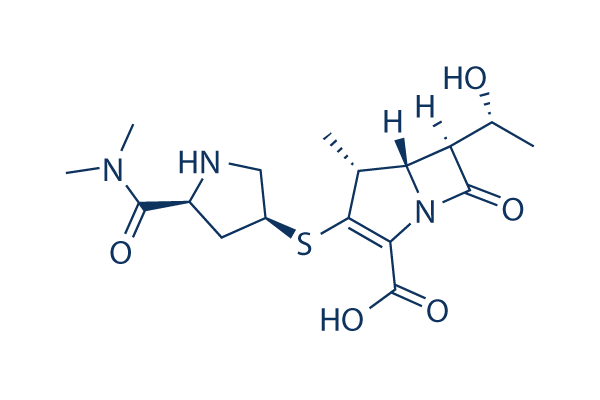
Chemische structuur
Moleculair gewicht: 383.46
Kwaliteitscontrole (Quality Control)
| Gerelateerde doelwitten | Integrase Bacterial Anti-infection Fungal Antiviral COVID-19 Parasite Reverse Transcriptase HIV HCV Protease |
|---|---|
| Overige Antibiotics Inhibitoren | Puromycin G418 Sulfate (Geneticin) Nanchangmycin Sitafloxacin Hydrate Nadifloxacin Spiramycin Trovafloxacin Mesylate G-418 Thiamphenicol Kitasamycin |
Chemische informatie, Opslag en Stabiliteit (Chemical Information, Storage & Stability)
| Moleculair gewicht | 383.46 | Formule | C17H25N3O5S |
Opslag (Vanaf de ontvangstdatum) | |
|---|---|---|---|---|---|
| CAS-nr. | 96036-03-2 | SDF downloaden | Opslag van stamoplossingen |
|
|
| Synoniemen | SM 7338 | Smiles | CC1C2C(C(=O)N2C(=C1SC3CC(NC3)C(=O)N(C)C)C(=O)O)C(C)O | ||
Oplosbaarheid (Solubility)
|
In vitro |
Water : 77 mg/mL
DMSO
: Insoluble
Ethanol : Insoluble |
Molariteitscalculator
|
In vivo |
|||||
In vivo Formuleringscalculator (Heldere oplossing)
Stap 1: Voer de onderstaande informatie in (Aanbevolen: Een extra dier voor het geval van verlies tijdens het experiment)
Stap 2: Voer de in vivo formulering in (Dit is alleen de calculator, geen formulering. Neem eerst contact met ons op als er geen in vivo formulering is in het gedeelte Oplosbaarheid.)
Berekeningsresultaten:
Werkconcentratie: mg/ml;
Methode voor het bereiden van DMSO-mastervloeistof: mg geneesmiddel vooraf opgelost in μL DMSO ( Concentratie mastervloeistof mg/mL, Neem eerst contact met ons op als de concentratie de DMSO-oplosbaarheid van de partij geneesmiddel overschrijdt. )
Methode voor het bereiden van in vivo formulering: Neem μL DMSO mastervloeistof, voeg vervolgens toeμL PEG300, mengen en helder maken, voeg vervolgens toeμL Tween 80, mengen en helder maken, voeg vervolgens toe μL ddH2O, mengen en helder maken.
Methode voor het bereiden van in vivo formulering: Neem μL DMSO mastervloeistof, voeg vervolgens toe μL Maïsolie, mengen en helder maken.
Opmerking: 1. Zorg ervoor dat de vloeistof helder is voordat u het volgende oplosmiddel toevoegt.
2. Zorg ervoor dat u het/de oplosmiddel(en) in de juiste volgorde toevoegt. U moet ervoor zorgen dat de verkregen oplossing, bij de vorige toevoeging, een heldere oplossing is voordat u verdergaat met het toevoegen van het volgende oplosmiddel. Fysische methoden zoals vortexen, echografie of een warmwaterbad kunnen worden gebruikt om het oplossen te bevorderen.
Werkingsmechanisme (Mechanism of Action)
| In vitro |
Meropenem has an antibacterial spectrum which is broadly similar to that of imipenem but, whilst slightly less active against staphylococci and enterococci, it is more active against Pseudomonas aeruginosa, all Enterobacteriaceae and Haemophilus influenzae. This compound is two- to four-fold more active than imipenem against Gram-negative organisms and its spectrum of antimicrobial activity is wider than those of all other drugs tested. Its MICs are not significantly influenced by high inocula and the drug is generally bactericidal. It demonstrates antagonism with several other beta-lactams against strains producing Type I cephalosporinases. This antibiotic binds most strongly to penicillin-binding protein 2 of Escherichia coli and Pseudomonas aeruginosa, and to penicillin-binding proteins 1 of Staphylococcus aureus. This chemical is a new carbapenem antibiotic which differs chemically from imipenem/cilastatin by having a 1-beta-methyl substitution, providing it with excellent intrinsic stability to human renal dehydropeptidase-I. It has one identified metabolite, a beta-lactam ring-opened form which is devoid of microbiological activity.
|
|---|---|
| In vivo |
Meropenem significantly increases the plamsa total clearance of valproate to about 1.5 times the control (6.09 mL/min/kg vs. 4.28 mL/min/kg) in rabbits. This compound significantly increases the urinary excretion of valproate- glucuronide in rabbits.
|
Referenties |
|
Informatie klinische proef (Clinical Trial Information)
(gegevens van https://clinicaltrials.gov, bijgewerkt op 2026-08-12)
| NCT-nummer | Rekrutering | Aandoeningen | Sponsor/Medewerkers | Startdatum | Fasen |
|---|---|---|---|---|---|
| NCT07759453 | NOT_YET_RECRUITING | Liver Transplant; Carbapenem-resistant Enterobacterales; CRE Colonization |
IRCCS Azienda Ospedaliero-Universitaria di Bologna |
2026-10-01 | PHASE3 |
| NCT07004049 | RECRUITING | Bloodstream Infection; Ventilator Associated Bacterial Pneumonia; Hospital Acquired Bacterial Pneumonia; Carbapenem Resistant Bacterial Infection; Multidrug Resistance |
National University of Singapore |
2025-04-21 | PHASE4 |
| NCT06184659 | RECRUITING | Sepsis; Septic Shock |
Scandinavian Critical Care Trials Group |
2025-06-26 | PHASE4 |
| NCT07556107 | RECRUITING | Infection; Acute Kidney Injury; Sepsis |
Bassett Healthcare |
2026-08-17 | PHASE4 |
| NCT07327619 | RECRUITING | Hospital-acquired Bacterial Pneumonia and Ventilator-associated Bacterial Pneumonia |
Qilu Pharmaceutical Co., Ltd. |
2026-01-22 | PHASE3 |
| NCT07484633 | NOT_YET_RECRUITING | Infection; Sepsis; NICU; PICU; Beta Lactams |
Semmelweis University |
2026-04 | PHASE4 |

Producten zijn uitsluitend voor onderzoeksdoeleinden. Niet voor menselijk gebruik. Wij verkopen niet aan patiënten.
©Copyright 2013 Selleck Chemicals. Alle rechten voorbehouden.