
uitsluitend voor onderzoeksdoeleinden
Manidipine 2HCl Calcium Channel Remmer
Cat.Nr.: S2482
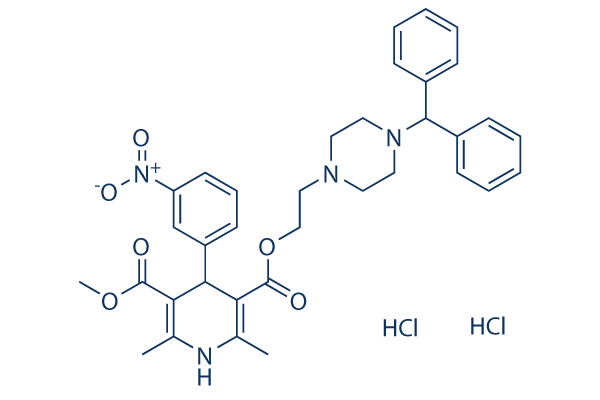
Chemische structuur
Moleculair gewicht: 683.62
Kwaliteitscontrole (Quality Control)
| Gerelateerde doelwitten | CFTR CRM1 CD markers AChR Sodium Channel Potassium Channel GABA Receptor TRP Channel ATPase GluR |
|---|---|
| Overige Calcium Channel Inhibitoren | Bay K 8644 BAPTA-AM Tetrandrine Flunarizine 2HCl Nilvadipine Cilnidipine YM-58483 (BTP2) Ionomycin Imperatorin Astragaloside A |
Chemische informatie, Opslag en Stabiliteit (Chemical Information, Storage & Stability)
| Moleculair gewicht | 683.62 | Formule | C35H38N4O6.2HCl |
Opslag (Vanaf de ontvangstdatum) | |
|---|---|---|---|---|---|
| CAS-nr. | 89226-75-5 | SDF downloaden | Opslag van stamoplossingen |
|
|
| Synoniemen | CV-4093 | Smiles | CC1=C(C(C(=C(N1)C)C(=O)OCCN2CCN(CC2)C(C3=CC=CC=C3)C4=CC=CC=C4)C5=CC(=CC=C5)[N+](=O)[O-])C(=O)OC.Cl.Cl | ||
Oplosbaarheid (Solubility)
|
In vitro |
DMSO
: 100 mg/mL
(146.28 mM)
Water : Insoluble Ethanol : Insoluble |
Molariteitscalculator
|
In vivo |
|||||
In vivo Formuleringscalculator (Heldere oplossing)
Stap 1: Voer de onderstaande informatie in (Aanbevolen: Een extra dier voor het geval van verlies tijdens het experiment)
Stap 2: Voer de in vivo formulering in (Dit is alleen de calculator, geen formulering. Neem eerst contact met ons op als er geen in vivo formulering is in het gedeelte Oplosbaarheid.)
Berekeningsresultaten:
Werkconcentratie: mg/ml;
Methode voor het bereiden van DMSO-mastervloeistof: mg geneesmiddel vooraf opgelost in μL DMSO ( Concentratie mastervloeistof mg/mL, Neem eerst contact met ons op als de concentratie de DMSO-oplosbaarheid van de partij geneesmiddel overschrijdt. )
Methode voor het bereiden van in vivo formulering: Neem μL DMSO mastervloeistof, voeg vervolgens toeμL PEG300, mengen en helder maken, voeg vervolgens toeμL Tween 80, mengen en helder maken, voeg vervolgens toe μL ddH2O, mengen en helder maken.
Methode voor het bereiden van in vivo formulering: Neem μL DMSO mastervloeistof, voeg vervolgens toe μL Maïsolie, mengen en helder maken.
Opmerking: 1. Zorg ervoor dat de vloeistof helder is voordat u het volgende oplosmiddel toevoegt.
2. Zorg ervoor dat u het/de oplosmiddel(en) in de juiste volgorde toevoegt. U moet ervoor zorgen dat de verkregen oplossing, bij de vorige toevoeging, een heldere oplossing is voordat u verdergaat met het toevoegen van het volgende oplosmiddel. Fysische methoden zoals vortexen, echografie of een warmwaterbad kunnen worden gebruikt om het oplossen te bevorderen.
Werkingsmechanisme (Mechanism of Action)
| Targets/IC50/Ki |
Calcium channel
(Guinea-pig single ventricular cells ) 2.6 nM
|
|---|---|
| In vitro |
At a holding potential of −37 mV, Manidipine decreases the Ca2+ current at concentrations above 0.1 nM, and abolishes it at 100 nM. Manidipine concentration-dependently inhibits the calcium concentration response curves. Manidipine inhibits coronay artery and renal artery with pIC50 of 9.3 nM and 9.1 nM, respectively. Manidipine partly inhibits sympathetic nerve activity and suppresses the mean arterial pressure response to infused norepinephrine. Manidipine also inhibits aldosterone secretion. Manidipine increases in both urinary calcium and uric acid. In addition, Manidipine, at nanomolar concentrations, is efficacious in modulating gene transcriptions that are involved in proinflammatory changes of mesangial cells.
|
| In vivo |
Manidipine (3 mg/kg and 10 mg/kg, p.o.) dose-dependently decreases systolic blood pressure in the three types of hypertensive rats. At the dose of 10 mg/kg, Manidipine decreases the blood pressure to the normotensive level between 1 hour and 3 hours after Manidipine is administered; the antihypertensive effect lasted for at least 8 hours. When Manidipine is administered at 10 μg/kg, the hypotensive action is markedly augmented. Manidipine potently inhibits the Ca inward current, When the potential is at -60 mV. Manidipine consistently inhibits the Ca current evoked by depolarization to 0 mV. However, a low concentration of Manidipine (1-3 nM) enhances the Ca current evoked by the depolarizing pulse of -20 mV, when the membrane potential is held at -80 mV. Inhibition of the Ca current induced by Manidipine develops slowly and over 10 minutes is required to reach the maximum inhibition.
|
Referenties |
|

Producten zijn uitsluitend voor onderzoeksdoeleinden. Niet voor menselijk gebruik. Wij verkopen niet aan patiënten.
©Copyright 2013 Selleck Chemicals. Alle rechten voorbehouden.