
uitsluitend voor onderzoeksdoeleinden
HMN-214 PLK Remmer
Cat.Nr.: S1485
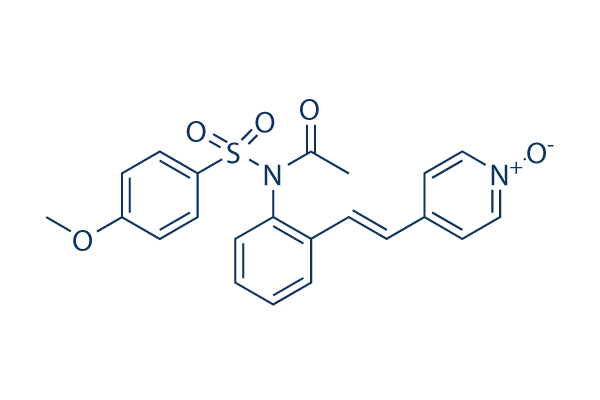
Chemische structuur
Moleculair gewicht: 424.47
Kwaliteitscontrole (Quality Control)
| Gerelateerde doelwitten | CDK HSP PD-1/PD-L1 ROCK Wee1 DNA/RNA Synthesis Microtubule Associated Ras KRas Aurora Kinase |
|---|---|
| Overige PLK Inhibitoren | Volasertib (BI6727) BI 2536 Rigosertib Sodium (ON-01910) GSK461364 Onvansertib (NMS-1286937, NMS-P937) CFI-400945 Ro3280 SBE 13 HCl MLN0905 Centrinone (LCR-263) |
Chemische informatie, Opslag en Stabiliteit (Chemical Information, Storage & Stability)
| Moleculair gewicht | 424.47 | Formule | C22H20N2O5S |
Opslag (Vanaf de ontvangstdatum) | |
|---|---|---|---|---|---|
| CAS-nr. | 173529-46-9 | SDF downloaden | Opslag van stamoplossingen |
|
|
| Synoniemen | N/A | Smiles | CC(=O)N(C1=CC=CC=C1C=CC2=CC=[N+](C=C2)[O-])S(=O)(=O)C3=CC=C(C=C3)OC | ||
Oplosbaarheid (Solubility)
|
In vitro |
DMSO
: 12 mg/mL
(28.27 mM)
Water : Insoluble Ethanol : Insoluble |
Molariteitscalculator
|
In vivo |
|||||
In vivo Formuleringscalculator (Heldere oplossing)
Stap 1: Voer de onderstaande informatie in (Aanbevolen: Een extra dier voor het geval van verlies tijdens het experiment)
Stap 2: Voer de in vivo formulering in (Dit is alleen de calculator, geen formulering. Neem eerst contact met ons op als er geen in vivo formulering is in het gedeelte Oplosbaarheid.)
Berekeningsresultaten:
Werkconcentratie: mg/ml;
Methode voor het bereiden van DMSO-mastervloeistof: mg geneesmiddel vooraf opgelost in μL DMSO ( Concentratie mastervloeistof mg/mL, Neem eerst contact met ons op als de concentratie de DMSO-oplosbaarheid van de partij geneesmiddel overschrijdt. )
Methode voor het bereiden van in vivo formulering: Neem μL DMSO mastervloeistof, voeg vervolgens toeμL PEG300, mengen en helder maken, voeg vervolgens toeμL Tween 80, mengen en helder maken, voeg vervolgens toe μL ddH2O, mengen en helder maken.
Methode voor het bereiden van in vivo formulering: Neem μL DMSO mastervloeistof, voeg vervolgens toe μL Maïsolie, mengen en helder maken.
Opmerking: 1. Zorg ervoor dat de vloeistof helder is voordat u het volgende oplosmiddel toevoegt.
2. Zorg ervoor dat u het/de oplosmiddel(en) in de juiste volgorde toevoegt. U moet ervoor zorgen dat de verkregen oplossing, bij de vorige toevoeging, een heldere oplossing is voordat u verdergaat met het toevoegen van het volgende oplosmiddel. Fysische methoden zoals vortexen, echografie of een warmwaterbad kunnen worden gebruikt om het oplossen te bevorderen.
Werkingsmechanisme (Mechanism of Action)
| Targets/IC50/Ki |
PLK1
|
|---|---|
| In vitro |
HMN-214 is an oral prodrug that is rapidly converted to HMN-176. The in vitro data of this compound are scarce. However, HMN-176, active metabolite of this prodrug, shows potent and broad-spectrumanti-tumor activity against various cancer cells, including HeLa, PC-3, DU-145, MIAPaCa-2, U937, MCF-7, A549, and WiDr, with a mean IC50 value of 118 nM. HMN-176 is also cytotoxic to drug-resistant human and murine cell lines, including P388/CDDP, P388/VCR, K2/CDDP, and K2/VP-16, with IC50 values ranging from 143 nM–265 nM. In HeLa cells, HMN-176 (3 μM) blocks cell cycle at G2/M phase.
In Doxorubicin-resistant K2/ARS cells, HMN-176 inhibits cell growth with an IC50 value of 2 μM. HMN-176 (3 μM) down-regulates the expression of the multidrug resistance gene (MDR1), due to the disturbance of NF-Y transcription factor binding to the MDR1 promoter.
In human RPE1 and CFPAC-1 cells, HMN-176 (2.5 μM) delays satisfaction of the spindle assembly checkpoint. HMN-176 (250 nM–2.5 μM) inhibits meiotic spindle assembly and aster formationin Spisula oocytes. HMN-176 (2.5 μM) also inhibits aster microtubule formation from human centrosomes. These results indicate that the anti-tumor activity of HMN-176 is at least partially via disrupting centrosome-mediated MT assembly during mitosis.
|
| In vivo |
HMN-214 is an oral pro-drug of HMN-176 with improved oral absorption. This compound (30 mg/kg) triggers no obvious neurotoxicity in mice. In mouse xenograft model of PC-3, A549, and WiDr cells, this compound (10 mg/kg–20 mg/kg) inhibits tumor growth.
In nude mice model bearing multidrug-resistant KB-A.1 cells, this compound (10 mg/kg–20 mg/kg) significantly suppresses MDR1 mRNA expression.
|
Referenties |
|

Producten zijn uitsluitend voor onderzoeksdoeleinden. Niet voor menselijk gebruik. Wij verkopen niet aan patiënten.
©Copyright 2013 Selleck Chemicals. Alle rechten voorbehouden.