
uitsluitend voor onderzoeksdoeleinden
GSK461364 PLK Remmer
Cat.Nr.: S2193
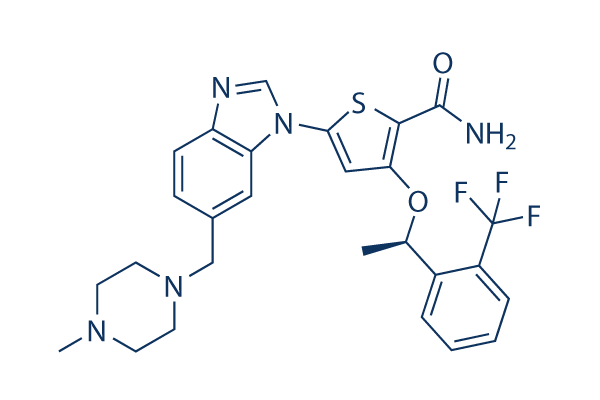
Chemische structuur
Moleculair gewicht: 543.6
Kwaliteitscontrole (Quality Control)
| Gerelateerde doelwitten | CDK HSP PD-1/PD-L1 ROCK Wee1 DNA/RNA Synthesis Microtubule Associated Ras KRas Aurora Kinase |
|---|---|
| Overige PLK Inhibitoren | Volasertib (BI6727) BI 2536 Rigosertib Sodium (ON-01910) Onvansertib (NMS-1286937, NMS-P937) CFI-400945 HMN-214 Ro3280 SBE 13 HCl MLN0905 Centrinone (LCR-263) |
Celkweek, behandeling & werkconcentratie
(Cell Culture, Treatment & Working Concentration)
| Cellijnen | Assaytype | Concentratie | Incubatietijd | Formulering | Activiteitsbeschrijving | PMID |
|---|---|---|---|---|---|---|
| human MV4-11 cells | Cytotoxicity assay | 24 h | Cytotoxicity against human MV4-11 cells after 24 hrs by CellTiter-Blue assay, GI50=0.679 μM | 26191363 | ||
| HEK293T | Antiproliferative assay | 72 hrs | Antiproliferative activity against HEK293T cells measured after 72 hrs by CellTiter-Blue assay, IC50=0.001μM | 28792760 | ||
| MDA-MB-231 | Antiproliferative assay | 72 hrs | Antiproliferative activity against human MDA-MB-231 cells measured after 72 hrs by CellTiter-Blue assay, IC50=0.001μM | 28792760 | ||
| MM1S | Antiproliferative assay | 72 hrs | Antiproliferative activity against human MM1S cells measured after 72 hrs by CellTiter-Blue assay, IC50=0.001μM | 28792760 | ||
| MDA-MB-23 | Function assay | 6 hrs | Inhibition of PLK1 in human MDA-MB-23 cells assessed as decrease in TCTP phosphorylation after 6 hrs by Western blot method, IC50<0.1μM | 28792760 | ||
| HEK293T | Function assay | 6 hrs | Inhibition of PLK1 in HEK293T cells assessed as decrease in TCTP phosphorylation after 6 hrs by Western blot method, IC50<0.1μM | 28792760 | ||
| TC32 | qHTS assay | qHTS of pediatric cancer cell lines to identify multiple opportunities for drug repurposing: Primary screen for TC32 cells | 29435139 | |||
| SJ-GBM2 | qHTS assay | qHTS of pediatric cancer cell lines to identify multiple opportunities for drug repurposing: Primary screen for SJ-GBM2 cells | 29435139 | |||
| A673 | qHTS assay | qHTS of pediatric cancer cell lines to identify multiple opportunities for drug repurposing: Primary screen for A673 cells | 29435139 | |||
| SK-N-MC | qHTS assay | qHTS of pediatric cancer cell lines to identify multiple opportunities for drug repurposing: Primary screen for SK-N-MC cells | 29435139 | |||
| BT-37 | qHTS assay | qHTS of pediatric cancer cell lines to identify multiple opportunities for drug repurposing: Primary screen for BT-37 cells | 29435139 | |||
| NB-EBc1 | qHTS assay | qHTS of pediatric cancer cell lines to identify multiple opportunities for drug repurposing: Primary screen for NB-EBc1 cells | 29435139 | |||
| U-2 OS | qHTS assay | qHTS of pediatric cancer cell lines to identify multiple opportunities for drug repurposing: Primary screen for U-2 OS cells | 29435139 | |||
| SK-N-SH | qHTS assay | qHTS of pediatric cancer cell lines to identify multiple opportunities for drug repurposing: Primary screen for SK-N-SH cells | 29435139 | |||
| NB1643 | qHTS assay | qHTS of pediatric cancer cell lines to identify multiple opportunities for drug repurposing: Primary screen for NB1643 cells | 29435139 | |||
| LAN-5 | qHTS assay | qHTS of pediatric cancer cell lines to identify multiple opportunities for drug repurposing: Primary screen for LAN-5 cells | 29435139 | |||
| BT-12 | qHTS assay | qHTS of pediatric cancer cell lines to identify multiple opportunities for drug repurposing: Primary screen for BT-12 cells | 29435139 | |||
| Rh18 | qHTS assay | qHTS of pediatric cancer cell lines to identify multiple opportunities for drug repurposing: Primary screen for Rh18 cells | 29435139 | |||
| OHS-50 | qHTS assay | qHTS of pediatric cancer cell lines to identify multiple opportunities for drug repurposing: Primary screen for OHS-50 cells | 29435139 | |||
| NB1643 | qHTS assay | qHTS of pediatric cancer cell lines to identify multiple opportunities for drug repurposing: Confirmatory screen for NB1643 cells | 29435139 | |||
| A673 | qHTS assay | qHTS of pediatric cancer cell lines to identify multiple opportunities for drug repurposing: Confirmatory screen for A673 cells) | 29435139 | |||
| SK-N-MC | qHTS assay | qHTS of pediatric cancer cell lines to identify multiple opportunities for drug repurposing: Confirmatory screen for SK-N-MC cells | 29435139 | |||
| BT-12 | qHTS assay | qHTS of pediatric cancer cell lines to identify multiple opportunities for drug repurposing: Confirmatory screen for BT-12 cells | 29435139 | |||
| LAN-5 | qHTS assay | qHTS of pediatric cancer cell lines to identify multiple opportunities for drug repurposing: Confirmatory screen for LAN-5 cells | 29435139 | |||
| NB-EBc1 | qHTS assay | qHTS of pediatric cancer cell lines to identify multiple opportunities for drug repurposing: Confirmatory screen for NB-EBc1 cells | 29435139 | |||
| SJ-GBM2 | qHTS assay | qHTS of pediatric cancer cell lines to identify multiple opportunities for drug repurposing: Confirmatory screen for SJ-GBM2 cells | 29435139 | |||
| BT-37 | qHTS assay | qHTS of pediatric cancer cell lines to identify multiple opportunities for drug repurposing: Confirmatory screen for BT-37 cells | 29435139 | |||
| TC32 | qHTS assay | qHTS of pediatric cancer cell lines to identify multiple opportunities for drug repurposing: Confirmatory screen for TC32 cells | 29435139 | |||
| MG 63 (6-TG R) | qHTS assay | qHTS of pediatric cancer cell lines to identify multiple opportunities for drug repurposing: Confirmatory screen for MG 63 (6-TG R) cells | 29435139 | |||
| fibroblast cells | qHTS assay | qHTS of pediatric cancer cell lines to identify multiple opportunities for drug repurposing: Confirmatory screen for control Hh wild type fibroblast cells | 29435139 | |||
| Rh41 | qHTS assay | qHTS of pediatric cancer cell lines to identify multiple opportunities for drug repurposing: Confirmatory screen for Rh41 cells | 29435139 | |||
| Rh18 | qHTS assay | qHTS of pediatric cancer cell lines to identify multiple opportunities for drug repurposing: Confirmatory screen for Rh18 cells | 29435139 | |||
| Rh30 | qHTS assay | qHTS of pediatric cancer cell lines to identify multiple opportunities for drug repurposing: Confirmatory screen for Rh30 cells | 29435139 | |||
| OHS-50 | qHTS assay | qHTS of pediatric cancer cell lines to identify multiple opportunities for drug repurposing: Confirmatory screen for OHS-50 cells | 29435139 | |||
| SK-N-SH | qHTS assay | qHTS of pediatric cancer cell lines to identify multiple opportunities for drug repurposing: Confirmatory screen for SK-N-SH cells | 29435139 | |||
| Klik om meer experimentele gegevens over de cellijn te bekijken | ||||||
Chemische informatie, Opslag en Stabiliteit (Chemical Information, Storage & Stability)
| Moleculair gewicht | 543.6 | Formule | C27H28F3N5O2S |
Opslag (Vanaf de ontvangstdatum) | |
|---|---|---|---|---|---|
| CAS-nr. | 929095-18-1 | SDF downloaden | Opslag van stamoplossingen |
|
|
| Synoniemen | GSK461364A | Smiles | CC(C1=CC=CC=C1C(F)(F)F)OC2=C(SC(=C2)N3C=NC4=C3C=C(C=C4)CN5CCN(CC5)C)C(=O)N | ||
Oplosbaarheid (Solubility)
|
In vitro |
Ethanol : 30 mg/mL
DMSO
: 10 mg/mL
(18.39 mM)
Water : Insoluble |
Molariteitscalculator
|
In vivo |
|||||
In vivo Formuleringscalculator (Heldere oplossing)
Stap 1: Voer de onderstaande informatie in (Aanbevolen: Een extra dier voor het geval van verlies tijdens het experiment)
Stap 2: Voer de in vivo formulering in (Dit is alleen de calculator, geen formulering. Neem eerst contact met ons op als er geen in vivo formulering is in het gedeelte Oplosbaarheid.)
Berekeningsresultaten:
Werkconcentratie: mg/ml;
Methode voor het bereiden van DMSO-mastervloeistof: mg geneesmiddel vooraf opgelost in μL DMSO ( Concentratie mastervloeistof mg/mL, Neem eerst contact met ons op als de concentratie de DMSO-oplosbaarheid van de partij geneesmiddel overschrijdt. )
Methode voor het bereiden van in vivo formulering: Neem μL DMSO mastervloeistof, voeg vervolgens toeμL PEG300, mengen en helder maken, voeg vervolgens toeμL Tween 80, mengen en helder maken, voeg vervolgens toe μL ddH2O, mengen en helder maken.
Methode voor het bereiden van in vivo formulering: Neem μL DMSO mastervloeistof, voeg vervolgens toe μL Maïsolie, mengen en helder maken.
Opmerking: 1. Zorg ervoor dat de vloeistof helder is voordat u het volgende oplosmiddel toevoegt.
2. Zorg ervoor dat u het/de oplosmiddel(en) in de juiste volgorde toevoegt. U moet ervoor zorgen dat de verkregen oplossing, bij de vorige toevoeging, een heldere oplossing is voordat u verdergaat met het toevoegen van het volgende oplosmiddel. Fysische methoden zoals vortexen, echografie of een warmwaterbad kunnen worden gebruikt om het oplossen te bevorderen.
Werkingsmechanisme (Mechanism of Action)
| Kenmerken |
Demonstrates >390-fold selectivity for Plk1 relative to Plk2 and Plk3.
|
|---|---|
| Targets/IC50/Ki |
PLK1
(Cell-free assay) 2.2 nM(Ki)
|
| In vitro |
GSK461364 inhibits cancer cell line proliferation from multiple origins with minimal toxicity in nondividing human cells. RNA silencing of WT p53 increases the antiproliferative activity of this compound. As many cancer therapies tend to be more effective in p53 WT patients, the higher sensitivity of p53-deficient tumors toward this chemical could potentially offer an opportunity to treat tumors that are refractory to other chemotherapies as well as early line therapy for these genotypes. This compound is a thiophene amide that inhibits purified Plk1 enzyme in vitro with a Ki of 2 nM and has >100-fold selectivity for Plk1 compared with Plk2 and Plk3. It is a potent inhibitor of cell proliferation causing 50% growth inhibition (GI50) below 100 nM in most of the cell lines tested with limited toxicity against human nonproliferating cells. Inhibition of cell cycle progression is concentration dependent with initial delay at G2 phase at high concentrations of this agent and arrest at M phase at lower concentrations. Currently, it is in a dose-escalation first-time-in-human trial. Cell lines with mutations in the TP53 gene tended to be more sensitive to this compound, and that inhibiting the p53 response by RNA silencing confers increased sensitivity in some p53 wild-type (WT) cells. Furthermore, these more sensitive cell lines also have increased levels of chromosome instability, a characteristic associated with TP53 mutations. In preclinical testing, this chemical shows antiproliferative activity against multiple (>120) tumor cell lines and potently inhibits the proliferation of greater than 83% and 91% of these cell lines, with IC50 values lower than 50 and 100 nM, respectively. |
| Kinase Assay |
Enzymassays
|
|
Kinase-reacties worden uitgevoerd in een finaal assayvolume van 10 μL met behulp van de Z-Lyte Assay kit (Ser/Thr peptide 16). Kortom, reacties bevatten 50 mM HEPES (pH 7.5), 10 mM MgCl2, 1 mM EGTA, 1 mM DTT, 0.01% Brij 35, 0.01 mg/mL caseïne, 200 μM ATP, 200 μM Polo Box peptide (NH2-MAGPMQS[pT]PLNGAKK-OH), en 6 nM recombinant Plk1 (H6-tev-PLK 1-603). Plk1 wordt 60 minuten voorgeïncubeerd met 0 tot 1 μM GSK461364. Reacties worden vervolgens geïnitieerd door de toevoeging van 2 μM peptide. Na 15 minuten bij 23 °C worden reacties geblust en verwerkt volgens het Z′-Lyte-protocol en afgelezen op een EnVision-plaatlezer. Ruwe fluorescentiewaarden worden omgezet in de concentratie van het gevormde product met behulp van substraat- en productstandaarden. Omdat de potentie van remming voor deze verbinding varieert als functie van de ATP-concentratie op een manier die consistent is met een ATP-competitieve remmingsmodus, wordt een bovengrens voor de Ki voor deze chemische stof bepaald.
|
|
| In vivo |
Cell culture growth inhibition by GSK461364 can be cytostatic or cytotoxic but leads to tumor regression in xenograft tumor models under proper dose scheduling. This compound shows clear antitumor activity in human tumor xenograft models. It shows a dose-dependent mitotic arrest in mouse xenografts, which correlates with effects on tumor growth. Intraperitoneal administration of this chemical causes regression or tumor growth delay in different xenograft models, including Colo205 xenografts. Suppression of Plk1 in vivo by using this agent results in mitotic arrest with aberrant mitotic figures consisting of monopolar or collapsed mitotic spindles. |
Referenties |
|
Toepassingen (Applications)
| Methoden | Biomarkers | Afbeeldingen | PMID |
|---|---|---|---|
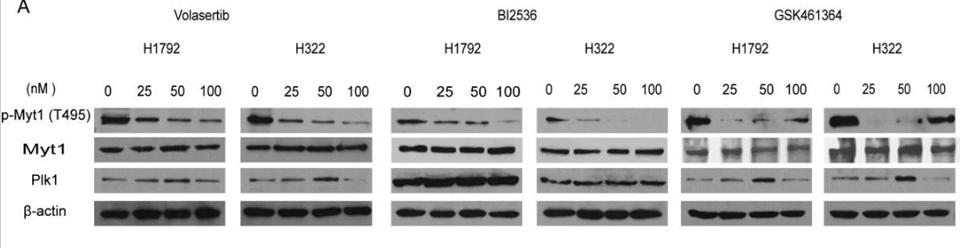
| Western blot | p-Myt1 / Myt1 / Plk1 |
|
26597303 |
Informatie klinische proef (Clinical Trial Information)
(gegevens van https://clinicaltrials.gov, bijgewerkt op 2017-06-26)
| NCT-nummer | Rekrutering | Aandoeningen | Sponsor/Medewerkers | Startdatum | Fasen |
|---|---|---|---|---|---|
| NCT00536835 | COMPLETED | Lymphoma, Non-Hodgkin |
GlaxoSmithKline |
2007-08-16 | PHASE1 |
| NCT00536835 | Completed | Lymphoma Non-Hodgkin |
GlaxoSmithKline |
2007-08-16 | Phase 1 |
Veelgestelde vragen (Frequently Asked Questions)
Vraag 1:
I would like to know whether the recommended in vivo formulation will be suitable for i.p. injections of it.
Antwoord:
It is a suspension in 1% DMSO+30% polyethylene glycol+1% Tween 80 at 30mg/ml, and is fine for oral gavage.

Producten zijn uitsluitend voor onderzoeksdoeleinden. Niet voor menselijk gebruik. Wij verkopen niet aan patiënten.
©Copyright 2013 Selleck Chemicals. Alle rechten voorbehouden.