
uitsluitend voor onderzoeksdoeleinden
GSK429286A ROCK Remmer
Cat.Nr.: S1474
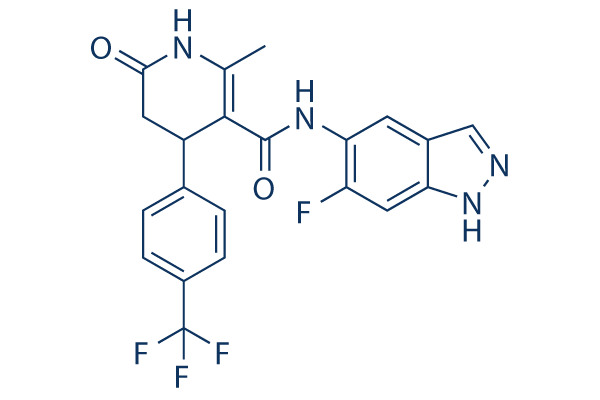
Chemische structuur
Moleculair gewicht: 432.37
Kwaliteitscontrole (Quality Control)
Celkweek, behandeling & werkconcentratie
(Cell Culture, Treatment & Working Concentration)
| Cellijnen | Assaytype | Concentratie | Incubatietijd | Formulering | Activiteitsbeschrijving | PMID |
|---|---|---|---|---|---|---|
| Sf9 cells | Function assay | Inhibition of human recombinant ROCK1 expressed in Sf9 cells at 10 mM, IC50=0.014 μM | 17201405 | |||
| Klik om meer experimentele gegevens over de cellijn te bekijken | ||||||
Chemische informatie, Opslag en Stabiliteit (Chemical Information, Storage & Stability)
| Moleculair gewicht | 432.37 | Formule | C21H16F4N4O2 |
Opslag (Vanaf de ontvangstdatum) | |
|---|---|---|---|---|---|
| CAS-nr. | 864082-47-3 | SDF downloaden | Opslag van stamoplossingen |
|
|
| Synoniemen | RHO-15 | Smiles | CC1=C(C(CC(=O)N1)C2=CC=C(C=C2)C(F)(F)F)C(=O)NC3=C(C=C4C(=C3)C=NN4)F | ||
Oplosbaarheid (Solubility)
|
In vitro |
DMSO
: 86 mg/mL
(198.9 mM)
Ethanol : 5 mg/mL Water : Insoluble |
Molariteitscalculator
|
In vivo |
|||||
In vivo Formuleringscalculator (Heldere oplossing)
Stap 1: Voer de onderstaande informatie in (Aanbevolen: Een extra dier voor het geval van verlies tijdens het experiment)
Stap 2: Voer de in vivo formulering in (Dit is alleen de calculator, geen formulering. Neem eerst contact met ons op als er geen in vivo formulering is in het gedeelte Oplosbaarheid.)
Berekeningsresultaten:
Werkconcentratie: mg/ml;
Methode voor het bereiden van DMSO-mastervloeistof: mg geneesmiddel vooraf opgelost in μL DMSO ( Concentratie mastervloeistof mg/mL, Neem eerst contact met ons op als de concentratie de DMSO-oplosbaarheid van de partij geneesmiddel overschrijdt. )
Methode voor het bereiden van in vivo formulering: Neem μL DMSO mastervloeistof, voeg vervolgens toeμL PEG300, mengen en helder maken, voeg vervolgens toeμL Tween 80, mengen en helder maken, voeg vervolgens toe μL ddH2O, mengen en helder maken.
Methode voor het bereiden van in vivo formulering: Neem μL DMSO mastervloeistof, voeg vervolgens toe μL Maïsolie, mengen en helder maken.
Opmerking: 1. Zorg ervoor dat de vloeistof helder is voordat u het volgende oplosmiddel toevoegt.
2. Zorg ervoor dat u het/de oplosmiddel(en) in de juiste volgorde toevoegt. U moet ervoor zorgen dat de verkregen oplossing, bij de vorige toevoeging, een heldere oplossing is voordat u verdergaat met het toevoegen van het volgende oplosmiddel. Fysische methoden zoals vortexen, echografie of een warmwaterbad kunnen worden gebruikt om het oplossen te bevorderen.
Werkingsmechanisme (Mechanism of Action)
| Kenmerken |
Greater selectivity than Y-27632.
|
|---|---|
| Targets/IC50/Ki |
ROCK1
(Cell-free assay) 14 nM
ROCK2
(Cell-free assay) 63 nM
|
| In vitro |
GSK429286A slightly inhibits RSK and p70S6K with IC50 of 0.78 μM and 1.94 μM, respectively. This compound significantly inhibits rat aortic ring dilation with IC50 of 190 nM. This chemical at 1 μM reduces ROCK2 activity over 20-fold, under conditions in which the only other kinase tested that is significantly inhibited is MSK1 whose activity is reduced ~5-fold. It is a more selective ROCK2 inhibitor than the widely utilized ROCK inhibitor Y-27632 as assessed on kinase-specificity panel, and does not significantly inhibit LRRK2 even at doses as high as 30 μM (500-fold higher than IC50 of inhibition of ROCK2). Like GSK269962A but not sunitinib, this compound treatment at 10 μM ablates basal or G14V-Rho mutant induced phosphorylation of MYPT at Thr850 in HEK-293 cells to a similar extent as H-1152 and Y-27632, consistent with ROCK mediating this phosphorylation, whereas it does not inhibit ERM protein phosphorylation either in the presence or absence of G14V-Rho.
|
| In vivo |
GSK429286A has 61% oral bioavailability in male Sprague-Dawley rats. Oral administration of this compound at single doses of 3-30 mg/kg dramatically reduces mean arterial pressure in the spontaneously hypertensive rats (SHRs) in a dose-dependent manner, with a maximum decrease of 50 mmHg after approximately 2 hours treatment at dose of 30 mg/kg.
|
Referenties |
|
Veelgestelde vragen (Frequently Asked Questions)
Vraag 1:
The product sold by Selleckchem has an “A” at the end. I am wondering if it is the same compound as GSK429286?
Antwoord:
For the compound GSK429286 and this compound, they are the same and have an identical CAS# (864082-47-3). Attached please find the reference about it, which was published by GSK, and the link is followed: http://www.ncbi.nlm.nih.gov/pubmed/19740074.

Producten zijn uitsluitend voor onderzoeksdoeleinden. Niet voor menselijk gebruik. Wij verkopen niet aan patiënten.
©Copyright 2013 Selleck Chemicals. Alle rechten voorbehouden.