
uitsluitend voor onderzoeksdoeleinden
Clemastine (HS-592) Fumarate H1-receptorantagonist
Cat.Nr.: S1847
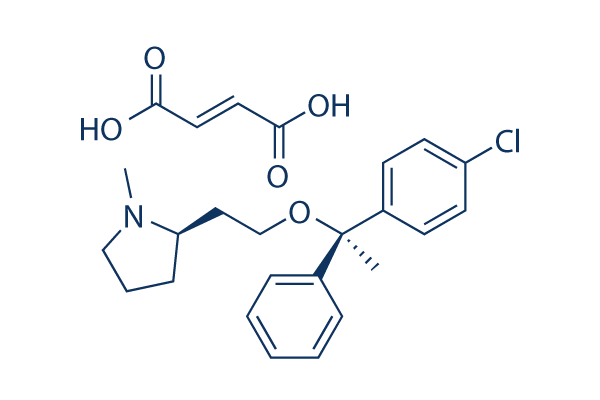
Chemische structuur
Moleculair gewicht: 459.96
Kwaliteitscontrole (Quality Control)
| Gerelateerde doelwitten | Adrenergic Receptor AChR 5-HT Receptor COX Calcium Channel Dopamine Receptor GABA Receptor TRP Channel Cholinesterase (ChE) GluR |
|---|---|
| Overige Histamine Receptor Inhibitoren | GSK2879552 Dihydrochloride JNJ-7777120 Ebastine Mianserin HCl Ciproxifan Maleate Astemizole Lafutidine Mizolastine Cloperastine hydrochloride Rupatadine |
Chemische informatie, Opslag en Stabiliteit (Chemical Information, Storage & Stability)
| Moleculair gewicht | 459.96 | Formule | C21H26ClNO.C4H4O4 |
Opslag (Vanaf de ontvangstdatum) | |
|---|---|---|---|---|---|
| CAS-nr. | 14976-57-9 | SDF downloaden | Opslag van stamoplossingen |
|
|
| Synoniemen | HS-592 fumarate, Meclastine fumarate | Smiles | CC(C1=CC=CC=C1)(C2=CC=C(C=C2)Cl)OCCC3CCCN3C.C(=CC(=O)O)C(=O)O | ||
Oplosbaarheid (Solubility)
|
In vitro |
DMSO
: 11 mg/mL
(23.91 mM)
Water : Insoluble Ethanol : Insoluble |
Molariteitscalculator
|
In vivo |
|||||
In vivo Formuleringscalculator (Heldere oplossing)
Stap 1: Voer de onderstaande informatie in (Aanbevolen: Een extra dier voor het geval van verlies tijdens het experiment)
Stap 2: Voer de in vivo formulering in (Dit is alleen de calculator, geen formulering. Neem eerst contact met ons op als er geen in vivo formulering is in het gedeelte Oplosbaarheid.)
Berekeningsresultaten:
Werkconcentratie: mg/ml;
Methode voor het bereiden van DMSO-mastervloeistof: mg geneesmiddel vooraf opgelost in μL DMSO ( Concentratie mastervloeistof mg/mL, Neem eerst contact met ons op als de concentratie de DMSO-oplosbaarheid van de partij geneesmiddel overschrijdt. )
Methode voor het bereiden van in vivo formulering: Neem μL DMSO mastervloeistof, voeg vervolgens toeμL PEG300, mengen en helder maken, voeg vervolgens toeμL Tween 80, mengen en helder maken, voeg vervolgens toe μL ddH2O, mengen en helder maken.
Methode voor het bereiden van in vivo formulering: Neem μL DMSO mastervloeistof, voeg vervolgens toe μL Maïsolie, mengen en helder maken.
Opmerking: 1. Zorg ervoor dat de vloeistof helder is voordat u het volgende oplosmiddel toevoegt.
2. Zorg ervoor dat u het/de oplosmiddel(en) in de juiste volgorde toevoegt. U moet ervoor zorgen dat de verkregen oplossing, bij de vorige toevoeging, een heldere oplossing is voordat u verdergaat met het toevoegen van het volgende oplosmiddel. Fysische methoden zoals vortexen, echografie of een warmwaterbad kunnen worden gebruikt om het oplossen te bevorderen.
Werkingsmechanisme (Mechanism of Action)
| Targets/IC50/Ki |
mTOR
Histamine H1 receptor
3 nM
|
|---|---|
| In vitro |
Clemastine Fumarate inhibits histamine induced rise in [Ca2+]i in HL-60 cells with an IC50 of 3 nM as compared with that of chlorpheniramine or diphenhydramine with IC50 values of 20 nM and 100 nM, respectively. At concentrations of ≥25 μM, Clemastine Fumarate significantly blocks NK and ADCC reactions of lymphocytes against the human erythroleukemia cell line K562 and human B-lymphoblast cell line SB, respectively. Clemastine Fumarate inhibits histamine-induced contraction of guinea pig ileum with an IC50 of 231 nM. Clemastine Fumarate potently inhibits the HERG K+ channel in a concentration-dependent manner in HEK 293 cells stably expressing HERG channels with an IC50 of 12 nM, which can be attenuated by the Y652A or F656A mutation of HERG. Clemastine Fumarate significantly potentiates ATP-induced increase in [Ca2+]i in HEKhP2X7 cells not relying on histamine receptor blockage but on sensitizing P2X7 receptor in a concentration-dependent manner with an EC50 of 10 μM, and increases the IL-1β release from LPS-induced human macrophages. |
| Kinase Assay |
Inhibitie van [Ca2+]i
|
|
HL-60 cellen worden gesuspendeerd op 1×10⁷ cellen/mL in een buffer bestaande uit 138 mM NaCl, 6 mM KCl, 1 mM MgSO4, 1 mM Na2HPO4, 5 mM NaHCO3, 5,5 mM glucose en 20 mM HEPES-NaOH, pH 7,4, aangevuld met 0,1% (w/v) runderserumalbumine. De kleurstof fura-2/AM wordt toegevoegd bij een concentratie van 4 μM en de cellen worden 10 minuten geïncubeerd bij 37 °C. Daarna worden de cellen verdund met de voornoemde buffer tot een concentratie van 5×10⁶ cellen/mL en 45 minuten geïncubeerd bij 37 °C. Vervolgens worden de cellen verdund met de voornoemde buffer tot een eindconcentratie van 0,5 × 10⁶ cellen/mL en gecentrifugeerd bij 250 g gedurende 10 minuten bij 20 °C. Cellen worden gesuspendeerd op 1,0 × 10⁶ cellen/mL in de voornoemde buffer en bewaard bij 20 °C tot de meting. HL-60 cellen worden tot 4 uur na het laden met fura-2/AM gebruikt en gesuspendeerd in 2 mL van de voornoemde buffer, met gebruik van acryl fluorescentiecuvetten. HL-60 cellen worden 3 minuten geïncubeerd bij 37 °C, in aanwezigheid van 1 mM Ca2+ en verschillende concentraties Clemastine Fumarate, vóór de toevoeging van histamine (100 μM). Fluorescentie wordt bepaald bij 37 °C, met constant roeren van de cellen op 1×10³ rpm, met gebruik van een Ratio II spectrofluorometer. De basale fluorescentie (basale [Ca2+]i) wordt gedurende 1 minuut gemeten. De basale [Ca2+]i-waarden worden afgetrokken van de overeenkomstige piek [Ca2+]i-waarden, om de toename in [Ca2+]i te berekenen. De excitatie- en emissiegolflengten zijn respectievelijk 340 en 500 nm. De IC50-waarde wordt beoordeeld aan de hand van een competitieve curve.
|
|
| In vivo |
Administration of Clemastine Fumarate (5-20 mg/kg) displays significantly inhibitory effect on simultaneously induced zymosan paw oedema and croton oil ear oedema in rats in a dose-dependent manner, with the inhibition of 53.6% and 46.8%, respectively, at the dose of 20 mg/kg, and with ID50 values of 18.0 mg/kg and 20.5 mg/kg, respectively. Clemastine Fumarate treatment strongly reduces innate immune responses to Listeria monocytogenes in mice by interfering with the extracellular signal-regulated kinase (ERK)-mediated production of proinflammatory cytokines such as TNF-α and IL-6 surprisingly not dependent on blocking the histamine H1 receptor, leading to significantly higher mortality. |
Referenties |
|
Informatie klinische proef (Clinical Trial Information)
(gegevens van https://clinicaltrials.gov, bijgewerkt op 2026-03-11)
| NCT-nummer | Rekrutering | Aandoeningen | Sponsor/Medewerkers | Startdatum | Fasen |
|---|---|---|---|---|---|
| NCT06065670 | NOT_YET_RECRUITING | Demyelinating Diseases; Demyelination; Corpus Callosum; Multiple Sclerosis Brain Lesion; Multiple Sclerosis Acute and Progressive; Clinically Isolated Syndrome, CNS Demyelinating |
University of California, San Francisco |
2026-09-15 | PHASE1; PHASE2 |
| NCT02521311 | RECRUITING | Optic Neuritis |
University of California, San Francisco |
2017-02-28 | PHASE2 |
| NCT07304024 | RECRUITING | Central Auditory Processing Disorder; Hearing Impaired (Partially); Hearing; Hearing Abnormality; Hearing Disability; Hearing Disorder; Hearing Disorders; Hearing Impairment, Sensorineural; Hearing Handicap; Hearing Impaired; Hearing Impairment; Hearing Loss; Central Auditory Disease; Noise Exposure; Noise Induced Hearing Loss; Noise-Induced Hearing Loss; Sound Perception; Myelin Degeneration; Myelinopathy; Myelin Integrity; Remyelination; Hidden Hearing Loss; Cocktail Party Skill; Cocktail Party Syndrome; CAPD; Age Problem |
University of Colorado, Denver |
2025-03-31 | PHASE1; PHASE2 |
| NCT07688746 | RECRUITING | White Matter Injury; Brain Injury, Fetus and Neonate; Neonatal Brain Injury; Periventricular Leukomalacia; Periventricular White Matter Abnormalities |
Bridget LaMonica Ostrem, M.D., Ph.D. |
2026-07-26 | PHASE1 |
| NCT05359653 | RECRUITING | Multiple Sclerosis (MS); Multiple Sclerosis, Relapsing-Remitting; Multiple Sclerosis, Primary Progressive; Multiple Sclerosis, Chronic Progressive; Multiple Sclerosis Relapse; Multiple Sclerosis Brain Lesion; Multiple Sclerosis Benign |
University of California, San Francisco |
2023-08-01 | PHASE1; PHASE2 |
| NCT06591091 | RECRUITING | Depression |
University of Illinois at Chicago |
2025-12-10 | PHASE2 |

Producten zijn uitsluitend voor onderzoeksdoeleinden. Niet voor menselijk gebruik. Wij verkopen niet aan patiënten.
©Copyright 2013 Selleck Chemicals. Alle rechten voorbehouden.