
uitsluitend voor onderzoeksdoeleinden
Bafetinib (INNO-406) Bcr-Abl/Lyn-remmer
Cat.Nr.: S1369
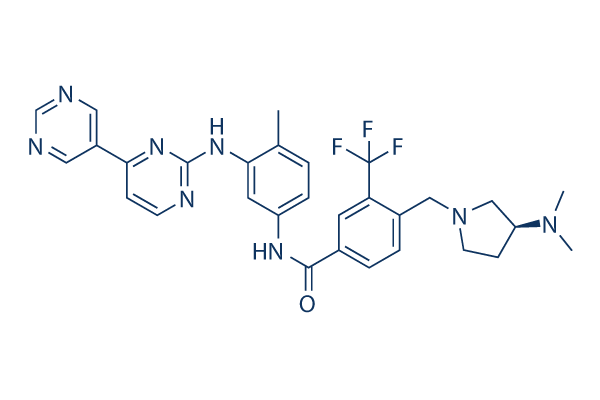
Chemische structuur
Moleculair gewicht: 576.62
Kwaliteitscontrole (Quality Control)
| Gerelateerde doelwitten | EGFR VEGFR JAK FGFR PDGFR Src HIF FLT3 HER2 FLT |
|---|---|
| Overige Bcr-Abl Inhibitoren | Degrasyn (WP1130) Rebastinib (DCC-2036) GNF-5 Berbamine GNF-2 Olverembatinib dimesylate (GZD824) PD173955 GNF-7 Berbamine dihydrochloride Radotinib |
Chemische informatie, Opslag en Stabiliteit (Chemical Information, Storage & Stability)
| Moleculair gewicht | 576.62 | Formule | C30H31F3N8O |
Opslag (Vanaf de ontvangstdatum) | |
|---|---|---|---|---|---|
| CAS-nr. | 859212-16-1 | SDF downloaden SDF downloaden | Opslag van stamoplossingen |
|
|
| Synoniemen | INNO-406, NS-187 | Smiles | CC1=C(C=C(C=C1)NC(=O)C2=CC(=C(C=C2)CN3CCC(C3)N(C)C)C(F)(F)F)NC4=NC=CC(=N4)C5=CN=CN=C5 | ||
Oplosbaarheid (Solubility)
|
In vitro |
DMSO
: 100 mg/mL
(173.42 mM)
Water : Insoluble Ethanol : Insoluble |
Molariteitscalculator
|
In vivo |
|||||
In vivo Formuleringscalculator (Heldere oplossing)
Stap 1: Voer de onderstaande informatie in (Aanbevolen: Een extra dier voor het geval van verlies tijdens het experiment)
Stap 2: Voer de in vivo formulering in (Dit is alleen de calculator, geen formulering. Neem eerst contact met ons op als er geen in vivo formulering is in het gedeelte Oplosbaarheid.)
Berekeningsresultaten:
Werkconcentratie: mg/ml;
Methode voor het bereiden van DMSO-mastervloeistof: mg geneesmiddel vooraf opgelost in μL DMSO ( Concentratie mastervloeistof mg/mL, Neem eerst contact met ons op als de concentratie de DMSO-oplosbaarheid van de partij geneesmiddel overschrijdt. )
Methode voor het bereiden van in vivo formulering: Neem μL DMSO mastervloeistof, voeg vervolgens toeμL PEG300, mengen en helder maken, voeg vervolgens toeμL Tween 80, mengen en helder maken, voeg vervolgens toe μL ddH2O, mengen en helder maken.
Methode voor het bereiden van in vivo formulering: Neem μL DMSO mastervloeistof, voeg vervolgens toe μL Maïsolie, mengen en helder maken.
Opmerking: 1. Zorg ervoor dat de vloeistof helder is voordat u het volgende oplosmiddel toevoegt.
2. Zorg ervoor dat u het/de oplosmiddel(en) in de juiste volgorde toevoegt. U moet ervoor zorgen dat de verkregen oplossing, bij de vorige toevoeging, een heldere oplossing is voordat u verdergaat met het toevoegen van het volgende oplosmiddel. Fysische methoden zoals vortexen, echografie of een warmwaterbad kunnen worden gebruikt om het oplossen te bevorderen.
Werkingsmechanisme (Mechanism of Action)
| Kenmerken |
Dual Bcr-Abl/Lyn inhibitor.
|
|---|---|
| Targets/IC50/Ki |
Abl
(Cell-free assay) 5.8 nM
Lyn
(Cell-free assay) 19 nM
|
| In vitro |
Bafetinib blocks WT Bcr-Abl autophosphorylation and its downstream kinase activity with IC50 of 11 nM and 22 nM in K562 and 293T cells, respectively. This compound suppresses the growth of the Bcr-Abl-positive cell lines including K562, KU812, and BaF3/wt cells potently without effects on the proliferation of the Bcr-Abl-negative U937 cell line. Moreover, it exhibits a dose-dependent antiproliferative effect against Bcr-Abl point mutant cell lines, such as BaF3/E255K cells. In Bcr-Abl+ leukemia cell lines, this chemical induces both caspase-mediated and caspase-independent cell death by blocking the phosphorylation of Bcr-Abl. |
| Kinase Assay |
Kinase-assay
|
|
Bcr-Abl-kinase-assays worden uitgevoerd in 25 μL reactiemengsel dat 250 μM peptidesubstraat, 740 Bq/μL [γ-33P]ATP en 20 μM koud adenosinetrifosfaat (ATP) bevat, met behulp van het SignaTECT-proteïnetyrosinekinase-assaysysteem. Elk Bcr-Abl-kinase wordt gebruikt in een concentratie van 10 nM. Kinase-assays voor Abl, Src en Lyn worden uitgevoerd met een enzym-linked immunosorbent assay (ELISA)-kit. De remmende effecten van deze verbinding tegen 79 tyrosinkinasen worden getest met KinaseProfiler.
|
|
| In vivo |
In Bcr-Abl–positive KU812 mouse model, Bafetinib (0.2 mg/kg/day) significantly inhibits tumor growth, and completely inhibits tumor growth without adverse effects at 20 mg/kg/day. For Balb/c mice, this compound shows maximal tolerated dose of 200 mg/kg/d and bioavailability value (BA) of 32%. In a Central nervous system (CNS) leukemia model bearing Ba/F3/wt bcr-ablGFP, Ba/F3/Q252H, or Ba/F3/M351T cells, combination treatment of this chemical (60 mg/kg) and CsA (50 mg/kg) leads to more significant inhibition of leukemia growth in the brain than either this compound or CsA alone. |
Referenties |
|
Informatie klinische proef (Clinical Trial Information)
(gegevens van https://clinicaltrials.gov, bijgewerkt op 2018-04-17)
| NCT-nummer | Rekrutering | Aandoeningen | Sponsor/Medewerkers | Startdatum | Fasen |
|---|---|---|---|---|---|
| NCT01234740 | COMPLETED | Adult Anaplastic Astrocytoma; Adult Anaplastic Ependymoma; Adult Anaplastic Oligodendroglioma; Adult Giant Cell Glioblastoma; Adult Glioblastoma; Adult Gliosarcoma; Adult Mixed Glioma; Recurrent Adult Brain Tumor; Tumors Metastatic to Brain; Adult Anaplastic Oligoastrocytoma |
City of Hope Medical Center |
2010-12 | PHASE1 |
| NCT01144260 | COMPLETED | B-Cell Chronic Lymphocytic Leukemia |
CytRx |
2010-06 | PHASE2 |
| NCT01215799 | COMPLETED | Hormone Refractory Prostate Cancer |
CytRx |
2010-08 | PHASE2 |
| NCT00352677 | Completed | Chronic Myeloid Leukemia|Acute Lymphocytic Leukemia |
CytRx |
2006-07 | Phase 1 |
Veelgestelde vragen (Frequently Asked Questions)
Vraag 1:
Can you suggest the route of in vivo administration for it?
Antwoord:
It is fine for oral gavage when suspended in 0.5% methylcellulose+0.2% Tween 80 at 30mg/ml. If you dissolved this compound in 0.5% methyl cellulose and got a suspension, it is fine. And 0.2% Tween 80 can help the suspension dissolving more homogeneous.

Producten zijn uitsluitend voor onderzoeksdoeleinden. Niet voor menselijk gebruik. Wij verkopen niet aan patiënten.
©Copyright 2013 Selleck Chemicals. Alle rechten voorbehouden.