
uitsluitend voor onderzoeksdoeleinden
Arbidol HCl Influenza Virus Remmer
Cat.Nr.: S2120
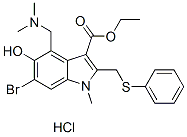
Chemische structuur
Moleculair gewicht: 513.88
Kwaliteitscontrole (Quality Control)
| Gerelateerde doelwitten | Integrase Bacterial Antibiotics Anti-infection Fungal Antiviral COVID-19 Parasite Reverse Transcriptase HIV |
|---|---|
| Overige Influenza Virus Inhibitoren | Nucleozin Cetylpyridinium chloride monohydrate D-Pinitol (-)-Arctigenin Adamantane Chebulinic acid |
Chemische informatie, Opslag en Stabiliteit (Chemical Information, Storage & Stability)
| Moleculair gewicht | 513.88 | Formule | C22H25BrN2O3S.HCl |
Opslag (Vanaf de ontvangstdatum) | |
|---|---|---|---|---|---|
| CAS-nr. | 131707-23-8 | SDF downloaden | Opslag van stamoplossingen |
|
|
| Synoniemen | Umifenovir hydrochloride, Arbidol hydrochloride | Smiles | CCOC(=O)C1=C(N(C2=CC(=C(C(=C21)CN(C)C)O)Br)C)CSC3=CC=CC=C3.Cl | ||
Oplosbaarheid (Solubility)
|
In vitro |
DMSO
: 100 mg/mL
(194.59 mM)
Ethanol : 50 mg/mL Water : Insoluble |
Molariteitscalculator
|
In vivo |
|||||
In vivo Formuleringscalculator (Heldere oplossing)
Stap 1: Voer de onderstaande informatie in (Aanbevolen: Een extra dier voor het geval van verlies tijdens het experiment)
Stap 2: Voer de in vivo formulering in (Dit is alleen de calculator, geen formulering. Neem eerst contact met ons op als er geen in vivo formulering is in het gedeelte Oplosbaarheid.)
Berekeningsresultaten:
Werkconcentratie: mg/ml;
Methode voor het bereiden van DMSO-mastervloeistof: mg geneesmiddel vooraf opgelost in μL DMSO ( Concentratie mastervloeistof mg/mL, Neem eerst contact met ons op als de concentratie de DMSO-oplosbaarheid van de partij geneesmiddel overschrijdt. )
Methode voor het bereiden van in vivo formulering: Neem μL DMSO mastervloeistof, voeg vervolgens toeμL PEG300, mengen en helder maken, voeg vervolgens toeμL Tween 80, mengen en helder maken, voeg vervolgens toe μL ddH2O, mengen en helder maken.
Methode voor het bereiden van in vivo formulering: Neem μL DMSO mastervloeistof, voeg vervolgens toe μL Maïsolie, mengen en helder maken.
Opmerking: 1. Zorg ervoor dat de vloeistof helder is voordat u het volgende oplosmiddel toevoegt.
2. Zorg ervoor dat u het/de oplosmiddel(en) in de juiste volgorde toevoegt. U moet ervoor zorgen dat de verkregen oplossing, bij de vorige toevoeging, een heldere oplossing is voordat u verdergaat met het toevoegen van het volgende oplosmiddel. Fysische methoden zoals vortexen, echografie of een warmwaterbad kunnen worden gebruikt om het oplossen te bevorderen.
Werkingsmechanisme (Mechanism of Action)
| In vitro |
Arbidol inhibits the cell entry of HCV pseudoparticles of genotypes 1a, 1b, and 2a in a dose-dependent fashion. Arbidol also displays a dose-dependent inhibition of HCV membrane fusion, as assayed by using HCV pseudoparticles (HCVpp) and fluorescent liposomes. Arbidol is found to present potent inhibitory activity against enveloped and non-enveloped RNA viruses, including FLU-A, RSV, HRV 14 and CVB3 when added before, during, or after viral infection, with IC50 ranging from 2.7 to 13.8 mg/mL. Arbidol shows selective antiviral activity against AdV-7, a DNA virus, only when added after infection (therapeutic index (TI) = 5.5). Arbidol induces changes to viral mRNA synthesis of the PB2, PA, NP, NA, and NS genes in MDCK cultures infected with influenza A/PR/8/34. Arbidol interacts and modifies the physicochemical properties of the phospholipids in the membrane, having a significant effect on negatively charged phospholipids but a minor one on zwitterionic phospholipids. Arbidol is located at the interface of the membrane, participates in hydrogen bonding either with water or the phospholipid or both, and decreases the hydrogen bonding network of the phospholipids giving place to a phospholipid phase similar to the dehydrated solid one. Arbidol is found to have potent inhibitory activity against HTNV when added in vitro before or after viral infection, with IC50 of 0.9 mg/mL and 1.2 mg/mL, respectively.
|
Referenties |
|
|---|
Informatie klinische proef (Clinical Trial Information)
(gegevens van https://clinicaltrials.gov, bijgewerkt op 2024-05-22)
| NCT-nummer | Rekrutering | Aandoeningen | Sponsor/Medewerkers | Startdatum | Fasen |
|---|---|---|---|---|---|
| NCT01651663 | Unknown status | Influenza |
Pharmstandard |
2011-09 | Phase 4 |

Producten zijn uitsluitend voor onderzoeksdoeleinden. Niet voor menselijk gebruik. Wij verkopen niet aan patiënten.
©Copyright 2013 Selleck Chemicals. Alle rechten voorbehouden.