
uitsluitend voor onderzoeksdoeleinden
Apigenin P450 (e.g. CYP17) Remmer
Cat.Nr.: S2262
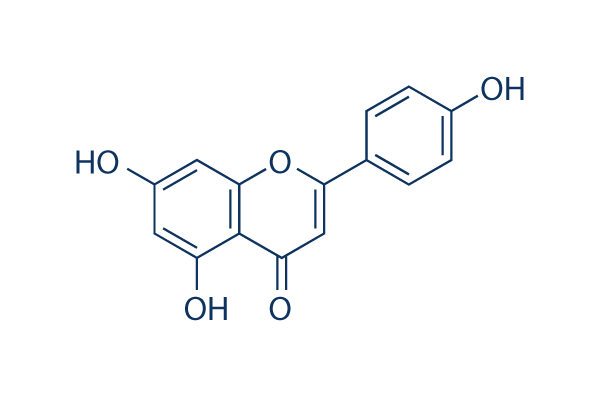
Chemische structuur
Moleculair gewicht: 270.24
Kwaliteitscontrole (Quality Control)
| Gerelateerde doelwitten | Dehydrogenase HSP Transferase PDE phosphatase PPAR Vitamin Carbohydrate Metabolism Mitochondrial Metabolism Casein Kinase |
|---|---|
| Overige P450 (e.g. CYP17) Inhibitoren | Baicalein Naringenin Diosmetin Alizarin Orteronel Benzbromarone Sodium Danshensu Naringin Piperine Danshensu |
Celkweek, behandeling & werkconcentratie
(Cell Culture, Treatment & Working Concentration)
| Cellijnen | Assaytype | Concentratie | Incubatietijd | Formulering | Activiteitsbeschrijving | PMID |
|---|---|---|---|---|---|---|
| mouse RAW264.7 cells | Function assay | Inhibition of COX2 protein expression in mouse RAW264.7 cells, IC50=0.5 μM | ||||
| human H295R cells | Function assay | Inhibition of aromatase expressed in human H295R cells, IC50=1 μM | ||||
| HEK293 FS cells | Function assay | Inhibition of NOX4 expressed in HEK293 FS cells assessed as H2O2 production by H2O2/Tyr/LPO assay, IC50=1.13 μM | ||||
| human HeLa cells | Function assay | Inhibition of MRP1 transfected in human HeLa cells assessed as inhibition of [3H]LTC4 transport by rapid filtration assay, Ki=2.4 μM | ||||
| human MV4-11 cells | Cytotoxicity assay | 72 h | Cytotoxicity against human MV4-11 cells harboring FLT3 mutation after 72 hrs by tetrazolium based Ez CyTox cell viability assay, GI50=2.81 μM | |||
| human mast cells | Function assay | Inhibition of SYK in human mast cells assessed as reduction in mast cell degranulation, EC50=3 μM | ||||
| MDCK cells | Function assay | Inhibition of BCRP expressed in MDCK cells using Hoechst 33342 staining, IC50=3.1 μM | ||||
| human MDA-kb2 cells | Function assay | Antagonist activity at androgen receptor in human MDA-kb2 cells assessed as inhibition of DHT-induced luciferase activity by luciferase reporter gene assay, IC50=5.2 μM | ||||
| MCF-7 MX cells | Function assay | Inhibition of BCRP expressed in MCF-7 MX cells using Hoechst 33342 staining, IC50=5.9 μM | ||||
| mouse RAW264.7 cells | Function assay | 24 h | Antiinflammatory activity against mouse RAW264.7 cells assessed as inhibition of LPS-induced nitrite accumulation after 24 hrs by Griess reagent method, IC50=6.7 μM | |||
| human H9 cells | Function assay | 3 days | Antiviral activity against HIV1 3B infected in human H9 cells assessed as inhibition of viral replication after 3 days by p24 antigen capture assay, EC50=9 μM | |||
| HEK293 cells | Function assay | 24 h | Agonist activity at mouse PPARgamma expressed in HEK293 cells co-expressing with Gal4 reporter vector after 24 hrs by dual-luciferase reporter assay, EC50=24.9 μM | |||
| mouse 26-L5 cells | Proliferation assay | 72 h | Antiproliferative activity against mouse 26-L5 cells after 72 hrs by MTT assay, EC50=25 μM | |||
| human RS4:11 cells | Cytotoxicity assay | 72 h | Cytotoxicity against human RS4:11 cells harboring wild type FLT3 after 72 hrs by tetrazolium based Ez CyTox cell viability assay, GI50=27.9 μM | |||
| mouse B16-BL6 cells | Proliferation assay | 72 h | Antiproliferative activity against mouse B16-BL6 cells after 72 hrs by MTT assay, EC50=31.6 μM | |||
| human H9 cells | Cytotoxicity assay | 3 days | Cytotoxicity against human H9 cells after 3 days, IC50=35 μM | |||
| human HT1080 cells | Proliferation assay | 72 h | Antiproliferative activity against human HT1080 cells after 72 hrs by MTT assay, IC | |||
| MDCK cells | Cytotoxicity assay | Cytotoxicity against MDCK cells by MTT assay, CC50=39.59 μM | ||||
| mouse L929 cells | Function assay | 15 mins | Potentiation of recombinant human TNF-alpha-induced cytotoxicity of mouse L929 cells assessed as survivality preincubated for 15 mins before TNFalpha addition measured after 24 hrs by crystal violet staining | |||
| human THP1 cells | Function assay | 20 uM | 1 h | Inhibition of NOX2 in human THP1 cells assessed as downregulation of TPA-induced CD36 mRNA expression at 20 uM incubated for 1 hr prior to TPA challenge measured after 24 hrs by RT-PCR analysis | ||
| MDA-MB-231 cells | Function assay | 5 uM | Inhibition of PMA-stimulated NF-kappaB signaling (unknown origin) expressed in MDA-MB-231 cells at 5 uM incubated for 16 hrs by luciferase reporter gene assay | |||
| Klik om meer experimentele gegevens over de cellijn te bekijken | ||||||
Chemische informatie, Opslag en Stabiliteit (Chemical Information, Storage & Stability)
| Moleculair gewicht | 270.24 | Formule | C15H10O5 |
Opslag (Vanaf de ontvangstdatum) | |
|---|---|---|---|---|---|
| CAS-nr. | 520-36-5 | SDF downloaden | Opslag van stamoplossingen |
|
|
Oplosbaarheid (Solubility)
|
In vitro |
DMSO
: 54 mg/mL
(199.82 mM)
Water : Insoluble Ethanol : Insoluble |
Molariteitscalculator
|
In vivo |
|||||
In vivo Formuleringscalculator (Heldere oplossing)
Stap 1: Voer de onderstaande informatie in (Aanbevolen: Een extra dier voor het geval van verlies tijdens het experiment)
Stap 2: Voer de in vivo formulering in (Dit is alleen de calculator, geen formulering. Neem eerst contact met ons op als er geen in vivo formulering is in het gedeelte Oplosbaarheid.)
Berekeningsresultaten:
Werkconcentratie: mg/ml;
Methode voor het bereiden van DMSO-mastervloeistof: mg geneesmiddel vooraf opgelost in μL DMSO ( Concentratie mastervloeistof mg/mL, Neem eerst contact met ons op als de concentratie de DMSO-oplosbaarheid van de partij geneesmiddel overschrijdt. )
Methode voor het bereiden van in vivo formulering: Neem μL DMSO mastervloeistof, voeg vervolgens toeμL PEG300, mengen en helder maken, voeg vervolgens toeμL Tween 80, mengen en helder maken, voeg vervolgens toe μL ddH2O, mengen en helder maken.
Methode voor het bereiden van in vivo formulering: Neem μL DMSO mastervloeistof, voeg vervolgens toe μL Maïsolie, mengen en helder maken.
Opmerking: 1. Zorg ervoor dat de vloeistof helder is voordat u het volgende oplosmiddel toevoegt.
2. Zorg ervoor dat u het/de oplosmiddel(en) in de juiste volgorde toevoegt. U moet ervoor zorgen dat de verkregen oplossing, bij de vorige toevoeging, een heldere oplossing is voordat u verdergaat met het toevoegen van het volgende oplosmiddel. Fysische methoden zoals vortexen, echografie of een warmwaterbad kunnen worden gebruikt om het oplossen te bevorderen.
Werkingsmechanisme (Mechanism of Action)
| Kenmerken |
Much more potent than kaempferol and myricetin in CT-L inhibition.
|
|---|---|
| Targets/IC50/Ki |
CYP2C9
2 μM(Ki)
|
| In vitro |
Apigenin inhibits PKC by competing with adenosine triphosphate (ATP). This compound also reduces the level of TPA-stimulated phosphorylation of cellular proteins and inhibits TPA-induced c-jun and c-fos expression. It exhibits the reverting effect on the transformed morphology of v-H-ras transformed NIH3T3 cells. It has been shown to possess anti-mutagenic properties in a setting of nitropyrene-induced genotoxicity in Chinese hamster ovary cells. This chemical suppresses of LPS-induced cyclooxygenase-2 and nitric oxide synthase-2 activity and expression in mouse macrophages. It has been reported to inhibit protein kinase C activity, mitogen-activated protein kinase (MAPK), transformation of C3HI mouse embryonic fibroblasts and downstream oncogenes in v-Ha-ras-transformed NIH3T3 cells. This compound blocks peroxisome proliferation-regulated kinase (ERK), a MAPK in isolated hepatocytes. It has further been shown to down-regulate the expression of the Na+/Ca2+-exchanger, a protein important for calcium extrusion in neonatal rat cardiac myocytes. It induces a reversible G2/M and G0/G1 arrest by inhibiting p34 (cdc2) kinase activity, accompanied by increased p53 protein stability in epidermal cells and fibroblasts. It is also effective in inhibiting TNFα-induced intracellular adhesion molecule-1 upregulation in cultured human endothelial cells. It inhibits the expression of HIF-1α and VEGF via the PI3K/Akt/p70S6K1 and HDM2/p53 pathways in human ovarian cancer cells. It inhibits differentiation by suppressing MAPK signal transduction and reducing API transcription factor level in human keratinocytes. This compound also inhibits proliferating of human keratinocytes.
|
| In vivo |
Apigenin down-regulates production of IL-4 in ovalbumin-immunized BALB/C mice. This compound inhibits melanoma lung metastases by impairing interaction of tumor cells with endothelium. It is shown to cause a significant increase in uterine weight and overall uterine concentration of estrogen receptor (ER)-α in female mice (64) and also suppresses prostate and breast cancer cell growth through estrogen receptor β1. This chemical suppresses the levels of IGF-I in prostate tumor xenografts and increases levels of IGFBP-3, a binding protein that sequesters IGF-I in vascular circulation. This compound (12.5 mg/kg) increases cell proliferation in the dentate gyrus of hippocampus of adult mice.
|
Referenties |
|
Toepassingen (Applications)
| Methoden | Biomarkers | Afbeeldingen | PMID |
|---|---|---|---|
| Western blot | MHC / MHC2A / MHC2B / MyoD CXCR4 CDK1 / Cyclin B1 / p21 |

|
29108230 |
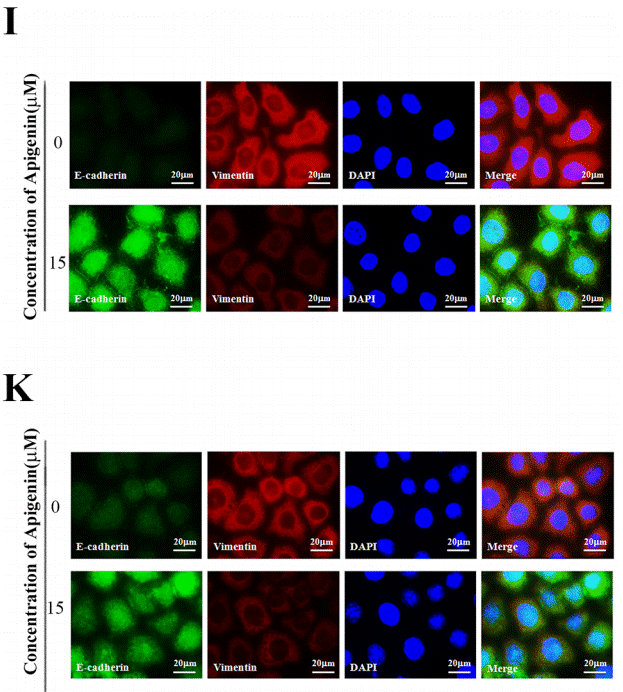
| Immunofluorescence | E-caherin / Vimentin Snail |
|
27203387 |
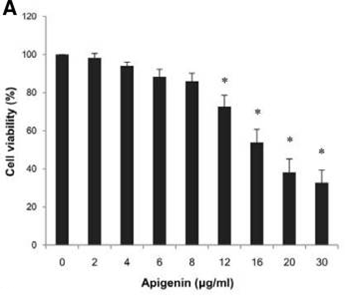
| Growth inhibition assay | Cell viability |
|
23224239 |
Informatie klinische proef (Clinical Trial Information)
(gegevens van https://clinicaltrials.gov, bijgewerkt op 2026-07-01)
| NCT-nummer | Rekrutering | Aandoeningen | Sponsor/Medewerkers | Startdatum | Fasen |
|---|---|---|---|---|---|
| NCT07678749 | ENROLLING_BY_INVITATION | Closed Sinus Lift; Apigenin Loaded Scaffold |
Al-Azhar University |
2025-11-05 | |
| NCT06889584 | COMPLETED | Healthy |
University of South Carolina |
2025-02-15 | |
| NCT05788705 | UNKNOWN | Rheumatoid Arthritis |
Adel A.Gomaa |
2023-07 | |
| NCT06560216 | COMPLETED | Healthy |
Chulalongkorn University |
2024-10-28 | |
| NCT05999682 | COMPLETED | Sepsis; Septic Shock |
Zhujiang Hospital |
2023-09-01 | PHASE1; PHASE2 |
| NCT05696665 | UNKNOWN | Parkinson Disease; Neurodegenerative Diseases |
Jinnah Postgraduate Medical Centre |
2022-07-05 |

Producten zijn uitsluitend voor onderzoeksdoeleinden. Niet voor menselijk gebruik. Wij verkopen niet aan patiënten.
©Copyright 2013 Selleck Chemicals. Alle rechten voorbehouden.