
uitsluitend voor onderzoeksdoeleinden
Allopurinol ROS Remmer
Cat.Nr.: S1630
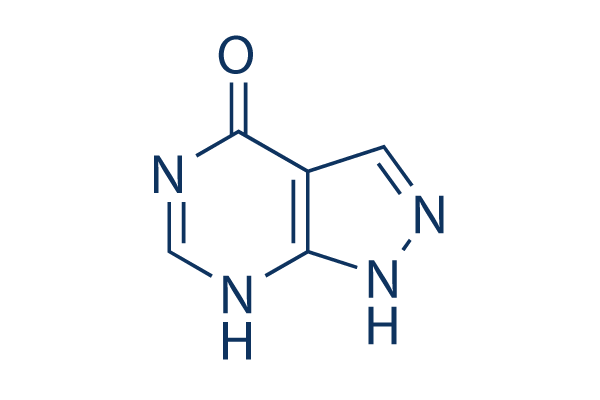
Chemische structuur
Moleculair gewicht: 136.11
Kwaliteitscontrole (Quality Control)
| Gerelateerde doelwitten | PD-1/PD-L1 CXCR STING AhR Immunology & Inflammation related CD markers Interleukins Anti-infection Antioxidant COX |
|---|---|
| Overige ROS Inhibitoren | MitoQ (Mitoquinone) Mesylate Piperlongumine H2DCFDA (DCFH-DA) Neohesperidin Gallic acid Pyrogallol Idebenone Disufenton sodium Troxerutin Carnosic acid |
Chemische informatie, Opslag en Stabiliteit (Chemical Information, Storage & Stability)
| Moleculair gewicht | 136.11 | Formule | C5H4N4O |
Opslag (Vanaf de ontvangstdatum) | |
|---|---|---|---|---|---|
| CAS-nr. | 315-30-0 | SDF downloaden | Opslag van stamoplossingen |
|
|
| Synoniemen | N/A | Smiles | C1=NNC2=C1C(=O)NC=N2 | ||
Oplosbaarheid (Solubility)
|
In vitro |
DMSO
: 27 mg/mL
(198.36 mM)
Ethanol : 3 mg/mL Water : Insoluble |
Molariteitscalculator
|
In vivo |
|||||
In vivo Formuleringscalculator (Heldere oplossing)
Stap 1: Voer de onderstaande informatie in (Aanbevolen: Een extra dier voor het geval van verlies tijdens het experiment)
Stap 2: Voer de in vivo formulering in (Dit is alleen de calculator, geen formulering. Neem eerst contact met ons op als er geen in vivo formulering is in het gedeelte Oplosbaarheid.)
Berekeningsresultaten:
Werkconcentratie: mg/ml;
Methode voor het bereiden van DMSO-mastervloeistof: mg geneesmiddel vooraf opgelost in μL DMSO ( Concentratie mastervloeistof mg/mL, Neem eerst contact met ons op als de concentratie de DMSO-oplosbaarheid van de partij geneesmiddel overschrijdt. )
Methode voor het bereiden van in vivo formulering: Neem μL DMSO mastervloeistof, voeg vervolgens toeμL PEG300, mengen en helder maken, voeg vervolgens toeμL Tween 80, mengen en helder maken, voeg vervolgens toe μL ddH2O, mengen en helder maken.
Methode voor het bereiden van in vivo formulering: Neem μL DMSO mastervloeistof, voeg vervolgens toe μL Maïsolie, mengen en helder maken.
Opmerking: 1. Zorg ervoor dat de vloeistof helder is voordat u het volgende oplosmiddel toevoegt.
2. Zorg ervoor dat u het/de oplosmiddel(en) in de juiste volgorde toevoegt. U moet ervoor zorgen dat de verkregen oplossing, bij de vorige toevoeging, een heldere oplossing is voordat u verdergaat met het toevoegen van het volgende oplosmiddel. Fysische methoden zoals vortexen, echografie of een warmwaterbad kunnen worden gebruikt om het oplossen te bevorderen.
Werkingsmechanisme (Mechanism of Action)
| Targets/IC50/Ki |
xanthine oxidase
|
|---|---|
| In vitro |
Allopurinol reverses the increased xanthine oxidase activity in ischemia-reperfusion injury of neonatal rat hearts. This compound (10 mM) treatment suppresses xanthine oxidase activity induced by hypoxia-reoxygenation injury and the production of reactive oxygen species. It also decreases the concentration of intracellular Ca2+ increased by enhanced xanthine oxidase activity.
|
| In vivo |
Allopurinol shows abnormal pyrimidine metabolism together with renal toxicity which could be ameliorated by uridine, indicating that this compound essentially causes pyrimidine metabolism abnormality leading to renal impairment in normal mice. It increases urinary OD excretion to an extent similar to that in normal mice administered the same dose of this chemical in DNFB-sensitized mice. This compound promotes a clinical improvement which is accompanied by a reduction in the parasitic load in the blood, skin and lymph nodes but, even after long period of allopurinol administration alone, Leishmania may persist in dog tissues in Leishmania-infected dogs. It prevents early alcohol-induced liver injury in rats, most likely by preventing oxidant-dependent activation of NF-kappaB. This chemical protects dose-dependently against acetaminophen-induced cell injury, the loss of ATP and the increase of the GSSG content in the total liver and in the mitochondrial compartment without inhibiting reactive metabolite formation in mice. It almost completely inhibits hepatic xanthine oxidase and dehydrogenase activity, but only high doses prevents the increase of the mitochondrial GSSG content.
|
Referenties |
|
Informatie klinische proef (Clinical Trial Information)
(gegevens van https://clinicaltrials.gov, bijgewerkt op 2025-09-25)
| NCT-nummer | Rekrutering | Aandoeningen | Sponsor/Medewerkers | Startdatum | Fasen |
|---|---|---|---|---|---|
| NCT04875702 | RECRUITING | Gout |
Massachusetts General Hospital |
2024-02-22 | PHASE4 |
| NCT04875702 | RECRUITING | Gout |
Massachusetts General Hospital |
2024-02-22 | PHASE4 |
| NCT05943821 | RECRUITING | Cardiovascular Diseases; Uric Acid |
Poznan University of Medical Sciences |
2023-09-01 | PHASE3 |
| NCT05943821 | RECRUITING | Cardiovascular Diseases; Uric Acid |
Poznan University of Medical Sciences |
2023-09-01 | PHASE3 |
| NCT05536349 | RECRUITING | Leukemia |
M.D. Anderson Cancer Center |
2022-12-20 | PHASE2 |
| NCT05536349 | RECRUITING | Leukemia |
M.D. Anderson Cancer Center |
2022-12-20 | PHASE2 |

Producten zijn uitsluitend voor onderzoeksdoeleinden. Niet voor menselijk gebruik. Wij verkopen niet aan patiënten.
©Copyright 2013 Selleck Chemicals. Alle rechten voorbehouden.