
uitsluitend voor onderzoeksdoeleinden
CBL0137 Hydrochloride p53 Activator
Cat.Nr.: S8483
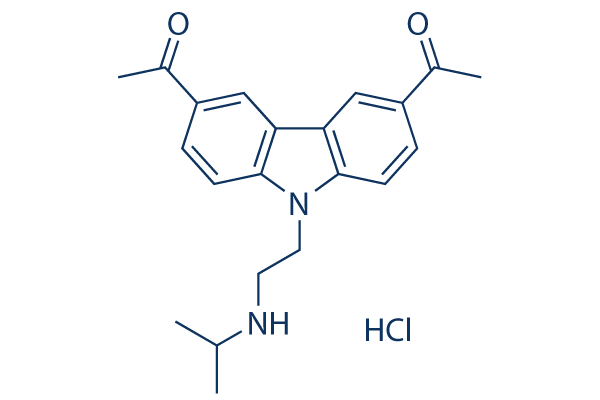
Chemische structuur
Moleculair gewicht: 372.89
Kwaliteitscontrole (Quality Control)
| Gerelateerde doelwitten | Bcl-2 Caspase PD-1/PD-L1 Ferroptosis Apoptosis related Synthetic Lethality STAT TNF-alpha Ras KRas |
|---|---|
| Overige p53 Inhibitoren | Eprenetapopt (APR-246) Pifithrin-α (PFTα) Hhydrobromide Pifithrin-μ RITA Serdemetan (JNJ-26854165) NSC 319726 (ZMC1) PRIMA-1 Tenovin-1 NSC59984 NSC348884 |
Chemische informatie, Opslag en Stabiliteit (Chemical Information, Storage & Stability)
| Moleculair gewicht | 372.89 | Formule | C21H24N2O2.HCl |
Opslag (Vanaf de ontvangstdatum) | |
|---|---|---|---|---|---|
| CAS-nr. | 1197397-89-9 | SDF downloaden | Opslag van stamoplossingen |
|
|
| Synoniemen | CBLC137 HCl, Curaxin 137 HCl | Smiles | CC(C)NCCN1C2=C(C=C(C=C2)C(=O)C)C3=C1C=CC(=C3)C(=O)C.Cl | ||
Oplosbaarheid (Solubility)
|
In vitro |
DMSO
: 20 mg/mL
(53.63 mM)
Water : 20 mg/mL Ethanol : Insoluble |
Molariteitscalculator
|
In vivo |
|||||
In vivo Formuleringscalculator (Heldere oplossing)
Stap 1: Voer de onderstaande informatie in (Aanbevolen: Een extra dier voor het geval van verlies tijdens het experiment)
Stap 2: Voer de in vivo formulering in (Dit is alleen de calculator, geen formulering. Neem eerst contact met ons op als er geen in vivo formulering is in het gedeelte Oplosbaarheid.)
Berekeningsresultaten:
Werkconcentratie: mg/ml;
Methode voor het bereiden van DMSO-mastervloeistof: mg geneesmiddel vooraf opgelost in μL DMSO ( Concentratie mastervloeistof mg/mL, Neem eerst contact met ons op als de concentratie de DMSO-oplosbaarheid van de partij geneesmiddel overschrijdt. )
Methode voor het bereiden van in vivo formulering: Neem μL DMSO mastervloeistof, voeg vervolgens toeμL PEG300, mengen en helder maken, voeg vervolgens toeμL Tween 80, mengen en helder maken, voeg vervolgens toe μL ddH2O, mengen en helder maken.
Methode voor het bereiden van in vivo formulering: Neem μL DMSO mastervloeistof, voeg vervolgens toe μL Maïsolie, mengen en helder maken.
Opmerking: 1. Zorg ervoor dat de vloeistof helder is voordat u het volgende oplosmiddel toevoegt.
2. Zorg ervoor dat u het/de oplosmiddel(en) in de juiste volgorde toevoegt. U moet ervoor zorgen dat de verkregen oplossing, bij de vorige toevoeging, een heldere oplossing is voordat u verdergaat met het toevoegen van het volgende oplosmiddel. Fysische methoden zoals vortexen, echografie of een warmwaterbad kunnen worden gebruikt om het oplossen te bevorderen.
Werkingsmechanisme (Mechanism of Action)
| Targets/IC50/Ki |
FACT
p53
(Cell-free assay) 0.37 μM(EC50)
NF-κB
(Cell-free assay) 0.47 μM(EC50)
|
|---|---|
| In vitro |
CBL0137 is a potent inducer of apoptosis in pancreatic cancer cell lines and is toxic not only for proliferating bulk tumor cells, but also for pancreatic cancer stem cells. CBL0137 and related molecules can simultaneously activate p53 and inhibit cellular stress pathways mediated by NF-κB and HSF-1. CBL0137 binds DNA but does not cause any sort of chemical modifications in DNA and therefore lacks genotoxicity. However, CBL0137 binding to DNA leads to functional inactivation of the Facilitates Chromatin Transcription (FACT) complex, a chromatin remodeling complex involved in transcription, replication, and DNA repair. In CBL0137-treated cells, FACT is lost from the nucleoplasm and trapped in chromatin, resulting in the inhibition of FACT-dependent transcription, including NF-kB-mediated transcription. Additionally, chromatin trapping of FACT leads to casein kinase 2 (CK2)-dependent phosphorylation and activation of p53. |
| In vivo |
In mice, CBL0137 is effective against several Pancreatic ductal adenocarcinoma (PDA) models, including patient derived xenografts, in which CBL0137 anti-tumor effect correlated with overexpression of FACT. CBL0137 targets glioblastoma (GBM) according to its proposed mechanism of action, crosses the blood-brain barrier, and is efficacious in both TMZ-responsive and -resistant orthotopic models. The property of crossing the blood-brain barrier, especially when administered i.v, bodes well for the potential of this drug to treat CNS tumors. In orthotopic models, i.v. administration leads to greater tumor tissue accumulation than oral dosing, leading to greater bioavailability. Normal brain tissue accumulation of CBL0137 does not cause observable neurotoxicity. |
Referenties |
|
Toepassingen (Applications)
| Methoden | Biomarkers | Afbeeldingen | PMID |
|---|---|---|---|
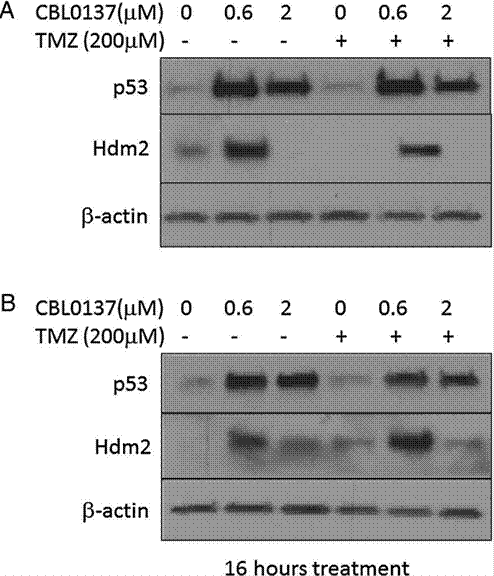
| Western blot | p53 / Hdm2 caspase-3 / caspase-7 / caspase-8 / caspase-9 / PARP |
|
27370399 |
Informatie klinische proef (Clinical Trial Information)
(gegevens van https://clinicaltrials.gov, bijgewerkt op 2026-05-22)
| NCT-nummer | Rekrutering | Aandoeningen | Sponsor/Medewerkers | Startdatum | Fasen |
|---|---|---|---|---|---|
| NCT05498792 | RECRUITING | Locally Advanced or Metastatic Melanoma |
Fox Chase Cancer Center |
2022-11-30 | EARLY_PHASE1 |
| NCT04870944 | SUSPENDED | Diffuse Midline Glioma, H3 K27-Altered; Metastatic Malignant Neoplasm in the Central Nervous System; Recurrent Diffuse Intrinsic Pontine Glioma; Recurrent Diffuse Midline Glioma, H3 K27-Altered; Recurrent Lymphoma; Recurrent Malignant Solid Neoplasm; Recurrent Primary Malignant Central Nervous System Neoplasm; Refractory Lymphoma; Refractory Malignant Solid Neoplasm; Refractory Primary Malignant Central Nervous System Neoplasm |
Children's Oncology Group |
2022-01-28 | PHASE1; PHASE2 |
| NCT03727789 | TERMINATED | Advanced Cutaneous Melanoma of the Extremity; Advanced Sarcoma of the Extremity; Clinical Stage III Cutaneous Melanoma AJCC v8; Clinical Stage IV Cutaneous Melanoma AJCC v8; Pathologic Stage IIIB Cutaneous Melanoma AJCC v8; Pathologic Stage IIIC Cutaneous Melanoma AJCC v8; Pathologic Stage IV Cutaneous Melanoma AJCC v8; Recurrent Cutaneous Melanoma of the Extremity; Recurrent Sarcoma of the Extremity; Stage III Soft Tissue Sarcoma of the Trunk and Extremities AJCC v8; Stage IIIA Soft Tissue Sarcoma of the Trunk and Extremities AJCC v8; Stage IIIB Soft Tissue Sarcoma of the Trunk and Extremities AJCC v8; Stage IV Soft Tissue Sarcoma of the Trunk and Extremities AJCC v8 |
Roswell Park Cancer Institute |
2019-07-01 | PHASE1 |
| NCT02931110 | TERMINATED | Hematological Malignancies |
Incuron |
2017-01 | PHASE1 |
| NCT01905228 | COMPLETED | Solid Tumors; Glioblastoma |
Incuron |
2013-07 | PHASE1 |

Producten zijn uitsluitend voor onderzoeksdoeleinden. Niet voor menselijk gebruik. Wij verkopen niet aan patiënten.
©Copyright 2013 Selleck Chemicals. Alle rechten voorbehouden.