
uitsluitend voor onderzoeksdoeleinden
Gabapentin GABA Receptor Agonist
Cat.Nr.: S2133
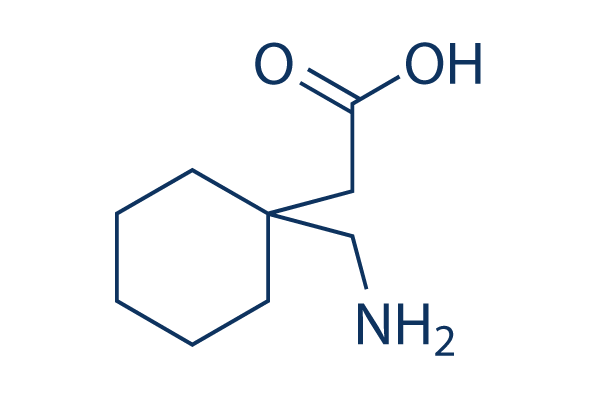
Chemische structuur
Moleculair gewicht: 171.24
Kwaliteitscontrole (Quality Control)
| Gerelateerde doelwitten | Adrenergic Receptor AChR 5-HT Receptor COX Calcium Channel Histamine Receptor Dopamine Receptor TRP Channel Cholinesterase (ChE) GluR |
|---|---|
| Overige GABA Receptor Inhibitoren | Dihydromyricetin CGP52432 Pentylenetetrazol 4-Aminobutyric acid (GABA) Oxiracetam Ginkgolide A (+)-Borneol (-)-Borneol Fluralaner Emamectin Benzoate |
Chemische informatie, Opslag en Stabiliteit (Chemical Information, Storage & Stability)
| Moleculair gewicht | 171.24 | Formule | C9H17NO2 |
Opslag (Vanaf de ontvangstdatum) | |
|---|---|---|---|---|---|
| CAS-nr. | 60142-96-3 | SDF downloaden | Opslag van stamoplossingen |
|
|
| Synoniemen | N/A | Smiles | C1CCC(CC1)(CC(=O)O)CN | ||
Oplosbaarheid (Solubility)
|
In vitro |
Water : 34.2 mg/mL Ethanol : 3 mg/mL
DMSO
: Insoluble
|
Molariteitscalculator
|
In vivo |
|||||
In vivo Formuleringscalculator (Heldere oplossing)
Stap 1: Voer de onderstaande informatie in (Aanbevolen: Een extra dier voor het geval van verlies tijdens het experiment)
Stap 2: Voer de in vivo formulering in (Dit is alleen de calculator, geen formulering. Neem eerst contact met ons op als er geen in vivo formulering is in het gedeelte Oplosbaarheid.)
Berekeningsresultaten:
Werkconcentratie: mg/ml;
Methode voor het bereiden van DMSO-mastervloeistof: mg geneesmiddel vooraf opgelost in μL DMSO ( Concentratie mastervloeistof mg/mL, Neem eerst contact met ons op als de concentratie de DMSO-oplosbaarheid van de partij geneesmiddel overschrijdt. )
Methode voor het bereiden van in vivo formulering: Neem μL DMSO mastervloeistof, voeg vervolgens toeμL PEG300, mengen en helder maken, voeg vervolgens toeμL Tween 80, mengen en helder maken, voeg vervolgens toe μL ddH2O, mengen en helder maken.
Methode voor het bereiden van in vivo formulering: Neem μL DMSO mastervloeistof, voeg vervolgens toe μL Maïsolie, mengen en helder maken.
Opmerking: 1. Zorg ervoor dat de vloeistof helder is voordat u het volgende oplosmiddel toevoegt.
2. Zorg ervoor dat u het/de oplosmiddel(en) in de juiste volgorde toevoegt. U moet ervoor zorgen dat de verkregen oplossing, bij de vorige toevoeging, een heldere oplossing is voordat u verdergaat met het toevoegen van het volgende oplosmiddel. Fysische methoden zoals vortexen, echografie of een warmwaterbad kunnen worden gebruikt om het oplossen te bevorderen.
Werkingsmechanisme (Mechanism of Action)
| Targets/IC50/Ki |
GABA receptor
|
|---|---|
| In vitro |
Gabapentin produces concentration-dependent inhibitions of the K(+)-induced [Ca(2+)](i) increase in fura-2-loaded human neocortical synaptosomes with IC50 of 17 mM and maximal inhibition of 37%. This compound may bind to the Ca(2+) channel alpha 2 delta subunit to selectively attenuate depolarization-induced Ca(2+) influx of presynaptic P/Q-type Ca(2+) channels; this results in decreased glutamate/aspartate release from excitatory amino acid nerve terminals leading to a reduced activation of AMPA heteroreceptors on noradrenergic nerve terminals. It produces alterations in the cytosolic and extracellular concentrations of several amino acids, including L-leucine, L-valine and L-phenylalanine, in rat cortical astrocytes and synaptosomes, effects that are postulated to be of pharmacological significance. This chemical reduces potassium-evoked calcium influx via voltage-gated calcium channels in a mouse pituitary cell line that constitutively expresses GABAB receptors comprising the functional gb1a–gb2 subunit heterodimer. It can increase N-methyl-d-aspartate (NMDA)-evoked currents in GABA-positive rat dorsal horn neurones in the presence of protein kinase C, possibly by increasing the glycine sensitivity of the NMDA receptor complex. This agent produces a delayed allosteric enhancement of an unspecified voltage-activated potassium current in rat dorsal root ganglion neurons.
|
| In vivo |
Gabapentin dose-dependently (10-100 mg/kg, p.o.) blocks both static and dynamic allodynia in the rats.
|
Referenties |
|
Informatie klinische proef (Clinical Trial Information)
(gegevens van https://clinicaltrials.gov, bijgewerkt op 2024-05-22)
| NCT-nummer | Rekrutering | Aandoeningen | Sponsor/Medewerkers | Startdatum | Fasen |
|---|---|---|---|---|---|
| NCT04613024 | Not yet recruiting | Weight Loss|Pain Postoperative |
Stanford University |
2023-07-01 | Early Phase 1 |
| NCT05276089 | Not yet recruiting | Opioid Use |
Dr Yu Fu|Teesside University|NIHR Applied Research Collaboration for North East and North Cumbria|North East Academic Health Science Network|Newcastle University |
2023-02-01 | Not Applicable |
| NCT05609682 | Recruiting | Post Operative Pain |
University of Oklahoma |
2022-11-29 | Early Phase 1 |
| NCT05750875 | Completed | Pruritus|Uremia|Chronic Kidney Diseases |
King Edward Medical University |
2022-05-01 | Phase 4 |

Producten zijn uitsluitend voor onderzoeksdoeleinden. Niet voor menselijk gebruik. Wij verkopen niet aan patiënten.
©Copyright 2013 Selleck Chemicals. Alle rechten voorbehouden.