
Technische gegevens
| Formule | C34H44N4O4 |
||||||
| Molecuulgewicht | 572.74 | CAS-nr. | 1403254-99-8 | ||||
| Oplosbaarheid (25°C)* | In vitro | DMSO | 100 mg/mL (174.59 mM) | ||||
| Water | Insoluble | ||||||
| Ethanol | Insoluble | ||||||
| In Vivo (Voeg oplosmiddelen afzonderlijk en in volgorde toe aan het product.) |
|
||||||
|
* <1 mg/ml betekent licht oplosbaar of onoplosbaar. * Houd er rekening mee dat Selleck de oplosbaarheid van alle verbindingen intern test en de werkelijke oplosbaarheid enigszins kan afwijken van gepubliceerde waarden. Dit is normaal en is te wijten aan lichte batch-tot-batch variaties. * Verzending op kamertemperatuur (Stabiliteitstests tonen aan dat dit product zonder koelmaatregelen kan worden verzonden.) |
|||||||
Voorbereiden van stamoplossingen
Biologische activiteit
| Beschrijving | Tazemetostat (EPZ-6438, E7438) is een potente en selectieve EZH2-remmer met Ki en IC50 van 2,5 nM en 11 nM in celvrije assays, wat een 35-voudige selectiviteit ten opzichte van EZH1 en >4.500-voudige selectiviteit ten opzichte van 14 andere HMT's vertoont. | ||
|---|---|---|---|
| Doelen |
|
||
| In vitro | Tazemetostat (EPZ-6438) vermindert concentratie-afhankelijk de globale H3K27Me3-niveaus in wildtype- of SMARCB1-mutantcellen, en induceert sterke antiproliferatieve effecten met IC50 variërend van 32 nM tot 1000 nM in SMARCB1-gedeleteerde MRT-cellijnen. Het induceert genexpressie van neuronale differentiatie en celcyclusremming, terwijl het de expressie van Hedgehog pathway-genen, MYC en EZH2 remt. Het antiproliferatieve effect van deze verbinding wordt versterkt door ofwel NSC-9900 of Hexadecadrol in verschillende EZH2-mutante lymfoomcellijnen. |
||
| In Vivo | Bij SCID-muizen met s.c. G401-xenografts induceert Tazemetostat (EPZ-6438) tumorstase tijdens de toedieningsperiode en produceert een significante vertraging van de tumorgroei met minimale invloed op het lichaamsgewicht. |
||
| Functies | Oraal biologisch beschikbare EZH2-selectieve remmer voor zowel wildtype als mutante. Wordt momenteel getest in fase II klinische studies voor de behandeling van diffuus grootcellig B-cellymfoom. |
Protocol (uit referentie)
| Kinase-assay: |
|
|---|---|
| Celassay: |
|
| Dierstudie: |
|
Referenties
|
Klantproductvalidatie
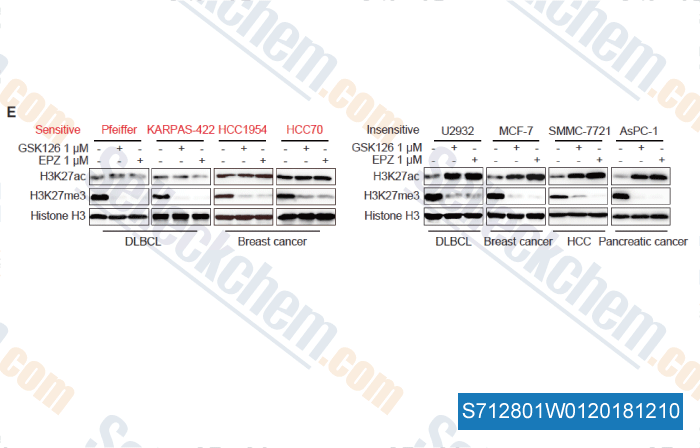
-
Gegevens van [ , , Cell, 2018, 175(1):186-199 ]
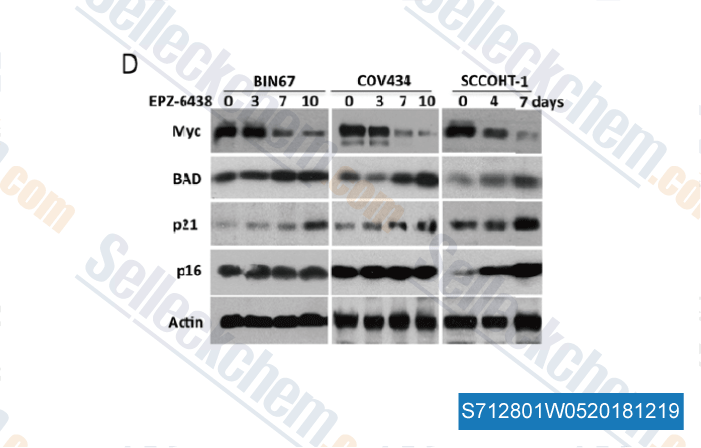
-
Gegevens van [ , , J Pathol, 2017, 242(3):371-383 ]
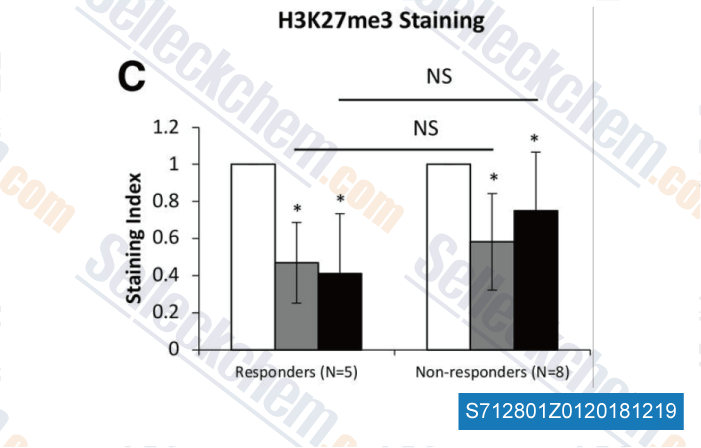
-
Gegevens van [ , , Clin Epigenetics, 2018, 10(1):121 ]
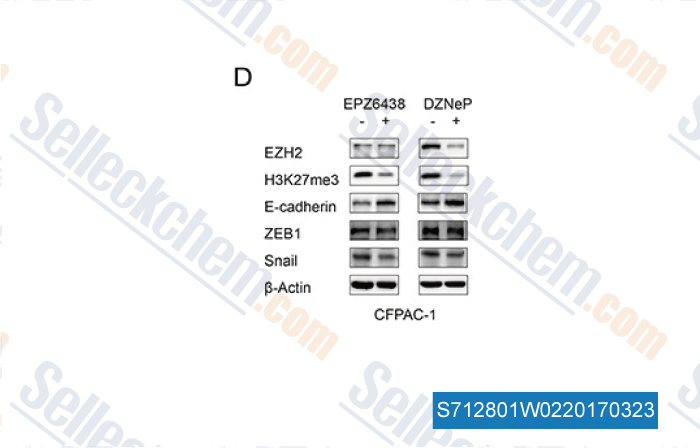
-
Gegevens van [ , , Oncotarget, 2016, 7(10):11194-207 ]
Sellecks EPZ-6438 (Tazemetostat) Is geciteerd door 189 Publicaties
| Whole-exome tumor-agnostic ctDNA analysis enhances minimal residual disease detection and reveals relapse mechanisms in localized colon cancer [ Nat Cancer, 2025, 10.1038/s43018-025-00960-z] | PubMed: 40301653 |
| Genome-wide CRISPR screen identifies Menin and SUZ12 as regulators of human developmental timing [ Nat Cell Biol, 2025, 27(9):1411-1421] | PubMed: 40897805 |
| Microprotein PLUM encoded by Lin28b uORF is a cytoplasmic determinant of pluripotency and embryonic development [ Nat Commun, 2025, 16(1):10324] | PubMed: 41298451 |
| Single cell suppression profiling of human regulatory T cells [ Nat Commun, 2025, 16(1):1325] | PubMed: 39900891 |
| Constitutive expression of the transcriptional co-activator IκBζ promotes melanoma growth and immunotherapy resistance [ Nat Commun, 2025, 16(1):5387] | PubMed: 40562773 |
| HIF-independent oxygen sensing via KDM6A regulates ferroptosis [ Mol Cell, 2025, 85(15):2973-2987.e6] | PubMed: 40712585 |
| A specific form of cPRC1 containing CBX4 is co-opted to mediate oncogenic gene repression in diffuse midline glioma [ Mol Cell, 2025, 85(11):2110-2127.e7] | PubMed: 40403727 |
| The NEXT complex regulates H3K27me3 levels to affect cancer progression by degrading G4/U-rich lncRNAs [ Nucleic Acids Res, 2025, 53(4)gkaf107] | PubMed: 39988317 |
| Differential regulation of FADS2 by EZH2 reveals a metabolic vulnerability in ovarian cancer treatment [ EBioMedicine, 2025, 119:105879] | PubMed: 40818202 |
| EZH2 inhibition mitigates HIV immune evasion, reduces reservoir formation, and promotes skewing of CD8+ T cells toward less-exhausted phenotypes [ Cell Rep, 2025, 44(5):115652] | PubMed: 40333189 |
RETOURBELEID
Selleck Chemicals onvoorwaardelijke retourbeleid zorgt voor een soepele online winkelervaring voor onze klanten. Als u op enigerlei wijze ontevreden bent met uw aankoop, kunt u elk artikel(en) binnen 7 dagen na ontvangst retourneren. In geval van problemen met de productkwaliteit, zowel protocolgerelateerde als productgerelateerde problemen, kunt u elk artikel(en) binnen 365 dagen na de oorspronkelijke aankoopdatum retourneren. Volg de onderstaande instructies bij het retourneren van producten.
VERZENDING EN OPSLAG
Selleck producten worden bij kamertemperatuur vervoerd. Als u het product op kamertemperatuur ontvangt, wees dan gerust, de Selleck kwaliteitsinspectieafdeling heeft experimenten uitgevoerd om te controleren of de normale temperatuurplaatsing van één maand de biologische activiteit van poederproducten niet beïnvloedt. Na ontvangst dient u het product op te slaan volgens de vereisten beschreven in het gegevensblad. De meeste Selleck producten zijn stabiel onder de aanbevolen omstandigheden.
NIET VOOR HUMANE, VETERINAIRE DIAGNOSTISCHE OF THERAPEUTISCHE DOELEINDEN.