
Technische gegevens
| Formule | C22H20N2O5 |
||||||
| Molecuulgewicht | 392.4 | CAS-nr. | 86639-52-3 | ||||
| Oplosbaarheid (25°C)* | In vitro | DMSO | 19 mg/mL (48.41 mM) | ||||
| Water | Insoluble | ||||||
| Ethanol | Insoluble | ||||||
| In Vivo (Voeg oplosmiddelen afzonderlijk en in volgorde toe aan het product.) |
|
||||||
|
* <1 mg/ml betekent licht oplosbaar of onoplosbaar. * Houd er rekening mee dat Selleck de oplosbaarheid van alle verbindingen intern test en de werkelijke oplosbaarheid enigszins kan afwijken van gepubliceerde waarden. Dit is normaal en is te wijten aan lichte batch-tot-batch variaties. * Verzending op kamertemperatuur (Stabiliteitstests tonen aan dat dit product zonder koelmaatregelen kan worden verzonden.) |
|||||||
Voorbereiden van stamoplossingen
Biologische activiteit
| Beschrijving | SN-38 (NK012) is een actieve metaboliet van CPT-11, remt DNA topoisomerase I, DNA-synthese en veroorzaakt frequent DNA-enkelstrengsbreuken. SN-38 induceert autophagy. | |
|---|---|---|
| Doelen |
|
|
| In vitro | SN-38, een biologisch actieve metaboliet van CPT-11. Deze verbinding veroorzaakt de sterkste remming van DNA topoisomerase I, gevolgd door CPT en vervolgens CPT-11. CPT-11 verschuift dosisafhankelijk de positie van ontspannen DNA in de richting van ingeknipt DNA, maar deze verbinding en CPT hebben geen effect op de positie van ontspannen DNA. Het remt dosis- en tijdafhankelijk de DNA-synthese. Respectieve IC50-waarden van deze chemische stof, bij DNA-synthese, zijn 0,077 μM. Het remmende effect ervan op RNA-synthese is minder dan dat op DNA-synthese en het remt de eiwitsynthese niet. Deze metaboliet veroorzaakte frequente DNA-enkelstrengsbreuken in P388-cellen. |
|
| In Vivo | Na orale toediening treden piekconcentraties van deze verbinding op binnen 1 uur, en het percentage ongebonden lacton in muizenplasma bij 1000 ng/mL is 3,4 +/- 0,67%, terwijl bij 100 ng/mL het percentage ongebonden 1,18 +/- 0,14% is. Lacton-AUC's bij muizen met humane neuroblastoomxenografts zijn groter dan bij dieren zonder tumor. |
Protocol (uit referentie)
| Kinase-assay: |
|
|---|---|
| Celassay: |
|
| Dierstudie: |
|
Referenties
|
Klantproductvalidatie
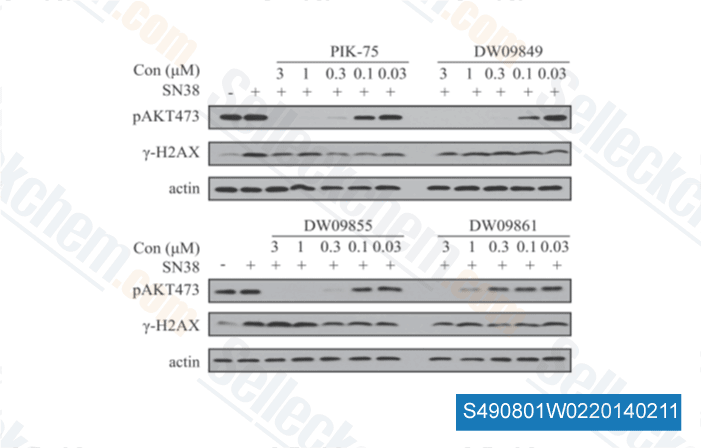
-
Gegevens van [ J Pharmacol Exp Ther , 2014 , 348(3), 432-41 ]
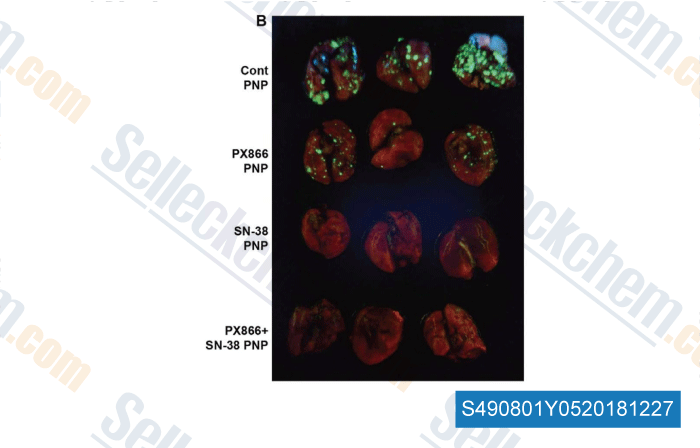
-
Gegevens van [ , , J Control Release, 2018, 275:85-91 ]
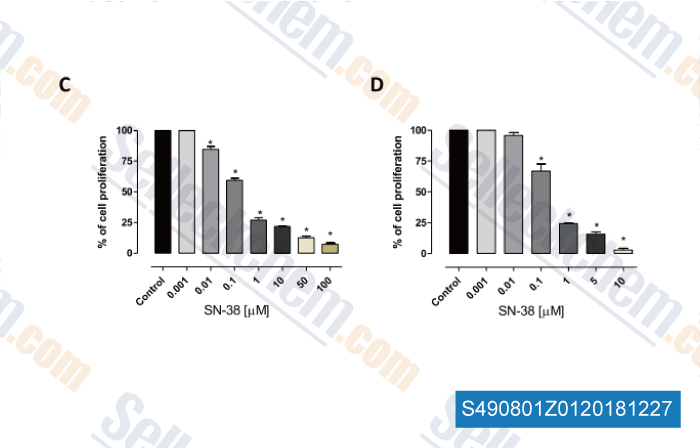
-
Gegevens van [ , , Cancer Lett, 2017, 411:35-43 ]
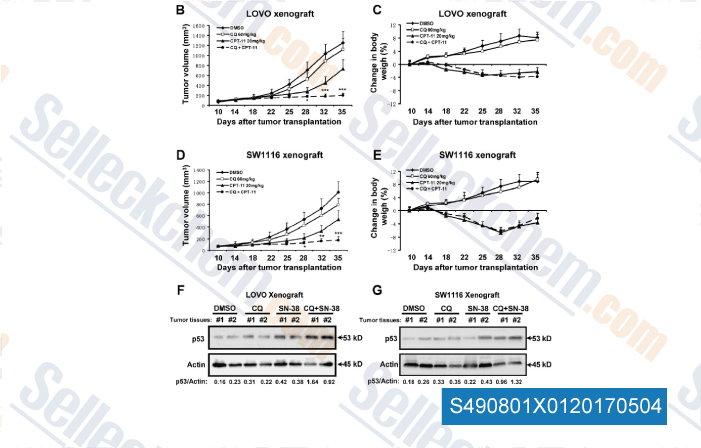
-
Gegevens van [ , , Free Radic Biol Med, 2017, 104:280-297 ]
Sellecks SN-38 Is geciteerd door 100 Publicaties
| Activation of lysosomal iron triggers ferroptosis in cancer [ Nature, 2025, 10.1038/s41586-025-08974-4] | PubMed: 40335696 |
| Cisplatin and temozolomide combinatorial treatment triggers hypermutability and immune surveillance in experimental cancer models [ Cancer Cell, 2025, S1535-6108(25)00223-5] | PubMed: 40513578 |
| KEAP1 and STK11/LKB1 alterations enhance vulnerability to ATR inhibition in KRAS mutant non-small cell lung cancer [ Cancer Cell, 2025, 43(8):1530-1548.e9] | PubMed: 40645185 |
| The molecular and functional landscape of resistance to FOLFIRI chemotherapy in metastatic colorectal cancer [ Cancer Discov, 2025, 10.1158/2159-8290.CD-24-0556] | PubMed: 40981426 |
| A patient-derived T cell lymphoma biorepository uncovers pathogenetic mechanisms and host-related therapeutic vulnerabilities [ Cell Rep Med, 2025, S2666-3791(25)00102-8] | PubMed: 40147445 |
| AREG and EREG Are Predictive Biomarkers of Response to EGFR Inhibition in Gastroesophageal Cancer [ Cancer Res, 2025, 85(16):3111-3122] | PubMed: 40637454 |
| Synthesis of carbon dots from spent coffee grounds: transforming waste into potential biomedical tools [ Nanoscale, 2025, 17(16):9947-9962] | PubMed: 40067158 |
| Targeted Inhibition of CHD1L by OTI-611 Reprograms Chemotherapy and Targeted Therapy-Induced Cell Cycle Arrest and Suppresses Proliferation to Produce Synergistic Antitumor Effects in Breast and Colorectal Cancer [ Cells, 2025, 14(5)318] | PubMed: 40072047 |
| ATR Inhibition Synergizes With Alkylating PI Polyamide Targeting MYCN by Suppressing DNA Repair in MYCN-Amplified Neuroblastoma [ Cancer Sci, 2025, 10.1111/cas.70043] | PubMed: 40052411 |
| PD-L1-Targeting Nanoparticles for the Treatment of Triple-Negative Breast Cancer: A Preclinical Model [ Int J Mol Sci, 2025, 26(7)3295] | PubMed: 40244130 |
RETOURBELEID
Selleck Chemicals onvoorwaardelijke retourbeleid zorgt voor een soepele online winkelervaring voor onze klanten. Als u op enigerlei wijze ontevreden bent met uw aankoop, kunt u elk artikel(en) binnen 7 dagen na ontvangst retourneren. In geval van problemen met de productkwaliteit, zowel protocolgerelateerde als productgerelateerde problemen, kunt u elk artikel(en) binnen 365 dagen na de oorspronkelijke aankoopdatum retourneren. Volg de onderstaande instructies bij het retourneren van producten.
VERZENDING EN OPSLAG
Selleck producten worden bij kamertemperatuur vervoerd. Als u het product op kamertemperatuur ontvangt, wees dan gerust, de Selleck kwaliteitsinspectieafdeling heeft experimenten uitgevoerd om te controleren of de normale temperatuurplaatsing van één maand de biologische activiteit van poederproducten niet beïnvloedt. Na ontvangst dient u het product op te slaan volgens de vereisten beschreven in het gegevensblad. De meeste Selleck producten zijn stabiel onder de aanbevolen omstandigheden.
NIET VOOR HUMANE, VETERINAIRE DIAGNOSTISCHE OF THERAPEUTISCHE DOELEINDEN.