
Technische gegevens
| Formule | C16H10BrN3O2 |
||||||
| Molecuulgewicht | 356.17 | CAS-nr. | 667463-62-9 | ||||
| Oplosbaarheid (25°C)* | In vitro | DMSO | 71 mg/mL (199.34 mM) | ||||
| Ethanol | 7 mg/mL (19.65 mM) | ||||||
| Water | Insoluble | ||||||
| In Vivo (Voeg oplosmiddelen afzonderlijk en in volgorde toe aan het product.) |
|
||||||
|
* <1 mg/ml betekent licht oplosbaar of onoplosbaar. * Houd er rekening mee dat Selleck de oplosbaarheid van alle verbindingen intern test en de werkelijke oplosbaarheid enigszins kan afwijken van gepubliceerde waarden. Dit is normaal en is te wijten aan lichte batch-tot-batch variaties. * Verzending op kamertemperatuur (Stabiliteitstests tonen aan dat dit product zonder koelmaatregelen kan worden verzonden.) |
|||||||
Voorbereiden van stamoplossingen
Biologische activiteit
| Beschrijving | BIO (GSK-3 Inhibitor IX, 6-bromoindirubin-3-oxime, 6-Bromoindirubin-3'-oxime, MLS 2052) is een specifieke remmer van GSK-3 met een IC50 van 5 nM voor GSK-3α/β in een celvrije test, vertoont een >16-voudige selectiviteit ten opzichte van CDK5, en is tevens een pan-JAK-remmer met een IC50 van 30 nM voor Tyk2. BIO induceert apoptose in menselijke melanoomcellen. | |||||||||||
|---|---|---|---|---|---|---|---|---|---|---|---|---|
| Doelen |
|
|||||||||||
| In vitro | BIO (6-bromoindirubin-3'-oxime) is een specifieke remmer van glycogeen synthase kinase-3 (GSK-3), met een IC50 van 5 nM voor GSK-3α/β, vertoont een >16-voudige selectiviteit ten opzichte van CDK5. Deze verbinding interageert in de ATP-bindingspocket van deze kinasen, vermindert β-cateninefosforylering op een GSK-3-specifieke plaats in cellulaire modellen, en bootst Wnt-signalering in Xenopus-embryo's nauwkeurig na. In menselijke en muizen embryonale stamcellen handhaaft deze chemische stof het ongedifferentieerde fenotype en ondersteunt het de expressie van de pluripotente staat-specifieke transcriptiefactoren Oct-3/4, Rex-1 en Nanog. Deze door verbindingen gemedieerde Wnt-activering is functioneel reversibel, aangezien het stopzetten van de verbinding leidt tot normale multidifferentiatieprogramma's in zowel menselijke als muizen embryonale stamcellen. Het bevordert proliferatie in zoogdiercardiomyocyten. 6BIO is ook een pan-JAK remmer, met IC50-waarden van 0,03, 1,5, 8,0, 0,5 μM voor TYK2, JAK1, JAK2 en JAK3. Deze verbinding remt selectief de fosforylering van STAT3 en induceert apoptose van menselijke melanoomcellen. | |||||||||||
| In Vivo | BIO onderdrukt de groei van melanoomtumoren in een muis xenograftmodel. | |||||||||||
| Functies | Het eerste farmacologische middel waarvan is aangetoond dat het zelfvernieuwing handhaaft in menselijke en muizen embryonale stamcellen. |
Protocol (uit referentie)
| Kinase-assay:[1] |
|
|---|---|
| Celassay:[1] |
|
| Dierstudie:[4] |
|
Referenties
|
Klantproductvalidatie
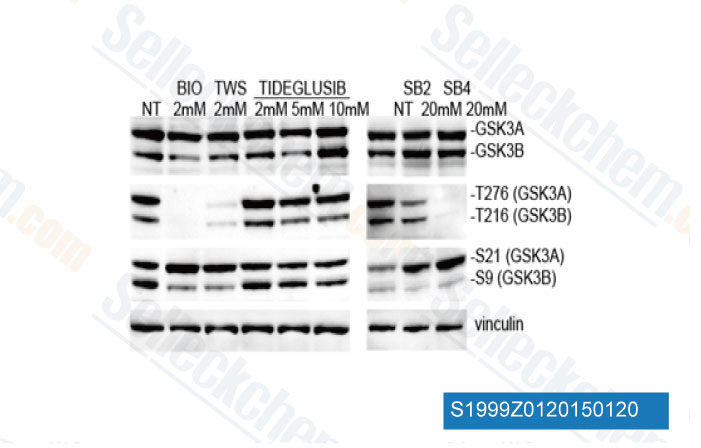
-
Gegevens van [ PLoS One , 2014 , 9(7), e100947 ]
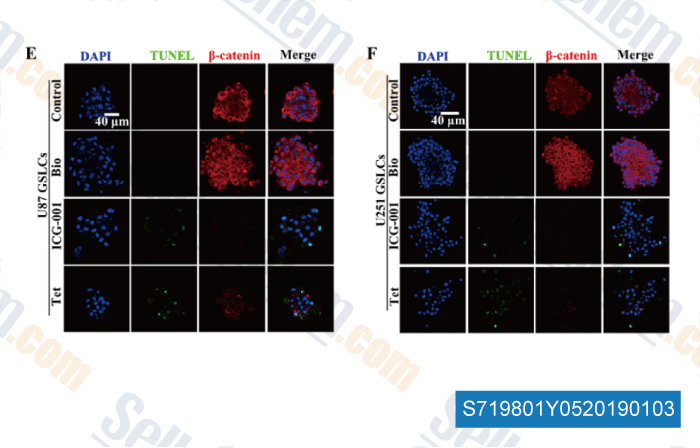
-
Gegevens van [ , , Int J Oncol, 2017, 50(1):101-110 ]
Sellecks GSK-3 Inhibitor IX (BIO) Is geciteerd door 40 Publicaties
| ARHGAP12 and ARHGAP29 exert distinct regulatory effects on switching between two cell morphological states through GSK-3 activity [ Cell Rep, 2025, 44(3):115361] | PubMed: 40053455 |
| Interplay of SHH, WNT and BMP4 signaling regulates the development of the lamina propria in the murine ureter [ Development, 2025, 152(3)DEV204214] | PubMed: 39817691 |
| Matrix Stiffness Regulates Mechanotransduction and Vascular Network Formation of hiPSC-Derived Endothelial Progenitors Encapsulated in 3D Hydrogels [ bioRxiv, 2025, 2025.04.11.648340] | PubMed: 40291699 |
| Donor Age Impairs Vasculogenic Potential of hiPSC-Derived Endothelial Progenitors [ bioRxiv, 2025, 2025.06.24.661422] | PubMed: 40667338 |
| Extraembryonic mesoderm cells derived from human embryonic stem cells rely on Wnt pathway activation [ Cell Prolif, 2024, 10.1111/cpr.13761] | PubMed: 39385268 |
| CDKAL1 Drives the Maintenance of Cancer Stem-Like Cells by Assembling the eIF4F Translation Initiation Complex [ Adv Sci (Weinh), 2023, 10(12):e2206542] | PubMed: 36786012 |
| Upregulation of β-catenin signaling represents a single common pathway leading to the various phenotypes of spinal degeneration and pain [ Bone Res, 2023, 11(1):18] | PubMed: 37059724 |
| Epithelial cell adhesion molecule (EpCAM) regulates HGFR signaling to promote colon cancer progression and metastasis [ J Transl Med, 2023, 21(1):530] | PubMed: 37543570 |
| MEK inhibition overcomes chemoimmunotherapy resistance by inducing CXCL10 in cancer cells [ Cancer Cell, 2022, S1535-6108(21)00662-0] | PubMed: 35051357 |
| Neddylation is essential for β-catenin degradation in Wnt signaling pathway [ Cell Rep, 2022, 38(12):110538] | PubMed: 35320710 |
RETOURBELEID
Selleck Chemicals onvoorwaardelijke retourbeleid zorgt voor een soepele online winkelervaring voor onze klanten. Als u op enigerlei wijze ontevreden bent met uw aankoop, kunt u elk artikel(en) binnen 7 dagen na ontvangst retourneren. In geval van problemen met de productkwaliteit, zowel protocolgerelateerde als productgerelateerde problemen, kunt u elk artikel(en) binnen 365 dagen na de oorspronkelijke aankoopdatum retourneren. Volg de onderstaande instructies bij het retourneren van producten.
VERZENDING EN OPSLAG
Selleck producten worden bij kamertemperatuur vervoerd. Als u het product op kamertemperatuur ontvangt, wees dan gerust, de Selleck kwaliteitsinspectieafdeling heeft experimenten uitgevoerd om te controleren of de normale temperatuurplaatsing van één maand de biologische activiteit van poederproducten niet beïnvloedt. Na ontvangst dient u het product op te slaan volgens de vereisten beschreven in het gegevensblad. De meeste Selleck producten zijn stabiel onder de aanbevolen omstandigheden.
NIET VOOR HUMANE, VETERINAIRE DIAGNOSTISCHE OF THERAPEUTISCHE DOELEINDEN.