
Technische gegevens
| Formule | C30H30O8.C2H4O2 |
||||||
| Molecuulgewicht | 578.61 | CAS-nr. | 866541-93-7 | ||||
| Oplosbaarheid (25°C)* | In vitro | DMSO | 116 mg/mL (200.48 mM) | ||||
| Ethanol | 89 mg/mL (153.81 mM) | ||||||
| Water | Insoluble | ||||||
| In Vivo (Voeg oplosmiddelen afzonderlijk en in volgorde toe aan het product.) |
|
||||||
|
* <1 mg/ml betekent licht oplosbaar of onoplosbaar. * Houd er rekening mee dat Selleck de oplosbaarheid van alle verbindingen intern test en de werkelijke oplosbaarheid enigszins kan afwijken van gepubliceerde waarden. Dit is normaal en is te wijten aan lichte batch-tot-batch variaties. * Verzending op kamertemperatuur (Stabiliteitstests tonen aan dat dit product zonder koelmaatregelen kan worden verzonden.) |
|||||||
Voorbereiden van stamoplossingen
Biologische activiteit
| Beschrijving | (R)-(-)-Gossypol (AT-101) azijnzuur, het R-(-) enantiomeer van Gossypol azijnzuur, bindt met Bcl-2, Bcl-xL en Mcl-1 met een Ki van 0,32 μM, 0,48 μM en 0,18 μM in celvrije testen; remt het BIR3-domein en BID niet. AT-101 triggert gelijktijdig apoptose en een cytoprotectief type van autophagy. Fase 2. | ||||||
|---|---|---|---|---|---|---|---|
| Doelen |
|
||||||
| In vitro | AT-101 remt een panel van verschillende lymfoproliferatieve maligniteiten met IC50 variërend van 1,2 μM tot 7,4 μM. AT-101 (10 μM) verstoort de Δψm op een concentratie- en tijdsafhankelijke manier in een diffuus groot B-cellymfoom en in mantelcellymfoomlijnen. AT-101 (1 μM of 2 μM) in combinatie met carfilzomib (6 nM of 10 nM) induceert Apoptosis in HBL-2 en Granta cellijnen. AT-101 (20 μM gedurende 24 uur) resulteert in een mediane 72% Apoptosis en downregulatie van Mcl-1 in CLL-lymfocyten in zowel suspensiecultuur als stromale cocultuur. Stromale cellen vertonen ondetecteerbare niveaus van antiapoptotische maar hoge niveaus van geactiveerde ERK- en AKT-eiwitten en hebben weinig of geen Apoptosis met AT-101. AT-101 induceert Apoptosis op een tijd- en dosisafhankelijke manier, met ED50-waarden van respectievelijk 1,9 mM en 2,4 mM in Jurkat T- en U937-cellen. AT-101 (10 μM) in combinatie met straling (32 Gy) induceert meer Apoptosis dan straling alleen en overschrijdt de som van de effecten veroorzaakt door de behandelingen met een enkel middel. AT-101 activeert SAPK/JNK op een dosis- en tijdsafhankelijke manier. AT-101 (10 µM) induceert Apoptosis door activering van caspase-9, -3 en -7 in VCaP-cellen. AT-101 (10 µM) vermindert Bcl-2 en Mcl-1 expressie in VCaP-cellen. AT-101 (< 20 μM) is in staat om de groei van multipel myeloomcellen te remmen, ondanks de stimulerende groeieffecten die worden geboden door stromale cellen in het beenmergmilieu. AT-101 (10 μM) induceert Apoptosis in multipel myeloomcellen via de activering van caspasen 3, caspasen 9 en PARP. AT-101 (10 μM) bevordert Apoptosis in multipel myeloomcellen door de Bax/Bcl-2-ratio en het mitochondriale membraanpotentiaal te verstoren. | ||||||
| In Vivo | AT-101 is nog steeds detecteerbaar in plasma met gemiddelde concentraties van 0,49 μM voor de groep van 35 mg/kg en 0,39 μM voor de groep van 200 mg/kg in SCID beige muizen met RL-DLBCL xenotransplantaten. De piekplasmaconcentratie van AT-101 wordt waargenomen na 30 minuten toediening van het medicijn in beide dosisniveaus, waarbij de groep van 200 mg/kg een gemiddelde plasmaconcentratie vertoont die bijna 4 keer groter is dan die van de groep van 35 mg/kg (respectievelijk 7,88 μM en 27,78 μM) in SCID beige muizen. AT-101 (25 mg/kg tot 100 mg/kg, oraal) resulteert onbepaalde tijd in een eerder begin van gewichtsverlies van meer dan 10% van het gewicht vóór de behandeling en de dood bij SCID beige muizen. AT-101 (35 mg/kg, oraal per dag gedurende 10 dagen) plus intraperitoneaal cyclofosfamide (Cy) en intraperitoneaal rituximab (R) vertonen een significante tumorvolumeregulatie vergeleken met elke andere behandelingsgroep. AT-101 (15 mg/kg, p.o., 5 dagen/week) als een enkel middel in intacte muizen vermindert significant de ontwikkeling van VCaP-tumorgroei vergeleken met onbehandelde tumoren in weken 2 tot 6. AT-101 in combinatie met chirurgische castratie vertraagt het begin van androgeen-onafhankelijke VCaP-tumorgroei vergeleken met castratie-alleen of AT-101-alleen groepen in muizen. |
Protocol (uit referentie)
| Kinase-assay:[1] |
|
|---|---|
| Celassay:[2] |
|
| Dierstudie:[2] |
|
Referenties
|
Klantproductvalidatie
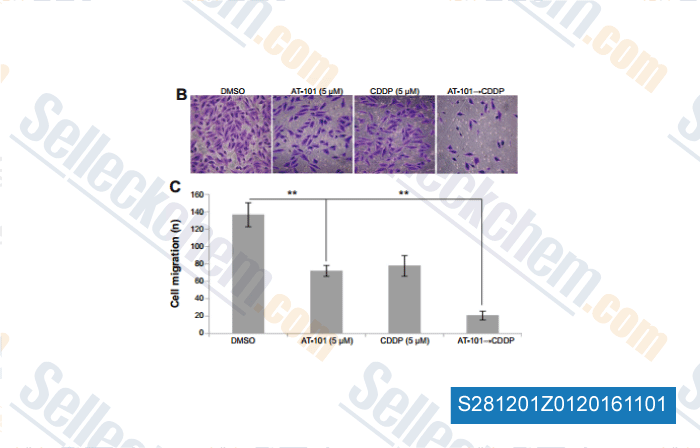
-
, , Drug Des Devel Ther, 2014, 8:2517-29.
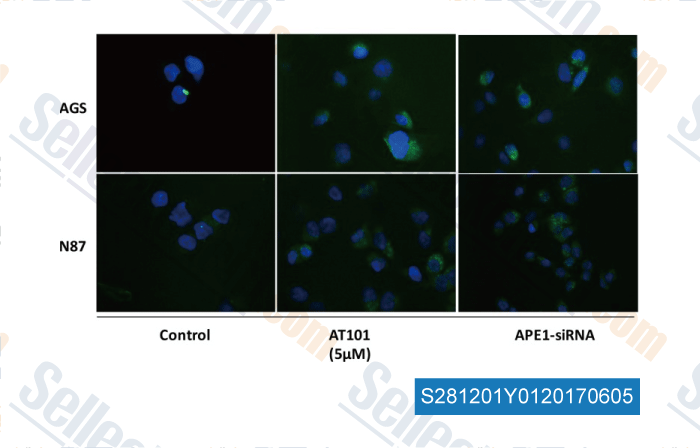
-
Gegevens van [ , , Oncotarget, 2016, 7(23):34430-41 ]
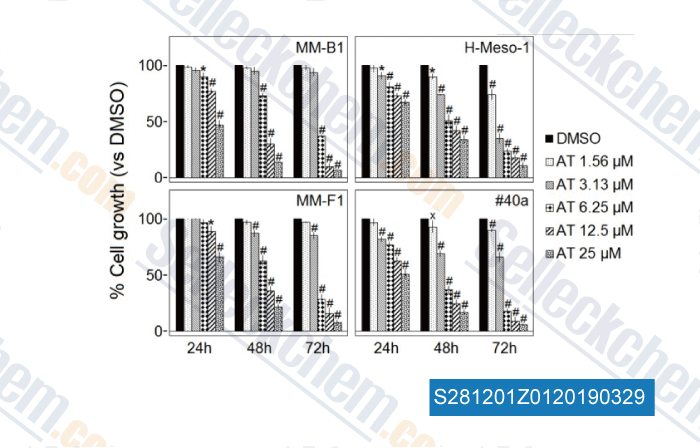
-
Gegevens van [ , , Front Pharmacol, 2018, 9:1269 ]
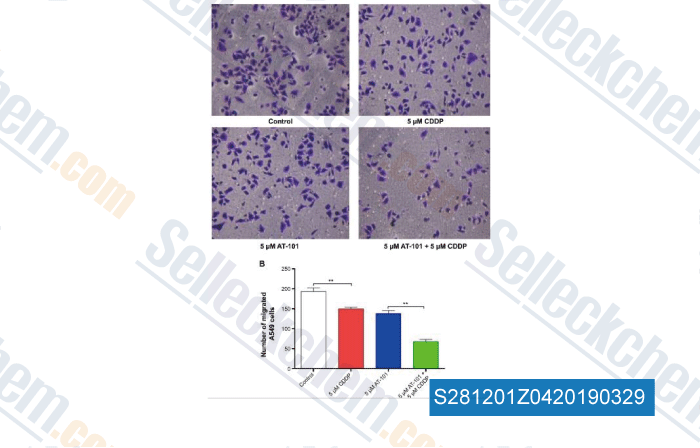
-
Gegevens van [ , , Drug Des Devel Ther, 2015, 9:2887-910 ]
Sellecks (R)-(-)-Gossypol (AT-101) acetic acid Is geciteerd door 20 Publicaties
| Follicle stimulating hormone controls granulosa cell glutamine synthesis to regulate ovulation [ Protein Cell, 2024, pwad065] | PubMed: 38167949 |
| Pharmacological Targeting of Bcl-2 Induces Caspase 3-Mediated Cleavage of HDAC6 and Regulates the Autophagy Process in Colorectal Cancer [ Int J Mol Sci, 2023, 24(7)6662] | PubMed: 37047634 |
| Exploiting ulnerabilities induced b recurrent mutations in chondrosarcoma and giant cell tumour of bone: therapeutic targeting of the altered epigenome and be [ Leiden University The Netherlands, 2023, ] | PubMed: None |
| Integrative analysis of drug response and clinical outcome in acute myeloid leukemia [ Cancer Cell, 2022, S1535-6108(22)00312-9] | PubMed: 35868306 |
| Lactate Dehydrogenase B Is Required for Pancreatic Cancer Cell Immortalization Through Activation of Telomerase Activity [ Front Oncol, 2022, 12:821620] | PubMed: 35669414 |
| Gossypol Acetic Acid Attenuates Cardiac Ischemia/Reperfusion Injury in Rats via an Antiferroptotic Mechanism [ Biomolecules, 2021, 11(11)1667] | PubMed: 34827665 |
| AT101 [(-)-Gossypol] Selectively Inhibits MCL1 and Sensitizes Carcinoma to BH3 Mimetics by Inducing and Stabilizing NOXA [ Cancers (Basel), 2020, 12(8):E2298] | PubMed: 32824203 |
| Using CETSA assay and a mathematical model to reveal dual Bcl-2/Mcl-1 inhibition and on-target mechanism for ABT-199 and S1. [ Eur J Pharm Sci, 2020, 142:105105] | PubMed: 31669390 |
| Comparison of putative BH3 mimetics AT-101, HA14-1, sabutoclax and TW-37 with ABT-737 in platelets. [ Platelets, 2020, 10.1080/09537104.2020.1724276] | PubMed: 32079453 |
| Effect of Exosomal APE1 on Sensitivity of NSCLC A549 Cells to Cisplatin [ Cancer Research on Prevention and Treatment, 2020, (7): 492-497] | PubMed: None |
RETOURBELEID
Selleck Chemicals onvoorwaardelijke retourbeleid zorgt voor een soepele online winkelervaring voor onze klanten. Als u op enigerlei wijze ontevreden bent met uw aankoop, kunt u elk artikel(en) binnen 7 dagen na ontvangst retourneren. In geval van problemen met de productkwaliteit, zowel protocolgerelateerde als productgerelateerde problemen, kunt u elk artikel(en) binnen 365 dagen na de oorspronkelijke aankoopdatum retourneren. Volg de onderstaande instructies bij het retourneren van producten.
VERZENDING EN OPSLAG
Selleck producten worden bij kamertemperatuur vervoerd. Als u het product op kamertemperatuur ontvangt, wees dan gerust, de Selleck kwaliteitsinspectieafdeling heeft experimenten uitgevoerd om te controleren of de normale temperatuurplaatsing van één maand de biologische activiteit van poederproducten niet beïnvloedt. Na ontvangst dient u het product op te slaan volgens de vereisten beschreven in het gegevensblad. De meeste Selleck producten zijn stabiel onder de aanbevolen omstandigheden.
NIET VOOR HUMANE, VETERINAIRE DIAGNOSTISCHE OF THERAPEUTISCHE DOELEINDEN.