
Technische gegevens
| Formule | C29H26ClFN4O4S.2C7H8O3S |
||||||
| Molecuulgewicht | 925.46 | CAS-nr. | 388082-77-7 | ||||
| Oplosbaarheid (25°C)* | In vitro | DMSO | 186 mg/mL (200.98 mM) | ||||
| Water | Insoluble | ||||||
| Ethanol | Insoluble | ||||||
| In Vivo (Voeg oplosmiddelen afzonderlijk en in volgorde toe aan het product.) |
|
||||||
|
* <1 mg/ml betekent licht oplosbaar of onoplosbaar. * Houd er rekening mee dat Selleck de oplosbaarheid van alle verbindingen intern test en de werkelijke oplosbaarheid enigszins kan afwijken van gepubliceerde waarden. Dit is normaal en is te wijten aan lichte batch-tot-batch variaties. * Verzending op kamertemperatuur (Stabiliteitstests tonen aan dat dit product zonder koelmaatregelen kan worden verzonden.) |
|||||||
Voorbereiden van stamoplossingen
Biologische activiteit
| Beschrijving | Lapatinib Ditosylaat is een potente EGFR- en ErbB2-remmer met IC50 van respectievelijk 10,8 en 9,2 nM in celvrije assays. | ||||||
|---|---|---|---|---|---|---|---|
| Doelen |
|
||||||
| In vitro | Lapatinib Ditosylaat remt de activiteit van ErbB4 zwak met een IC50 van 367 nM, en vertoont een >300-voudige selectiviteit voor EGFR en ErbB2 ten opzichte van andere kinasen zoals c-Src, c-Raf, MEK, ERK, c-Fms, CDK1, CDK2, p38, Tie-2 en VEGFR2. Deze verbinding remt significant de receptorautofosforylering van EGFR en ErbB2 op een dosisafhankelijke manier met een IC50 van respectievelijk 170 nM en 80 nM in HN5-cellen; evenals 210 nM en 60 nM, respectievelijk in BT474-cellen. In tegenstelling tot OSI-774 en Iressa (ZD1839) die bij voorkeur de groei van de EGFR-overexpresserende cellen remmen, remt het de groei van zowel EGFR- als ErbB2-overexpresserende cellen. Het vertoont een hogere remmende activiteit tegen EGFR- of ErbB2-overexpresserende cellen met een IC50 van 0,09-0,21 μM, vergeleken met cellen die lage niveaus van EGFR of ErbB2 tot expressie brengen met een IC50 van 3-12 μM, en vertoont een ~100-voudige selectiviteit ten opzichte van de normale fibroblastcellen. Deze chemische stof remt potent de uitgroei van EGFR-overexpresserende HN5- en A-431-cellen, evenals ErbB2-overexpresserende BT474- en N87-cellen, en induceert significant G1-arrest van HN5-cellen en apoptose van BT474-cellen, die geassocieerd zijn met remming van AKT-fosforylering. | ||||||
| In Vivo | Orale toediening van Lapatinib Ditosylaat (~100 mg/kg) tweemaal daags remt significant de groei van BT474- en HN5-xenografts op een dosisafhankelijke manier. |
Protocol (uit referentie)
| Kinase-assay:[1] |
|
|---|---|
| Celassay:[1] |
|
| Dierstudie:[1] |
|
Referenties
|
Klantproductvalidatie
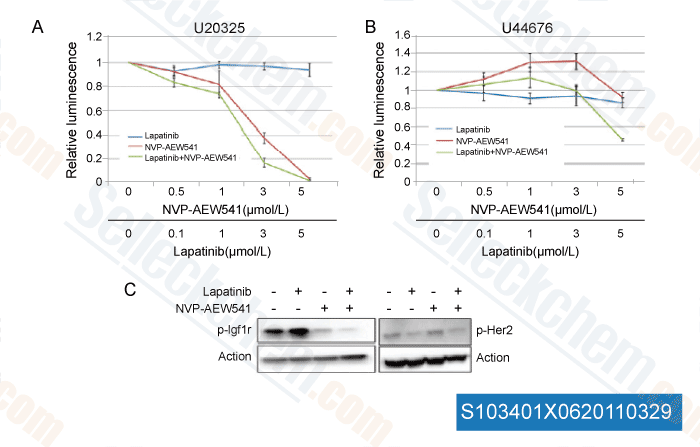
-
Gegevens van [ Mol Cancer Ther , 2011 , 10:697-707 ]
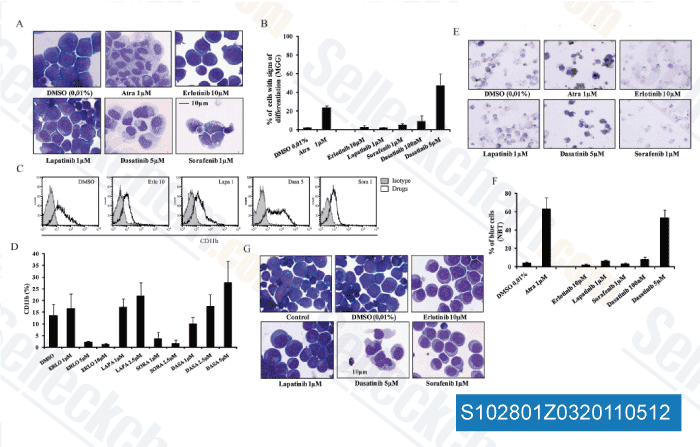
-
Gegevens van [ Biochem Pharmacol , 2011 , 82, 1457-1466 ]
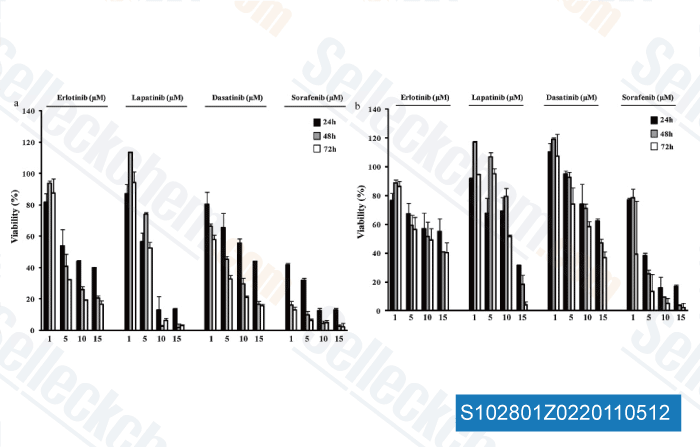
-
Gegevens van [ Biochem Pharmacol , 2011 , 82, 1457-1466 ]
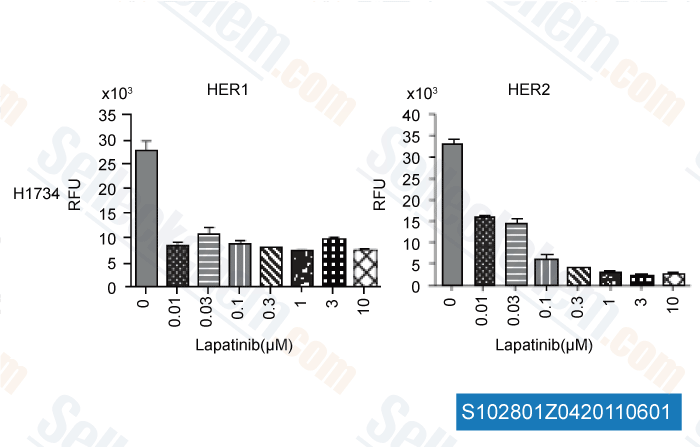
-
Gegevens van [ Int J Proteomics , 2011 , 2011, 215496 ]
Sellecks Lapatinib Ditosylate Is geciteerd door 149 Publicaties
| Inactivation of necroptosis-promoting protein MLKL creates a therapeutic vulnerability in colorectal cancer cells [ Cell Death Dis, 2025, 16(1):118] | PubMed: 39979285 |
| Multiscale Modeling Uncovers Macrophage Infiltration and TNF-α Signaling Networks for Targeting in Inflammatory Breast Cancer Tumor Emboli [ bioRxiv, 2025, 2025.05.29.656249] | PubMed: 40502021 |
| Altered ribosomal profile in acquired resistance and reversal associates with pathological response to chemotherapy in inflammatory breast cancer [ NPJ Breast Cancer, 2024, 10(1):65] | PubMed: 39075068 |
| Patient-derived rhabdomyosarcoma cells recapitulate the genetic and transcriptomic landscapes of primary tumors [ iScience, 2024, 27(10):110862] | PubMed: 39319271 |
| Profiling of ERBB receptors and downstream pathways reveals selectivity and hidden properties of ERBB4 antagonists [ iScience, 2024, 27(2):108839] | PubMed: 38303712 |
| Massively parallel reporter assays identify enhancer elements in oesophageal Adenocarcinoma [ NAR Cancer, 2024, 6(4):zcae041] | PubMed: 39417090 |
| Overcoming brain-derived therapeutic resistance in HER2+ breast cancer brain metastasis [ bioRxiv, 2024, 2024.02.19.581073] | PubMed: 38529509 |
| Proteomic Assessment of SKBR3/HER2+ Breast Cancer Cellular Response to Lapatinib and Investigational Ipatasertib Kinase Inhibitors [ bioRxiv, 2024, 2024.04.02.587656] | PubMed: 38617302 |
| Protocol for identifying properties of ERBB receptor antagonists using the barcoded ERBBprofiler assay [ STAR Protoc, 2024, 5(2):102987] | PubMed: 38635397 |
| Analysis and modeling of cancer drug responses using cell cycle phase-specific rate effects [ Nat Commun, 2023, 14(1):3450] | PubMed: 37301933 |
RETOURBELEID
Selleck Chemicals onvoorwaardelijke retourbeleid zorgt voor een soepele online winkelervaring voor onze klanten. Als u op enigerlei wijze ontevreden bent met uw aankoop, kunt u elk artikel(en) binnen 7 dagen na ontvangst retourneren. In geval van problemen met de productkwaliteit, zowel protocolgerelateerde als productgerelateerde problemen, kunt u elk artikel(en) binnen 365 dagen na de oorspronkelijke aankoopdatum retourneren. Volg de onderstaande instructies bij het retourneren van producten.
VERZENDING EN OPSLAG
Selleck producten worden bij kamertemperatuur vervoerd. Als u het product op kamertemperatuur ontvangt, wees dan gerust, de Selleck kwaliteitsinspectieafdeling heeft experimenten uitgevoerd om te controleren of de normale temperatuurplaatsing van één maand de biologische activiteit van poederproducten niet beïnvloedt. Na ontvangst dient u het product op te slaan volgens de vereisten beschreven in het gegevensblad. De meeste Selleck producten zijn stabiel onder de aanbevolen omstandigheden.
NIET VOOR HUMANE, VETERINAIRE DIAGNOSTISCHE OF THERAPEUTISCHE DOELEINDEN.